The slow road to smart robots

Add Axios as your preferred source to
see more of our stories on Google.
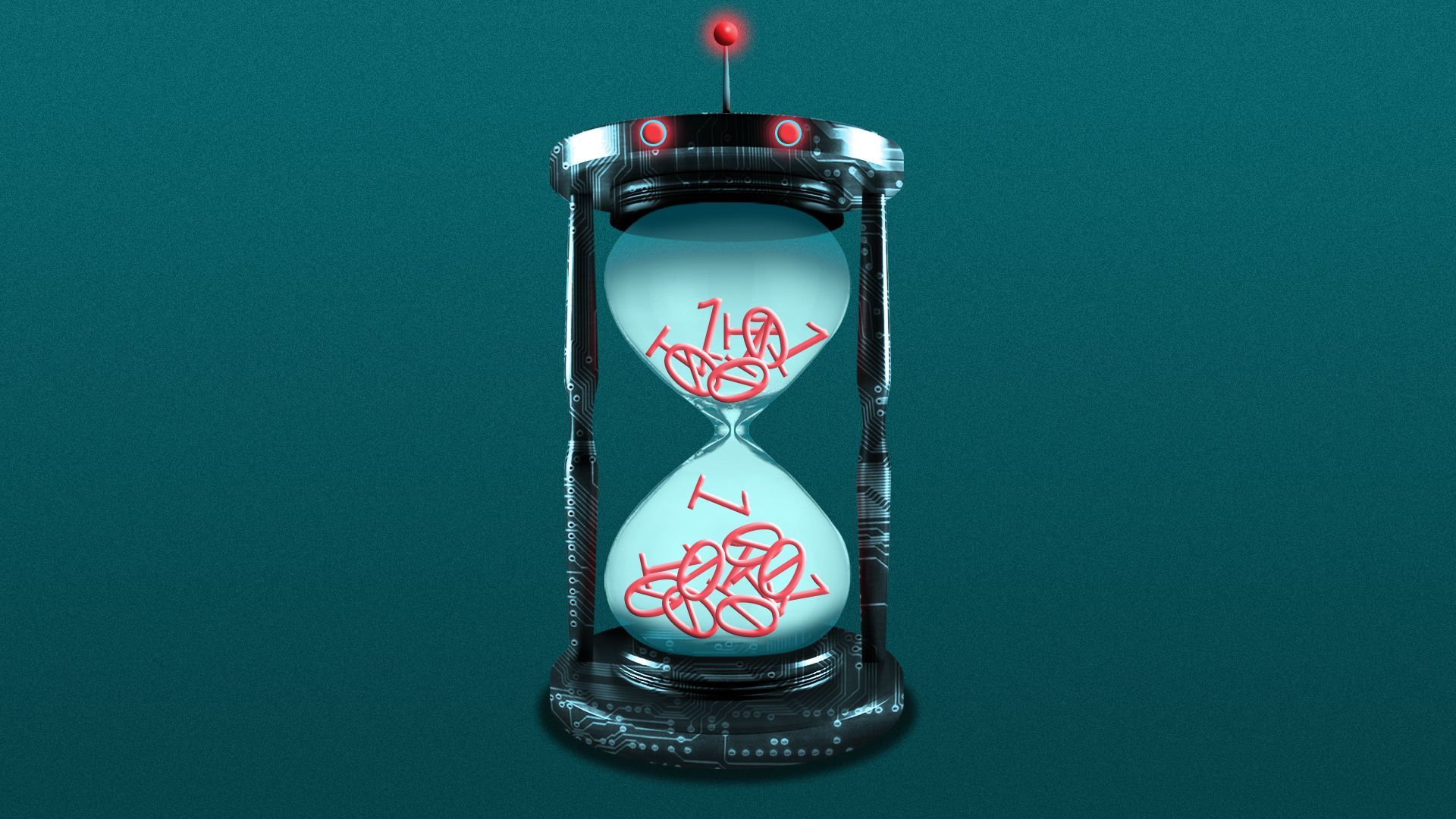
Illustration: Sarah Grillo/Axios
Building AI-powered robots that can flexibly operate in the real world is going to take much longer than Silicon Valley believes and promises, according to the former head of Google's robotics moonshot project, writing in Wired.
Why it matters: Today's generative AI revolution rests on the assumption that a multitude of long-awaited technologies — including humanoid robots, self-driving cars and superintelligent digital brains — are right around the corner.
Driving the news: Hans Peter Brondmo, the former CEO of Everyday Robotics — a 7-year effort by Google parent Alphabet that was scuttled last year — writes in Wired that "giving AI a body in the real world is both an issue of national security and an enormous economic opportunity."
- "The reason we called Everyday Robots a moonshot is that building highly complex systems at this scale went way beyond what venture-capital-funded startups have historically had the patience for."
- Brondmo now fears the U.S. is squandering its lead in this field and Silicon Valley won't be "patient enough to win the global race to give AI a robot body."
The big picture: Experts and investors agree that the convergence of robotics and AI is inevitable. But progress in uniting the two has faced a chicken-and-egg problem: Robots need more world-savvy AI in order to get smarter, and AI needs smarter robots to understand the world.
- Robots rely on machine learning-based AI to develop the capacity to tackle goals and respond to unfamiliar situations and unexpected obstacles in the real world.
- But some experts also believe that today's hallucination-prone AI models will need to be embodied — to encounter the physical world with limbs and sensors — in order to evolve an understanding of the line between reality and fantasy.
- Plenty of companies are pursuing this path. For instance, AI pioneer Fei-Fei Li's new startup, World Labs, aims to ground AI models in real-world understanding using human-like processing of visual data.
Everyday Robotics spent seven years and a small Google fortune developing a one-armed robot on a wheeled platform.
- By the time Google pulled the plug on the project in February 2023, the robots were helping clean up researchers' desks and sorting trash during the daytime; in the evening, they were improvising dances.
- The company said then that some of the team's work and employees would be rolled into Google Research.
Between the lines: Brondmo recalls that robotics experts at Google were divided over how to create machines that could execute simple everyday tasks, like picking up an apple from a table.
- Such a mission turns out to be anything but simple: To accomplish it, you need to understand what an apple is, how gravity works, what's required to hold a round object, how not to crush a fruit and so on.
Some researchers believed the best short-term results would come from a hybrid of AI training and procedural instructions. Others — including Google founder Larry Page — favored moving directly to "end to end" (e2e) learning, where you'd hand robots a general task and they'd be able to figure out how to execute it.
- That, Page felt, was a goal worthy of a moonshot. But it also turned out to be out of reach.
- "I have come to believe," Brondmo writes, "it will take many, many thousands, maybe even millions of robots doing stuff in the real world to collect enough data to train e2e models that make the robots do anything other than fairly narrow, well-defined tasks."
- The more "stuff" robots do in the real world, of course, the more important it will be to build them with safety catches and guardrails.
The bottom line: So far, robot hype is outpacing robot reality.
- Boston Dynamics' back-flipping humanoid and quadruped bots have wowed YouTube viewers — but you wouldn't want to let them anywhere near your office or home.
- Tesla's Optimus robot project has had Elon Musk's fanbase mesmerized for years. But Musk's regular promises that the robot will be available "next year" have earned a "boy who cried wolf" level of skepticism.
