Where workers have the "right to disconnect"

Add Axios as your preferred source to
see more of our stories on Google.
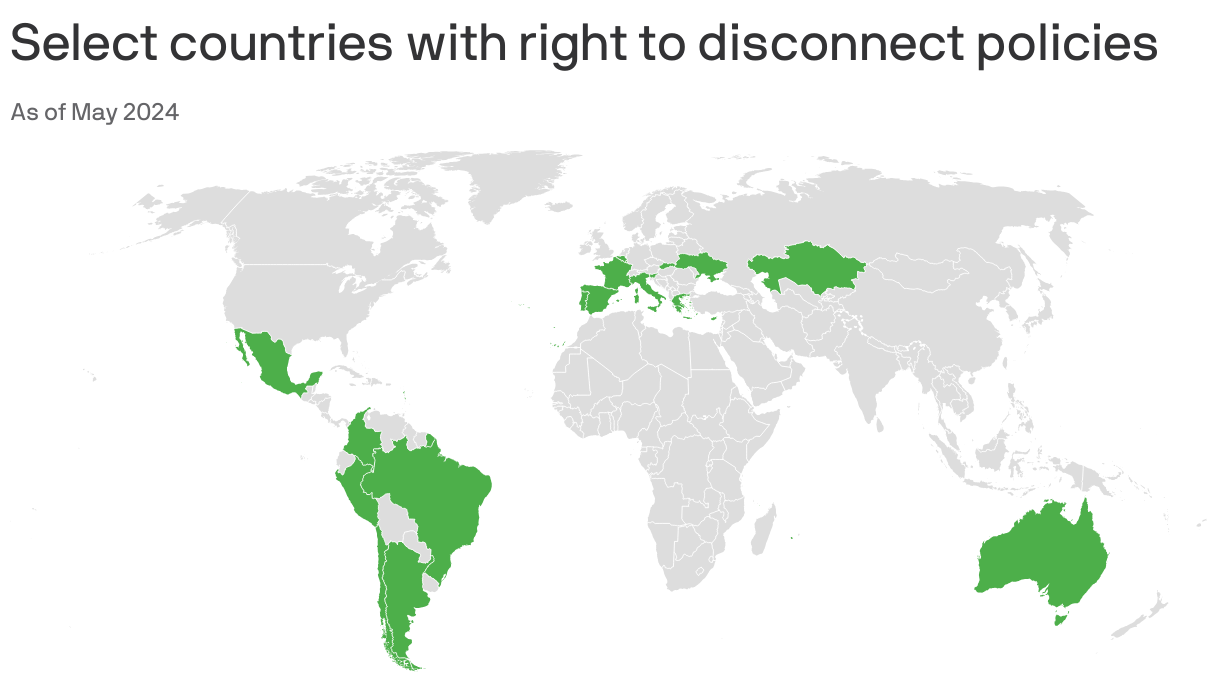
This week, Australia became one of a growing group of countries that give workers the "right to disconnect" — they don't have to respond to after-hours messages or calls from the boss unless it's an emergency.
Why it matters: The always-on work culture that's taken root among knowledge workers can lead to unhealthy levels of stress, harming people's lives outside the office.
State of play: After France became the first country to pass a right-to-disconnect law in 2016, many nations in Europe and South America followed suit.
- Even more countries stepped up in the wake of the pandemic when telework became more common and the lines between home and office were further obliterated.
Between the lines: The U.S. has no such law and it's hard to imagine that changing.
The big picture: Researchers and experts are increasingly drawing attention to the health and social problems that stem from an always-on work culture, writes Brigid Schulte, the director of New America's Better Life Lab, in her upcoming book "Over Work."
- Instead of public policies, like Australia's, work-life management is mainly left up to individuals and employers.
- Rather than hire sufficient staff or curb overwork, companies will typically tackle the issue on the surface by rolling out access to meditation apps or free yoga classes at lunch.
- White-collar workers are advised to implement self-care routines.
The other side: An Australian business group warned this week that the new law could sap worker productivity.
How it works: Australia's law passed in February and went into effect on Monday. It applies to companies with 15 or more employees.
- Workers have a right to refuse to "monitor, read or respond to contact or attempted contact outside their working hours, unless their refusal is unreasonable," per guidance from the Australian Fair Work Commission.
- If there's a dispute, companies and workers are advised to try and work it out themselves.
- Barring that, they can escalate the issue. The commission can order a company to stop contacting a worker after hours, and conversely can order a worker to respond if their refusal isn't deemed "reasonable."
- Failure to comply could result in fines.
Flashback: Once upon a time "after work" meant something.
- No more. "The very idea that, once work hours were over, no one could get hold of you—via email, text, Slack, whatever—is completely alien to contemporary young people, who never let their cellphones leave their hands," Slate's Dan Kois wrote last year, introducing an oral history on what that world was like. (Fun, apparently.)
The bottom line: Technology and the remote work revolution mean your boss can reach you at any time, for any reason. Some countries are looking to restore some sanity to the situation. Not ours.
