Mexico's judicial reform plans spark protests, clash with U.S. embassy

Add Axios as your preferred source to
see more of our stories on Google.
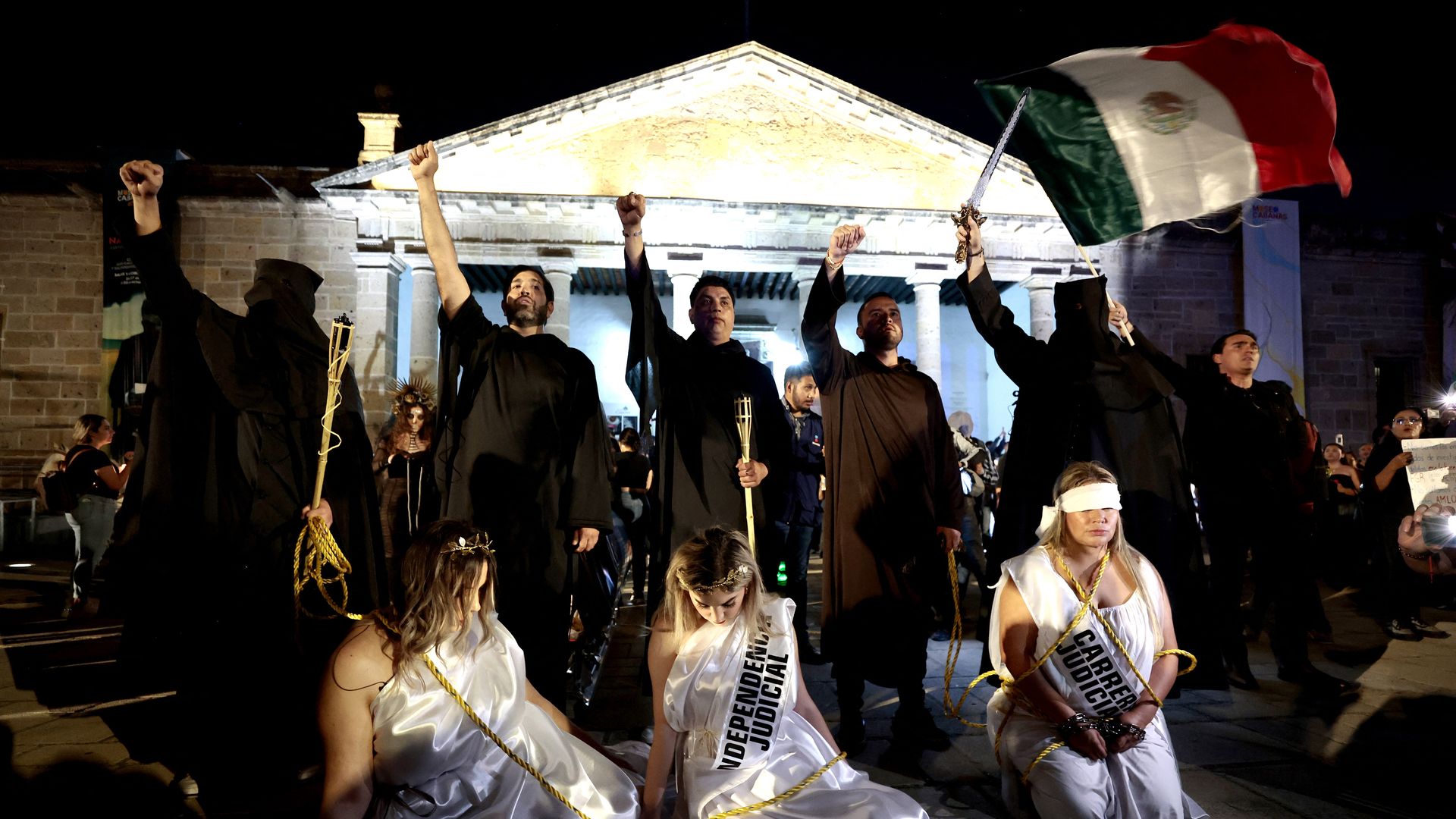
People dressed as "judicial independence" and "judicial experience" being chained as part of a protest against a reform in Mexico, Aug. 26. Photo: Ulises Ruiz/AFP via Getty Images
Mexico's ruling Morena party this week doubled down on plans to fast-track a massive revamp of the country's judicial system despite large protests and U.S. officials' concerns.
Why it matters: The constitutional reform would make changes that legal scholars, victims' advocates, international organizations, investment credit rating agencies and others say would weaken checks and balances in the courts.
Driving the news: President Andres Mánuel López Obrador on Tuesday said he was pausing his relationship with the U.S. and Canadian embassies after their ambassadors made public comments expressing concerns over the reform.
- About 55,000 Mexican justice workers are on an indefinite strike that began last week.
State of play: The reform, which López Obrador says would tackle corruption in the justice system and reduce high rates of unprosecuted crimes in Mexico, is being rushed through committees this week and lawmakers say it could be passed as soon as the next term starts, in early September.
- By then, Morena will have a supermajority in the house and a majority in the Senate.
- President-elect Claudia Sheinbaum, who takes office Oct. 1, has signaled she will sign the proposal into law.
Zoom in: A cornerstone of the proposal is to make federal and state judge positions, including those on the Supreme Court, publicly elected posts.
- Yet the reform doesn't clarify issues like how candidates will campaign or get the funds to do so.
- It is also lacking in details for the experience required to run, says Adriana García, a lawyer and expert adviser at Stanford Law School's Rule of Law Impact Lab.
- She says that opens the door for political parties and powerful organized crime groups to finance and back candidates they feel will be persuadable.
Between the lines: López Obrador first sketched out the judicial reform days after the Supreme Court found his proposed energy reform to be unconstitutional.
- López Obrador has also been critical of other courts for temporarily suspending his planned construction of a railway that razed parts of the Yucatán's rainforest and for ordering the release of detainees over due process violations.
- The reform "reads a bit like a vendetta," García says.
What they're saying: "It's a move from a merit-based appointment to one where some can essentially peddle their impartiality to the highest bidder," García says.
- Another controversial aspect is the creation of a "disciplinary tribunal" that would sanction judges if they're deemed to be remiss in their duties.
- "The criteria for what that means is super vague … the whole thing makes it so judges won't deliberate based on laws and the Constitution but on party affiliation or fear of fines," says Catalina Pérez Correa, associate researcher at Mexico's Center for Constitutional Studies.
The big picture: As Congress debates the judicial reform, it's also considering giving greater power to the military and eliminating watchdogs like the agency handling freedom of information requests.
- "Altogether it's a blow with an authoritarian tilt that will, no question, change how the Mexican state is structured" if the measures pass, Pérez Correa says.
Subscribe to Axios Latino to get vital news about U.S. Latinos and Latin America.
