Discovery of "rogue worlds" provides clues on how stars form

Add Axios as your preferred source to
see more of our stories on Google.
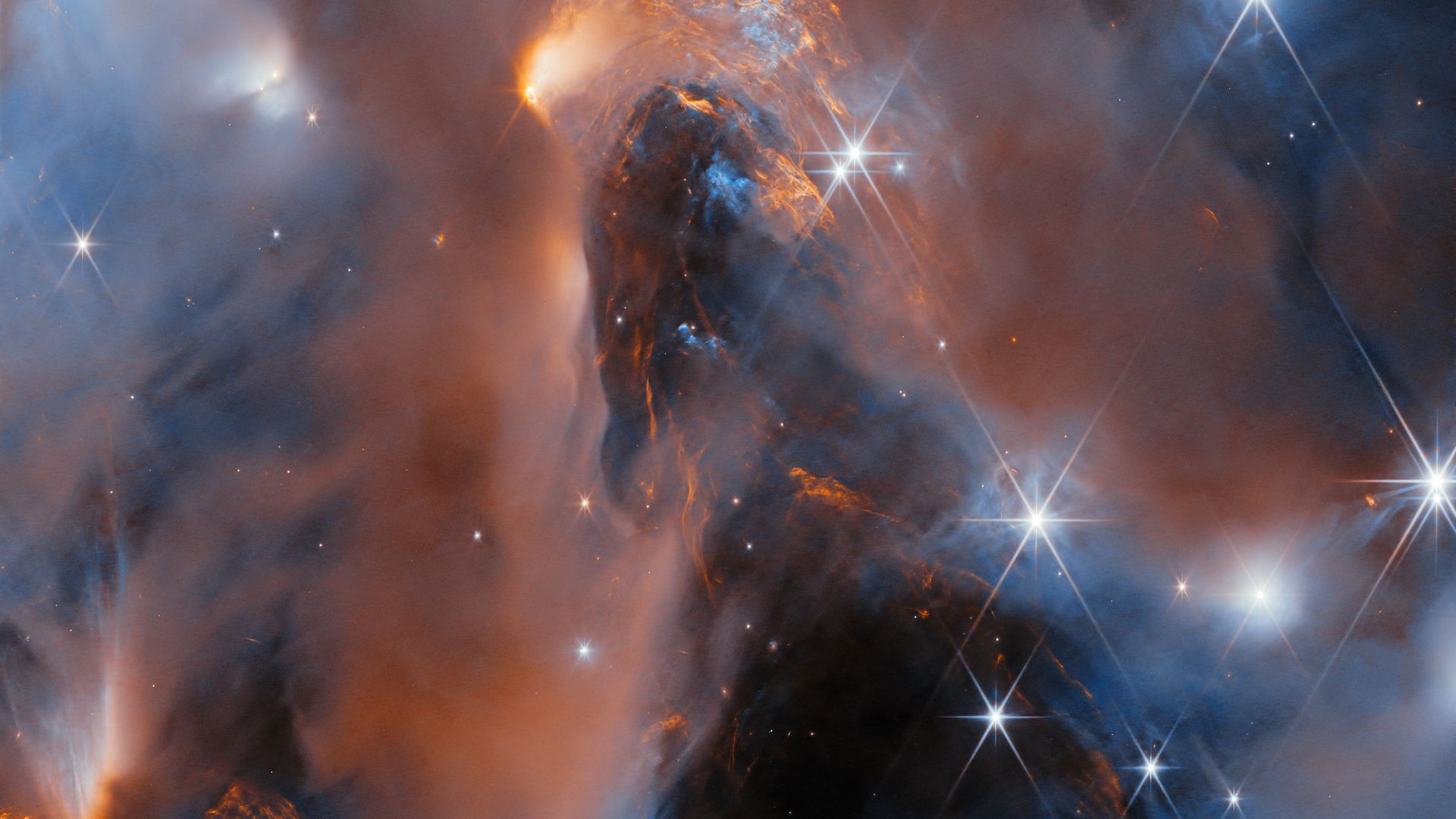
Image from the James Webb Space Telescope spectroscopic survey of NGC1333. Credit: ESA/Webb, NASA & CSA, A. Scholz, K. Muzic, A. Langeveld, R. Jayawardhana
Astronomers using the James Webb Space Telescope found six planet-sized rogue worlds that were created just like stars.
Why it matters: The objects blur the line between stars and planets and could offer scientists new clues about which forms under what conditions.
What they found: JWST surveyed NGC 1333, a young star-forming cluster nearly 1,000 light-years from Earth, and detected six "rogue worlds," objects that are free of any star's gravity.
- The free-floating worlds are five to 15 times the mass of Jupiter and likely formed like stars do when a cloud of gas and dust collapses under gravity, researchers report in a study to be published in The Astronomical Journal.
- These "failed stars" — or brown dwarfs — aren't massive enough to fuse hydrogen into helium but are too large to be considered a gas giant planet.
Zoom out: What "strikes me is what we didn't find," said study co-author Ray Jayawardhana, an astrophysicist and provost at Johns Hopkins University.
- JWST is sensitive enough to spot objects less than five times Jupiter's mass but no rogue objects of that size were detected.
- That suggests any objects smaller than that in this star cluster form like planets rather than stars the team reports.
What we're watching: It "suddenly raises the question of are we beginning to see the lowest mass object that can form the way that stars do?" Jayawardhana said, adding he's been trying to understand that threshold for nearly two decades.
Yes, but: Jayawardhana said they need to look at other star clusters of varying density to be sure they've found the stellar cut off.
- Another team last year reported finding even lower mass rogue objects in the denser Orion Nebula cluster.
- They speculated they might have formed liked planets — from the accretion of gas and dust in a disc that encircles a star after it forms — and were then ejected by the strong gravitational interactions in the denser star cluster.
The intrigue: The lightest of the six objects is surrounded by a disc of dust and gas.
- The disc suggests the object formed like a star because it would be difficult for an object to carry material like that if it is ejected from a star system — it is likely to get stripped away instead, Jayawardhana says.
- It's the least massive object seen with a disc, which is required for the formation of planets. That raises the possibility that a mini-planetary system — smaller than our own — could be forming around the small world.
Go deeper: NASA's largest telescopes provide science and inspiration
