How sports betting replaced the stock market

Add Axios as your preferred source to
see more of our stories on Google.
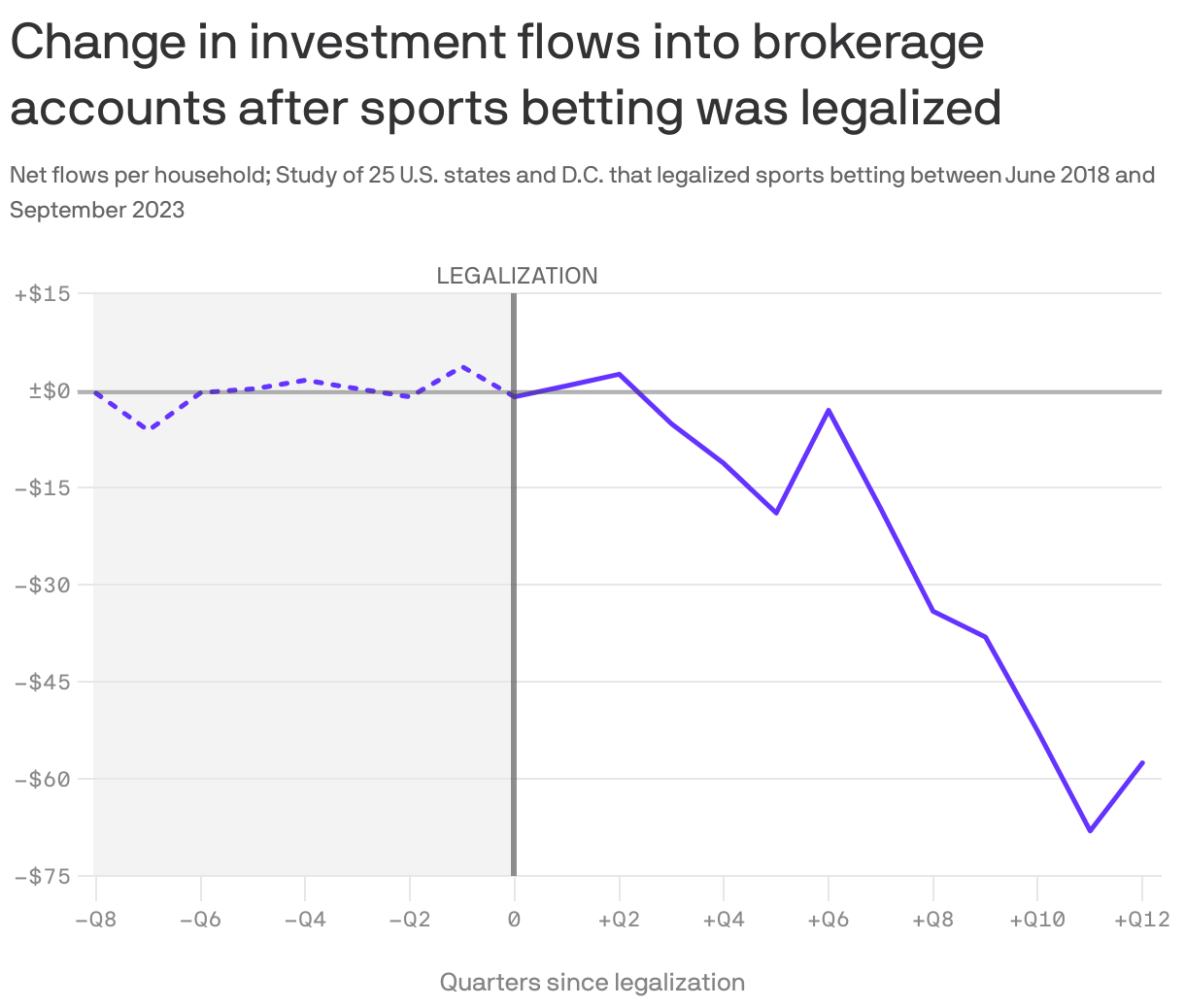
Americans put less money into their brokerage accounts in states where sports gambling has been legalized, per a new paper that has caused something of a stir.
Why it matters: Individuals in a majority of U.S. states now have a relatively new option should they want to tread in the footsteps of billionaires and make a consumption decision that feels kinda like an investment. They can bet on sports.
The big picture: One lesson of the meme-stock winter of 2021 was that get-rich-quick investing, even if it ends up losing money, can be a lot more fun than get-rich-slow investing that involves index funds and decades of doing nothing much at all.
- Compared to meme stocks and NFTs, sports betting doesn't even look like a particularly bad investment — especially if the betting companies are throwing hundreds of dollars of incentives at you.
Between the lines: Sports gambling makes more sense as a pure consumption expenditure than it does as an investment. Sports fans often report they're more engaged with the activity on the field when they have real money on the line.
- Insofar as that consumption expense comes out of monies that would otherwise be invested in the stock market, however, the result is lower wealth and possibly less long-term financial stability.
What they found: On average,* households in states that legalized gambling saw the amount of money they invested in the market fall almost every quarter for the first three years after legalization.
- After three years, the amount invested was about $50 per quarter lower than it was pre-legalization.
The bottom line: When the rich elide consumption and investment, it doesn't affect their standard of living. When working-class folks do so, however, it can.
*Fun fact: "Average" here doesn't mean a simple arithmetical mean. Instead, per Kevin Pisciotta of the University of Kansas, one of the authors, "each point is a complicated weighed conditional mean based on the Boruskyak et al estimator." Glad that's cleared up.
