What to know about potentially deadly mosquito-borne virus EEE

Add Axios as your preferred source to
see more of our stories on Google.
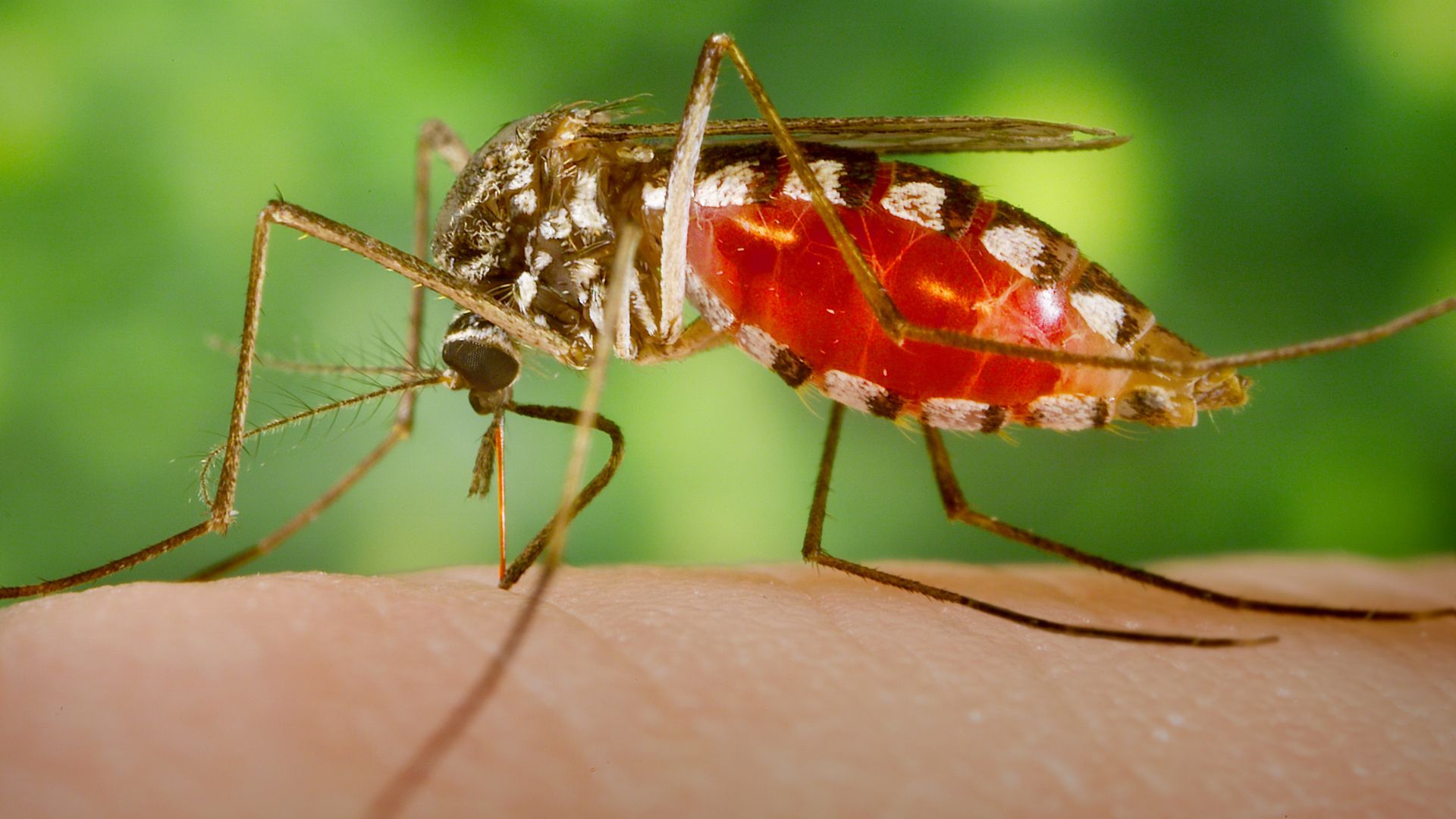
A mosquito feeding on a human finger. Photo: Centers for Disease Control and Prevention/Frank Collins/Smith Collection/Gado/Getty Images
A person in New Hampshire has died from the mosquito-borne virus eastern equine encephalitis, and Massachusetts health officials warn 10 counties are at high or critical risk from the disease that's been detected in several states.
The big picture: There are currently no vaccines or medicines available to treat EEE, also known as "Triple E," which about 30% of people die from, according to the Centers for Disease Control and Prevention.
- "[M]any survivors have ongoing neurologic problems," per an online CDC post.
State of play: Only a few cases are reported in the U.S. each year and most occur in eastern or Gulf Coast states.
- The New York State Department of Health announced Saturday that EEE had been found in horses in Orange, Saint Lawrence, Madison, Oneid, Ulster, Cayuga, Wayne and Washington counties.
- There were no confirmed human cases in N.Y. as of Tuesday evening and the health department said there's "no risk of infected horses spreading the virus to humans or other horses."
- The Vermont Department of Health earlier this month announced the first human case of eastern equine encephalitis since 2012.
Meanwhile, concern is mounting in Massachusetts and other states about West Nile virus, the leading mosquito-borne disease in the continental U.S., which recently hospitalized former NIAID director Anthony Fauci, who's recovering at home.
Zoom in: The state with the most counties affected by EEE is Massachusetts, where health officials announced on Aug. 16 this year's first human case in the state — a man in his 80s was exposed to the virus in Oxford, Worcester County, about 50 miles west of Boston.
- It was just over a month after officials found the first EEE-positive mosquito samples.
Threat level: Oxford health officials recommended an outdoor curfew from dusk to dawn, which the state's DPH notes is "peak biting times for many mosquitoes."
- Plymouth, some 40 miles south of Boston, said all public parks and fields would close daily from dusk until dawn from last Friday after a recent EEE infection diagnosed in a horse exposed in the town raised the risk level to high.
- The state's DPH announced plans to conduct aerial spraying for mosquitoes in areas of Plymouth County and truck-mounted spraying in parts of Worcester County during the week of Aug. 26.
What's happening: The eight communities in the aerial spray zone are Carver, Halifax, Kingston, Middleborough, Plymouth, Plympton, Rochester and Wareham, according to the Mass. DPH.
- The five communities in the truck spray zone are Douglas, Dudley, Oxford, Sutton and Uxbridge.
- The DPH is urging residents in affected communities to cover skin with long clothes, use mosquito repellent and consider rescheduling outdoor activities they might usually do when mosquitoes are most active.
- Other preventative measures include draining standing water in which mosquitoes can lay eggs and installing or repairing screens on all windows and doors.
What they're saying: "We have not seen an outbreak of EEE for four years in Massachusetts," Massachusetts Department of Public Health Commissioner Robbie Goldstein said in a statement.
- "This year's outbreak and activity raise the risk for communities in parts of the state. We need to use all our available tools to reduce risk and protect our communities. We are asking everyone to do their part."
Between the lines: The first symptoms of EEE emerge 3-10 days after a bite from an infected mosquito, according to the Mass. DPH. These include fever (often 103-106°F), a stiff neck, headache and lack of energy.
- "Inflammation and swelling of the brain, called encephalitis, is the most dangerous and frequent serious complication," per the health department.
- "The disease gets worse quickly and some patients may go into a coma within a week."
Go deeper: Mosquito days are getting worse due to climate change
Editor's note: This article has been updated with additional details throughout.
