Axios Vibes: Voters see Walz as more authentic than Vance

Add Axios as your preferred source to
see more of our stories on Google.
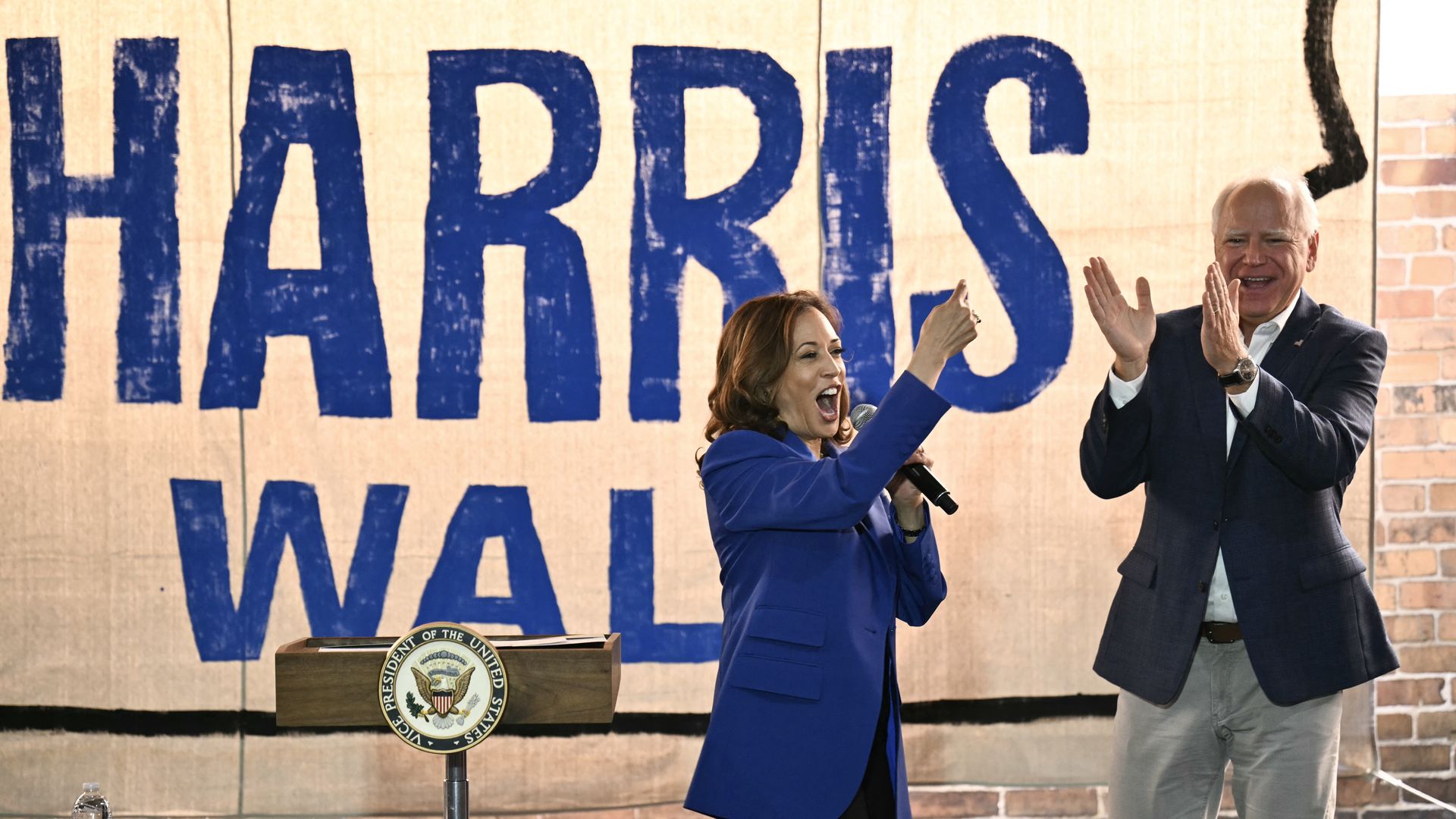
Vice President Kamala Harris points to her running mate, Minnesota Gov. Tim Walz, during a stop on their campaign bus tour in Rochester, Pa., on Sunday. Photo: Angela Weiss/AFP via Getty Images
Vice President Kamala Harris is getting a bigger boost from picking Minnesota Gov. Tim Walz as her running mate than former President Trump has gotten from Ohio Sen. JD Vance, according to two new polls.
Why it matters: Running mates don't usually determine presidential elections, but this race has enough twists to test that norm.
- Vance and Walz, military veterans from Midwestern states who emphasize their understanding of the working class, both were tapped with an eye for their potential to balance the more coastal, elite reputations of their running mates.
The big picture: Walz outperformed Vance on a range of authenticity and compassion questions — including who better understands small-town Americans' concerns — in a new Axios Vibes survey by The Harris Poll.
- A new Syracuse University-Ipsos poll, meanwhile, shows that Americans believe Harris' odds of winning have improved more with her selection of Walz than Trump's have improved with Vance on the ticket.
- Two in three voters in the Axios Vibes survey said the vice presidential candidate is important to their vote this year. But there's a partisan gap, with 81% of Democratic voters and just 59% of Republicans saying it's important.
By the numbers: In the Axios Vibes survey, Walz outperformed Vance on four measures:
- "Has an authentic connection to everyday Americans" (43% to 35% overall ... 36% to 29% with independents).
- "Understands the challenges in your community" (39% to 33% overall ... 32% to 27% with independents).
- "Understands the issues affecting rural and small-town America" (41% to 35% overall ... 35% to 29% with independents).
- "Feels and talks like someone from a small town" (39% to 34% overall ... 35% to 27% with independents).
Vance more than Walz was seen as supporting policies benefiting wealthy people in big cities (41% to 29% overall ... 37% to 22% with independents) and being more worried about himself than constituents (41% to 33% overall ... 37% to 25% with independents).
- "All the routes to victory, through the Blue Wall down into the Southwestern swing states, those are filled with real people," said John Gerzema, CEO of The Harris Poll, which has no affiliation with Vice President Harris.
- "In the battle of real people right now, Walz is more country than Vance. ... There's something in Walz that people seem to think is serving, selfless and sort of that ethos of a teacher, a coach."
Harris' odds of winning improved with her selection of Walz, said 36% of respondents in the survey for Syracuse University's Institute for Democracy, Journalism & Citizenship, while 31% disagreed.
- In the same survey, 25% said Trump's odds improved with Vance on the ticket, while 41% disagree — a net -16.
Reality check: The Syracuse-Ipsos survey asked respondents what impact adding Vance or Walz would have on their own votes. The answer was inconclusive among overall voters.
- But among independents, Walz marginally boosted Harris (22% said they'd now be more likely to back Harris, while 20% said Walz makes them more likely to back Trump).
- By contrast, Vance had a net negative impact on independents (13% more likely to back Trump and 21% more likely to back Harris).
The other side: The gap between Walz and Vance on authenticity and compassion measures isn't huge — and about one in four voters said they didn't know enough yet to make an assessment.
Methodology: The findings in the Axios Vibes survey by The Harris Poll are based on a nationally representative sample of 3,604 U.S. adults conducted online from August 9-13, 2024, where 575 identified as Latino and 459 as Latino voters.
- The sampling precision of Harris online polls is measured by using a Bayesian credible interval. For this study, the data for the overall population is accurate to within +/- 1.9 percentage points using a 95% confidence level.
- The data for Latino voters is accurate to within +/- 5.5 percentage points.
The Syracuse University/Ipsos poll was conducted Aug. 9-11, 2024, by Ipsos using the probability-based KnowledgePanel®. This poll is based on a nationally representative probability sample of 1,091 adults age 18 or older.
- The margin of sampling error is ±3.1 percentage points at the 95% confidence level, for results based on the entire sample of adults.
Disclosure: Axios senior contributor Margaret Talev is also the director of Syracuse University's Institute for Democracy, Journalism and Citizenship.
