Trump speeds AI-driven truth decay


Add Axios as your preferred source to
see more of our stories on Google.
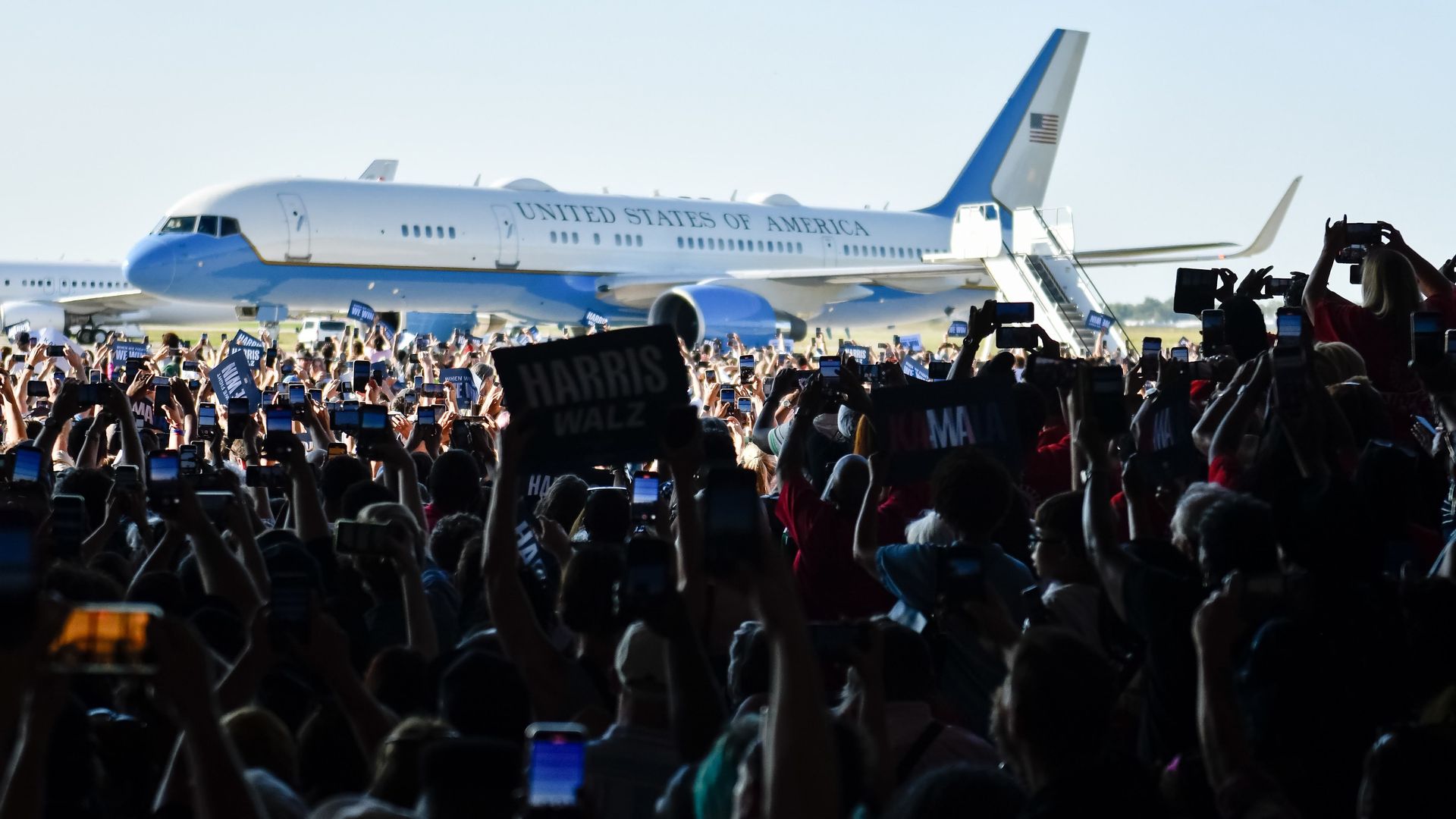
Supporters cheer at a Harris/Walz campaign rally at Detroit Metropolitan Airport in Romulus, Mich., on Aug. 7. Photo: Jeff Kowalsky/AFP via Getty Images
Donald Trump's false charge that his opponent used AI to forge a photo of a crowd of supporters shows yet another dimension of AI's potential to harm democracy.
Why it matters: AI's greatest danger, many experts in the field argue, isn't that it can be used to manufacture falsehoods — but that its very existence makes it so easy to undermine the truth.
Catch up quick: Trump posted a message on Truth Social Sunday claiming that photos showing Vice President Kamala Harris meeting a large crowd of supporters on a Detroit runway were doctored.
- "There was nobody at the plane, and she 'A.I.'d' it, and showed a massive 'crowd' of so-called followers, BUT THEY DIDN'T EXIST!" Trump declared.
Reality check: Many people have affirmed they were there and saw the crowds. Many of those people took their own photos.
- It's hard to tamper with the reality of a public event that had myriad witnesses.
Trump, who has long been obsessed with the size of his own and his rivals' crowds, noted that there were no people reflected on the metallic sides of the vice president's plane.
- But the aircraft has curved sides and was angled away from the crowd.
The big picture: You don't need AI to alter a photo — Photoshop has been doing that for decades.
- Today's AI produces images that are often easily flagged as artificial. But that won't always be the case. Audio impersonation is already more advanced. Video is next.
Between the lines: Warnings about the danger of deepfakes have helped arm the public against an expected flood of fakery.
- But they've also unavoidably made it possible to question the trustworthiness of any evidence you don't like.
- The next time a recording surfaces of some private event where a politician said something damaging, it will be that much easier to deny it.
Some Jan. 6 defendants tried to argue that photos showing them attacking the U.S. Capitol were AI-generated fakes, invoking what a recent American Bar Association article calls "the deepfake defense."
- "The growing use of AI-generated false and misleading information is exacerbating the challenge of the so-called liar's dividend, in which widespread wariness of falsehoods on a given topic can muddy the waters to the extent that people disbelieve true statements," a Freedom House report last year argued.
Our thought bubble: Skepticism and doubt advance the truth only when everyone involved is acting in good faith.
- A world in which nobody trusts anything is one where autocratic leaders can easily mobilize hate and invent their own realities.
The bottom line: As Yale historian Timothy Snyder, author of "On Tyranny," puts it, "What authoritarians do is they say, 'Look, there's no truth at all. Sure you don't trust me — but don't trust them, or them, or certainly not the media. Don't trust anybody.'"
- "And so just stay on your couch, basically ... just do nothing. Affect a pose of cynicism. Be equally skeptical about everything."
