How college sports deliver the world's Olympic stars

Add Axios as your preferred source to
see more of our stories on Google.
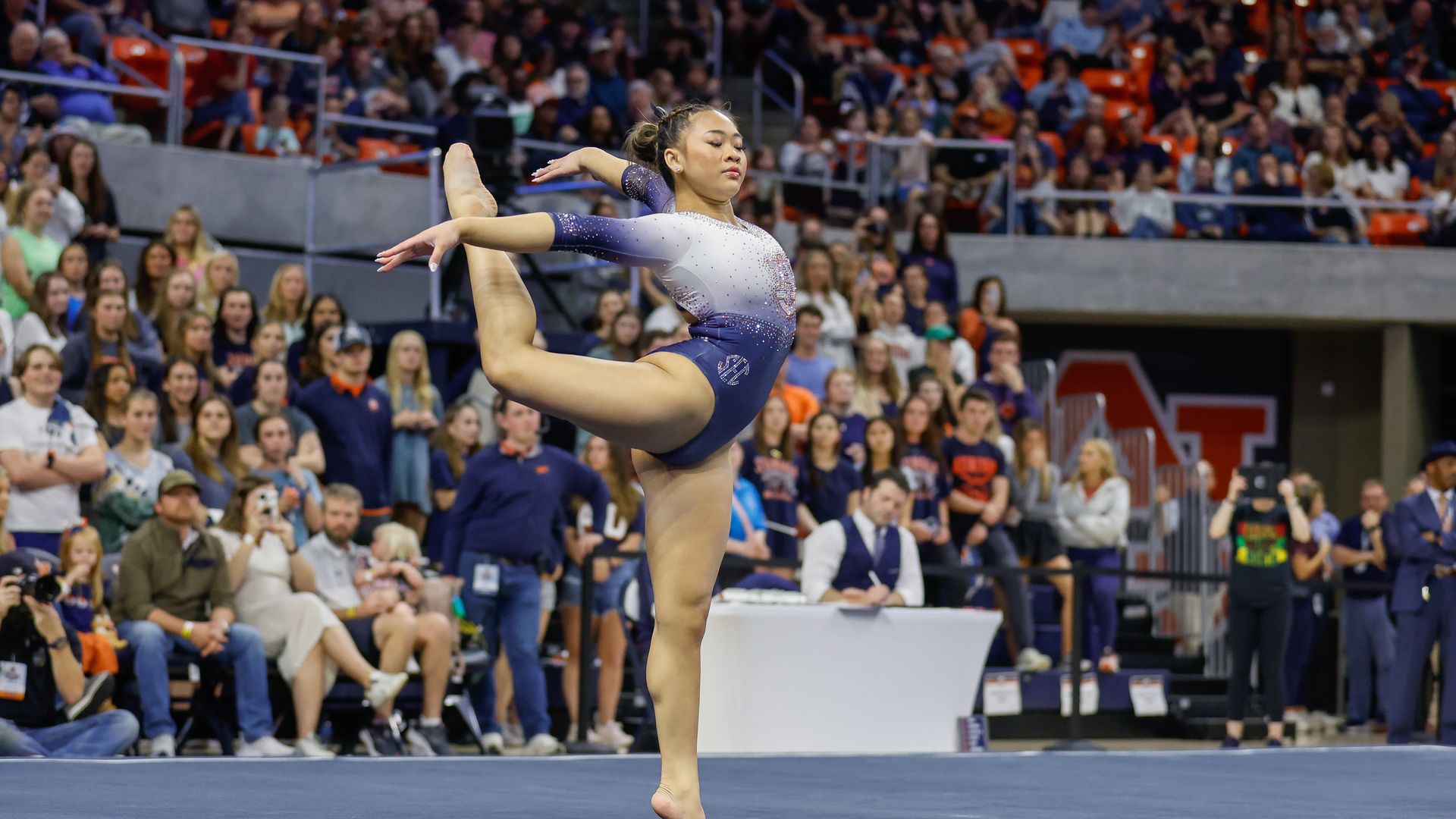
Sunisa Lee of Auburn competes on the floor during a meet against Georgia at Neville Arena on February 24, 2023 in Auburn, Alabama. Photo: Stew Milne/Getty Images
This year, more than 1,200 current, former and incoming NCAA athletes are competing in the Paris 2024 Olympic Games — and more than 840 are chasing gold for a country outside the United States.
Why it matters: College sports have been a key pipeline for Team USA talent throughout the decades of the Olympics — but American universities and their facilities have also evolved as training grounds for international competitors.
- Some of Team USA's most recognizable names — like Sunisa Lee, Sha'Carri Richardson and Katie Ledecky — have competed on both the Olympic and NCAA stage.
- And those NCAA roots transcend international borders, with athletes like swimmer Léon Marchand, France's record-shattering prodigy in the pool, competing in the U.S. during his time as an Arizona State Sun Devil.
By the numbers: According to the NCAA's Olympics dashboard data, 253 NCAA schools are represented by 125 different countries in Paris this summer.
- The U.S., Canada and Australia have the most NCAA athletes going for gold.
- In 2021, some 96 Canadian athletes with NCAA ties competed in Tokyo, but this year, according to NCAA data, over 130 NCAA athletes competed for Team USA's northern neighbors.
- The University of Southern California is at the top of the podium for Olympic representation, sending 59 athletes from 22 different countries to the international stage.
- Even France, the host of this year's Games, has 19 NCAA athletes competing — six of whom, including superstar Marchand, are swimmers.
Zoom out: Following a unanimous Supreme Court decision that further eroded the NCAA's embattled amateurism definition, the NCAA approved a policy allowing athletes to profit off their name, image and likeness since states across the country were developing their own NIL legislation.
- Gymnastics is one sport that has seen massive shifts in recent years following NIL rule changes: Five of seven U.S. female gymnasts sent to Paris (alternates included) — Lee, Jordan Chiles, Jade Carey, Joscelyn Roberson and Leanne Wong — are also current, former or incoming college competitors.
- Before those 2021 changes, many athletes were presented with two starkly different paths: profit from an elite career and give up on college sports or remain an "amateur" and compete for an NCAA program.
What they're saying: The amount of countries earning medals at the Games has increased, University of Delaware sports management professor Matthew Robinson said, highlighting the movement of international athletes training in the U.S. — sometimes funded by their own governments' sports ministries.
- Robinson, who partnered with the USOPC and the IOC Olympic Solidarity Fund to create international coach development programs, noted that research shows "50% of international sports success has nothing to do with sport" and rather stems from macro variables where the U.S. has an edge, like climate, GDP and population.
Yes, but: Some Olympic sports, notably those that do not bring in the big bucks, are still at risk of being booted from the collegiate lineup.
- Stanford, which sent the second most athletes of any NCAA school to the Games this year and the most for Team USA, decided in 2020 to slash nine Olympic sports from its 36 varsity teams as the school's athletic budget became emaciated by pandemic stresses.
- The NCAA may need to reevaluate its approach to non-revenue sports "to make sure ... we're accepting that responsibility to be partners in developing our (Olympic) national teams," then-NCAA President Mark Emmert said in 2021 on the heels of a massive update to the NCAA's amateurism bylaws.
- Unlike other countries, the U.S. government does not have a centralized sports ministry — placing the burden on the nation's expansive college sports framework to develop the country's peak talent. However, many programs' departments are sailing through choppy financial seas as the economic model of college sports continues to evolve.
Zoom in: "Colleges and universities across the U.S. are proud to invest in Olympic programs while zero public dollars are spent developing Team USA — making our system not only the envy of the world but totally unique," NCAA President Charlie Baker said in a statement provided to Axios.
- He noted the organization and its schools are developing changes to "deliver more benefits to student-athletes" but said "efforts to force schools to treat all college athletes as employees would be catastrophic to Olympic sports," pushing for congressional legislation "to address this issue."
- In June, the House Committee on Education and the Work Force voted to advance a bill that would exempt college student-athletes from employee status.
What's next: Conversations about revenue-sharing deals and paying college athletes also pose new uncertainties to the bond between collegiate and elite sports.
- In May, the NCAA and its power conferences approved new rules that will allow programs to directly pay college athletes, though there are still multiple steps that must be taken to make those rules a reality.
- As athletic departments brace for a looming new business model, fears about where revenue will be redirected (say, to paying star football athletes) — and what that could mean for non-revenue sports that often produce Olympic athletes — mount.
- "So that's the one concern ... are there going to be sports being dropped?" Robinson said. "Because at the end of the day, the football dog must get fed."
Go deeper: Gymnastics Giants: The schools that make the U.S. Olympic team
Editor's note: This story has been updated with a comment from NCAA President Charlie Baker.
