The stock market slump doesn't have to mean a recession is near

Add Axios as your preferred source to
see more of our stories on Google.
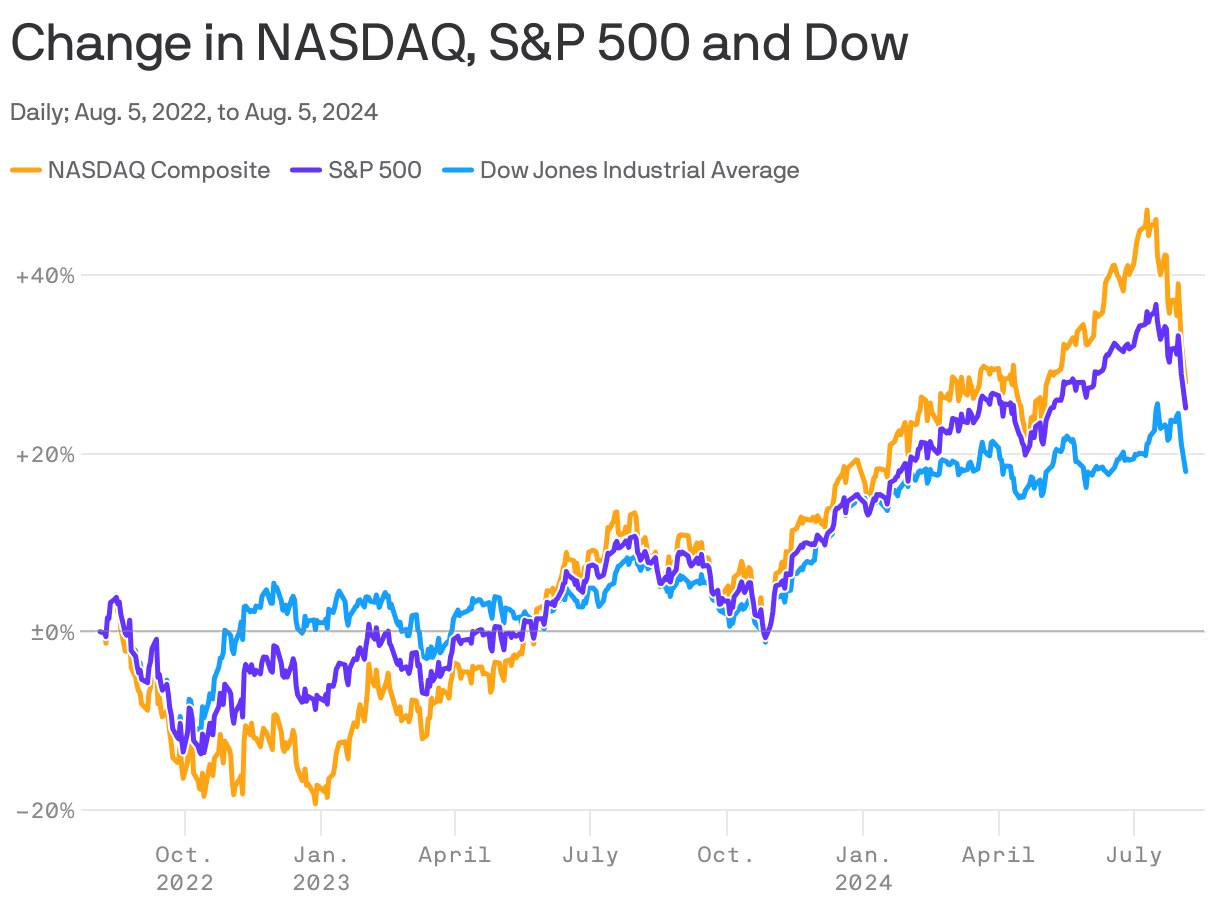
U.S. economic outlook has dimmed some. But the sharp stock selloff of recent days appears to have its roots in more obscure forces — and does not, in and of itself, mean a recession is looming.
Why it matters: After Monday's 3% drop, the S&P 500 is down 9% since reaching an all-time high just three weeks ago today.
Zoom in: The adjustment looks to be driven significantly by technical factors, including trades on the Japanese yen, big-company tech stocks, and low volatility reaching the end of their runs.
- None of that means the economy is in the clear. Indeed, the alarm bells sounded by the latest round of data are loud. But with Federal Reserve rate cuts incoming, there is still room to envision the economy skirting a downturn.
- The action on Wall Street, by contrast, looks like the kind of earthquake that rips through the financial markets semi-regularly as once-popular trades start to falter and traders are forced to pivot en masse.
Between the lines: When things are calm in financial markets, as they have largely been over the last year, traders plow more and more money into risky strategies reliant on borrowed money. When more volatile conditions arrive those trades go sideways and fuel even further volatility in a vicious cycle.
- For years, hedge funds have been able to exploit a big gap between U.S. and Japanese interest rates to profit off the "carry trade."
- But with the Bank of Japan raising rates and the Fed set to cut them, that no longer works — and the act of closing those positions helped drive Japanese stocks down a wild 12% in Monday's session and contributed to global contagion.
Meanwhile, the U.S. stock market rally has been built on a handful of mega-cap tech stocks that are poised to profit from the AI boom. Prices of those shares have looked frothy for months, and now the froth looks to be blowing off.
- On June 18, chipmaker Nvidia's shares were up 181% for the year. They have declined sharply since then — but are still up 107% for the year!
- That's a big downshift in valuation and outlook over a short time, but not exactly a crisis for the $28 trillion U.S. economy.
What they're saying: "After such a strong rally since last fall, valuations, sentiment, and investor positioning had become stretched," wrote analysts at LPL Financial yesterday.
- "What markets are experiencing today is an unwinding of that bullish positioning," writes Quincy Krosby, Jeffrey Buchbinder, and Joshua Cline.
Of note: The market selloff comes with a silver lining for American consumers. Money is flooding into U.S. bonds, driving interest rates lower. That essentially front-runs the Fed's planned rate cuts and makes borrowing cheaper immediately.
- The average 30-year fixed-rate mortgage was down to 6.34% yesterday, per Mortgage News Daily, the lowest in more than 18 months.
The bottom line: Some lines are old and a bit cliched, but still be true. Repeat after me: The stock market is not the economy.
