Why Japan's currency is triggering a global market selloff

Add Axios as your preferred source to
see more of our stories on Google.

Illustration: Allie Carl/Axios
Japanese stocks saw their worst day today since 1987 as Japan's currency soared to a seven-month high against the U.S. dollar — triggering a selloff in global stocks.
Why it matters: There's an unwinding of the popular "yen carry trade" happening "at lightning speed" that will continue to cause volatility until it's over, Art Hogan, chief market strategist at B. Riley Wealth, tells Axios.
Catch up fast: The premise of the trade is simple: Investors borrow cheap yen in Japan, where interest rates have been stuck at zero, and buy higher yielding assets in other countries with predictable returns, such as U.S. stocks (primarily Big Tech names) and bonds.
- Well, that approach recently lost its appeal, as the value of the yen has risen in recent weeks and after Japan's central bank raised rates last week.
The latest: That's the main fuel for today's market meltdown, according to Hogan.
- Profit taking, concerns about the direction of the U.S. economy given Friday's U.S. jobs report and a traditional calendar cycle of selling in August and September also factored into the equation, he added.
What they're saying: Wall Street is clamoring to figure out what the historic meltdown in a very large and important economy means and who is exposed to it, Callie Cox, chief market strategist at Ritholtz Wealth Management, tells Axios in an interview, about the selloff in Japan.
- "Contagion is the biggest worry right now, and investors are already kind of on edge after Friday's jobs report, already wondering about the economy and what's happening underneath the surface."
The big picture: If you're getting déjà vu — don't be alarmed.
- Part of what pushed Silicon Valley Bank to collapse last year was its bet on low interest rates here in the U.S.
- Those fears spread, but did not ultimately result in prolonged widespread selloff.
- Over the past week, as the yen carry trade has unraveled, it's also revealed the risk associated with investment concentration in Big Tech.
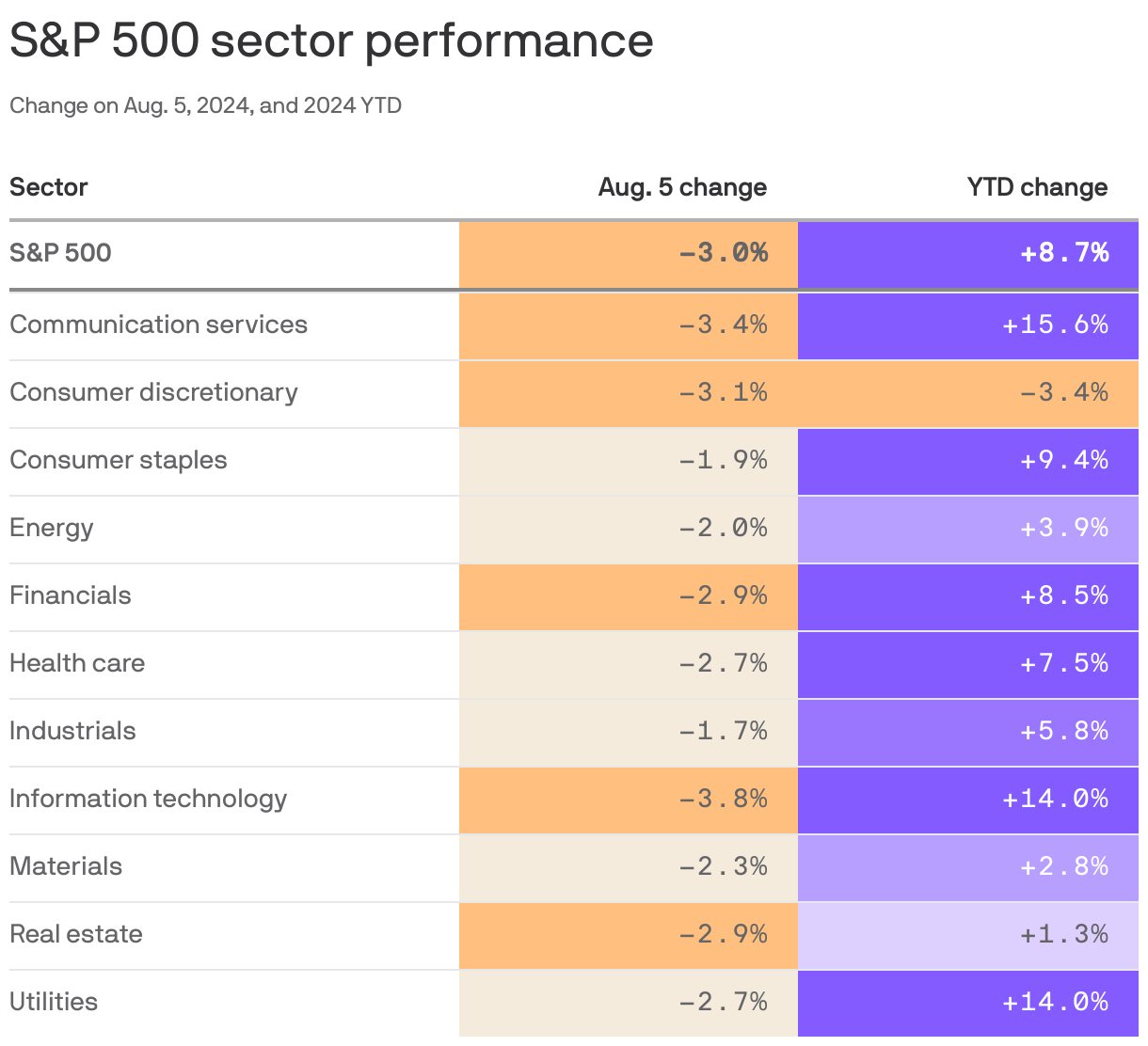
By the numbers: The tech sector was the most hammered by investors unwinding the yen carry trade, down 3.8% compared to the broader market decline of 3%, leaving room for more rotation into smaller names.
Zoom in: AMD and ASML — key semiconductor companies — closed up 1.8% and 1.4%, respectively, on the day as Nvidia, one of the most actively traded today, shed 6.4%.
- DoorDash and e.l.f. Beauty were also unscathed, rising 3.5% and 5.9%, respectively, on the day.
- Another notable gainer on the day was Kellanova, which closed up 16.2% on a report that it's the target of an acquisition by Mars.
What we're watching: Neither Hogan nor Cox believe the Fed will introduce an emergency interest rate cute.
- "The Fed's never been swayed or persuaded by equity markets," said Hogan. And an off-cycle move might have the reverse effect on investors.
The bottom line: "Fluky stuff happens every once in a while, but not everything is the next financial crisis," said Cox.
