The tech that showed Noah Lyles winning gold

Add Axios as your preferred source to
see more of our stories on Google.
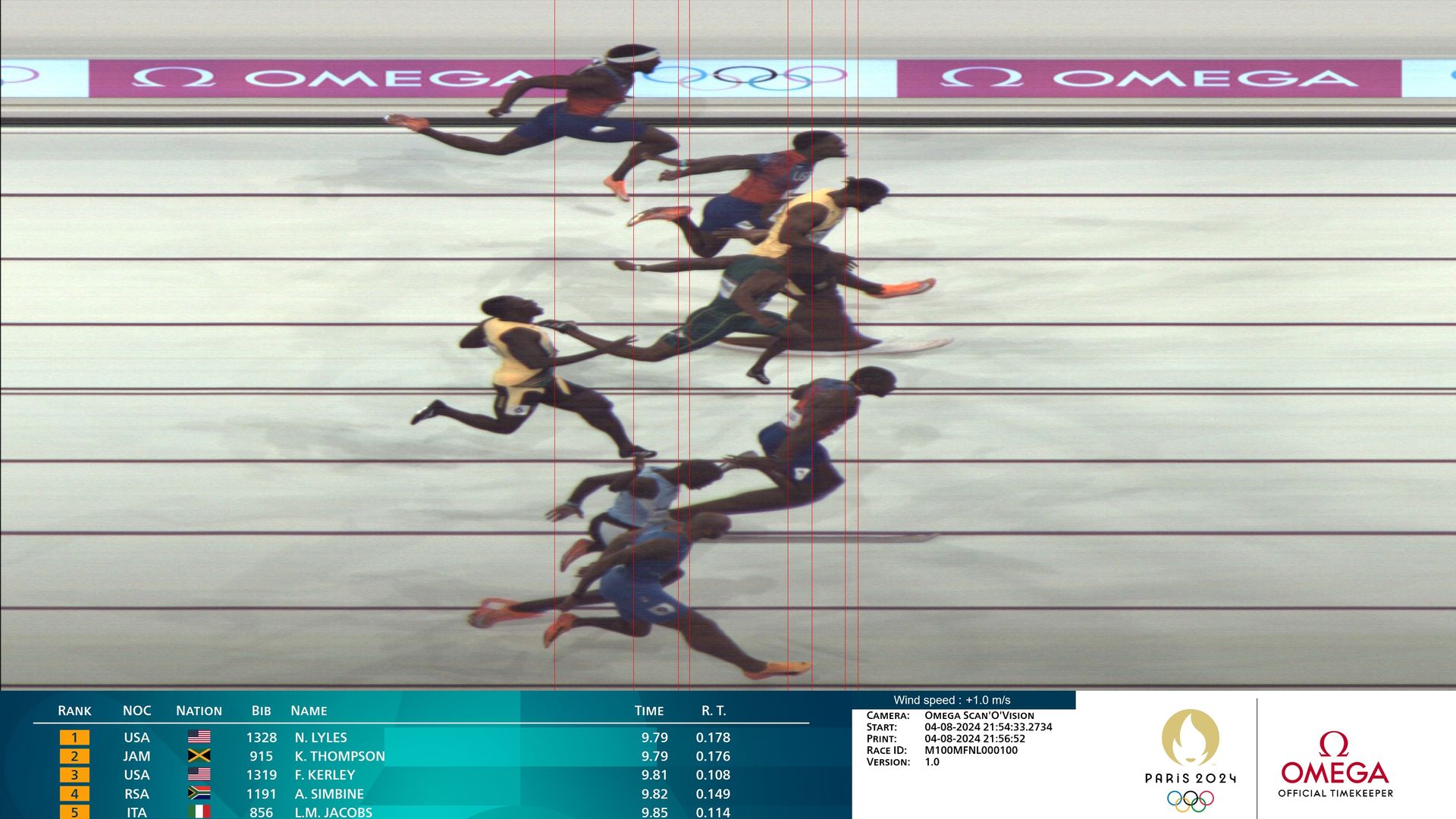
Omega's photo finish cameras helped show Noah Lyles winning the 100-meter race. Photo: Courtesy of Omega
PARIS — When judges needed to determine who won Sunday's Olympic 100-meter race, they drew on some fancy new technology — a camera from Omega that shoots 40,000 frames per second, aimed right at the race's last few millimeters.
The big picture: Omega, which has been the Olympics' official timekeeper for decades, is constantly looking for new ways to help measure athletes' performance and figure out just who won.
Zoom in: I saw the cameras and sensors in place firsthand at Stade de France, just hours before American Noah Lyles ran his ultimately victorious race, edging out Jamaica's Kishane Thompson in a historically close photo finish.
- Both finished with an identical 9.79 seconds, with Omega's technology used by judges to determine the winner.
- For the Paris games, Omega has added new tech in a range of sports, including the faster photo finish camera used for track and other races.
- The new cameras take four times as many pictures per second. It also adds higher resolution, perfect for tough calls such as the one that took place Sunday.
Yes, but: In track, the cameras are only focused on the 5 mm near the finish line.
- However, in taking so many pictures, the system can recreate a full picture of just whose body crossed the line first.
Zoom out: Measuring all the events requires tons of different equipment, literally. Omega has 350 tons of gear spread out across France and Tahiti (the surfing venue).
- It also has 200 kilometers of cable and draws on the skills of 550 timekeepers. Of that, 55 people are devoted just to athletics, the most for any single event.
Fun fact: While Omega uses Windows laptops throughout its Olympic operation, it was not hit by the massive CrowdStrike glitch just before the games got formally going.
- "No we didn't," Omega Timing CEO Alain Zobrist told me. "I can't tell you why," he said, while adding that it takes cybersecurity and integrity of its systems as a top priority and tries to make them as independent and resilient as possible.
What's next: AI is starting to play a role for Omega too, though not yet in the judging of the sports. So far, Omega is using computer vision and machine learning to help broadcasters and athletes better understand athletes' performances.
- Omega is using a range of cameras and sensors track the movements of swimmers and then tapping computer vision and AI to understand their acceleration, deceleration, number of strokes and time in the water. This allows for detailed performance analysis.
- In tennis, computer vision is helping understand athletes' reaction time to serves and how this correlates with the quality of their returns.
Go deeper: Virginia's Noah Lyles wins Olympic gold, becomes fastest man in the world
