Venezuela's contested election may push more people to leave

Add Axios as your preferred source to
see more of our stories on Google.
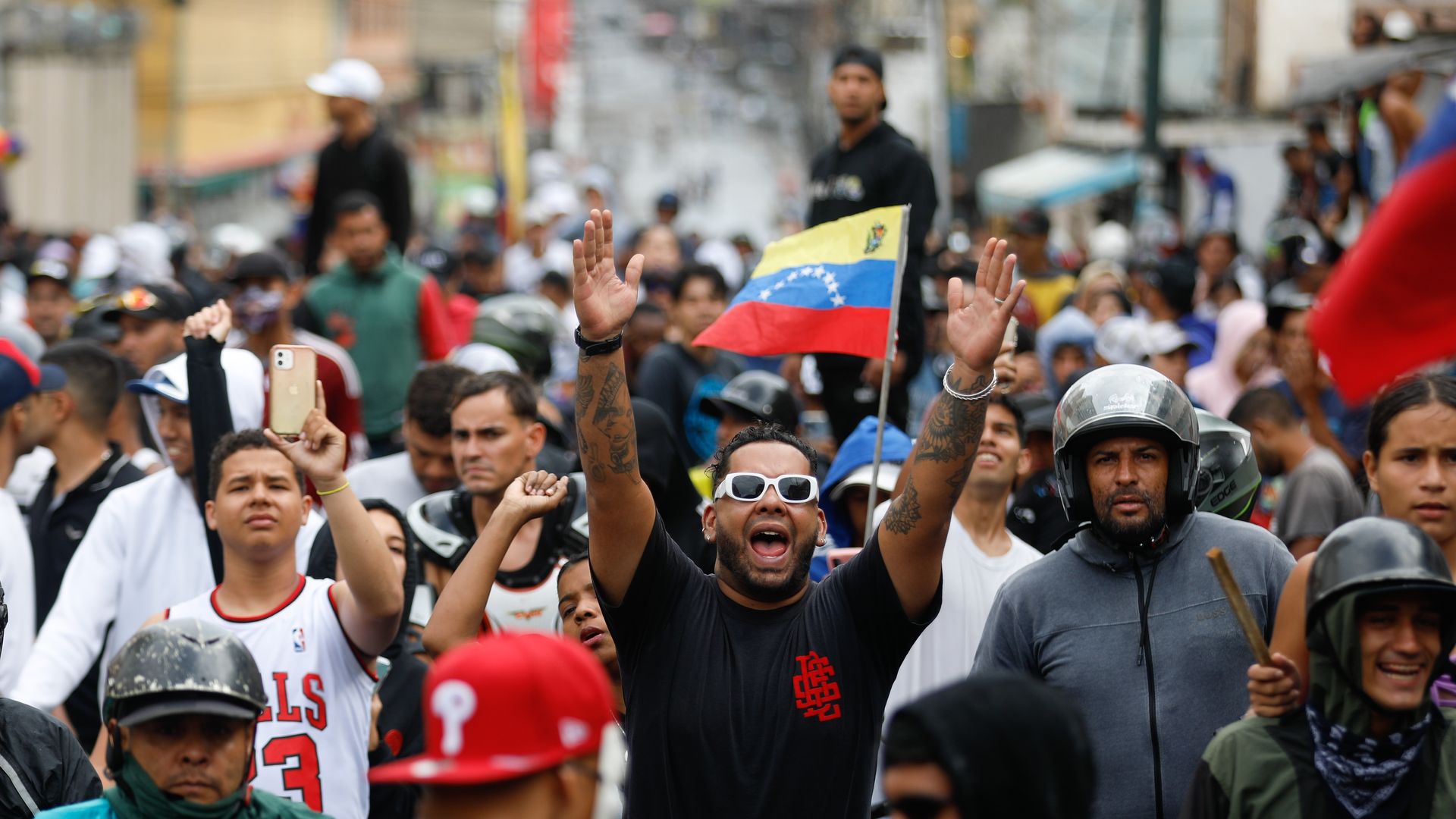
Protesters in Caracas, Venezuela on Tuesday marched against the alleged reelection of President Nicolás Maduro. Photo: Pedro Rances Mattey/Anadolu via Getty Images
Chaos sparked by Venezuela's disputed presidential election results is likely to worsen the country's crisis and push more people to leave, analysts say.
Why it matters: In the 11 years that President Nicolás Maduro has been in power, Venezuela democratic institutions and the economy have further deteriorated, with food, medicine and goods shortages compelling at least 7.7 million to leave the country.
Catch up quick: The electoral commission, CNE, without sharing precise data or any breakdown of vote counts, certified Maduro as the winner on Monday over opposition candidate Edmundo González Urrutia.
- The CNE is run by members of the ruling United Socialist Party of Venezuela (PSUV), which has long been accused of interfering in elections. PSUV's policies are widely known as Chavismo, after the late Hugo Chávez.
- The opposition says there was electoral fraud and that its monitors sent to voting sites to check the count saw tallies that indicated González won.
Zoom in: After 25 years of autocratic rule under the same party, Venezuelans at home and abroad had high expectations of change ahead of Sunday's elections.
- More than 40% of Venezuelans polled in the past few months said they'd consider emigrating if Maduro stayed in power.
- "The situation certainly seems poised for more outmigration," Ryan C. Berg, director of the Americas Program at the Center for Strategic and International Studies, tells Axios Latino.
- "I think we're going to see a few days of protests, but I think the regime will try to put down these protests or just ride them out," and then people might see no choice but to leave, he adds.
Yes, but: Pressure on Maduro to open up the vote to audits could mount as the region works to avoid another mass migration, Berg says.
- "We need to keep paying attention to a couple of the big heavyweights in the region, like Argentina, Brazil, Colombia, Mexico," Berg says, adding that it'll be important to watch what these leaders say could happen if " the regime continues to deny the right to any kind of transparency," he says.
What's next: The opposition on Monday announced a website to show the data it compiled from the election, but it hasn't said what its next move will be to contest Maduro's alleged victory.
- Trying to get a recount requires going to the Venezuelan Supreme Court, which is run by Maduro allies.
- "In the coming days we'll be announcing what actions we'll take to defend the truth," María Corina Machado, the opposition leader who was originally the candidate but was barred from running, said in a press conference late Sunday.
- People have so far made their discontent known through cacerolazos, the banging of pots and pans as a sign of protest.
- "Interestingly a lot of those protests are also growing in neighborhoods more typically aligned with" Chavismo, says Phil Gunson, a researcher for the International Crisis Group based out of Caracas.
- He says that could make things complicated for the government as the opposition pushes for the vote count to be disclosed.
What they're saying: "The repression of protests in past years left some wounds, so it's important for the people and the opposition's leadership to think through how to organize and push for an audit," Maryhen Jiménez, researcher of Latin American politics at Oxford University, tells Axios Latino.
- "I think if the domestic pressure for that is accompanied by diplomacy, international pressure from within Latin America especially, that will be key," she adds.
Subscribe to Axios Latino to get vital news about Latinos and Latin America, delivered to your inbox on Tuesdays and Thursdays.
