The never-sleepers

Add Axios as your preferred source to
see more of our stories on Google.
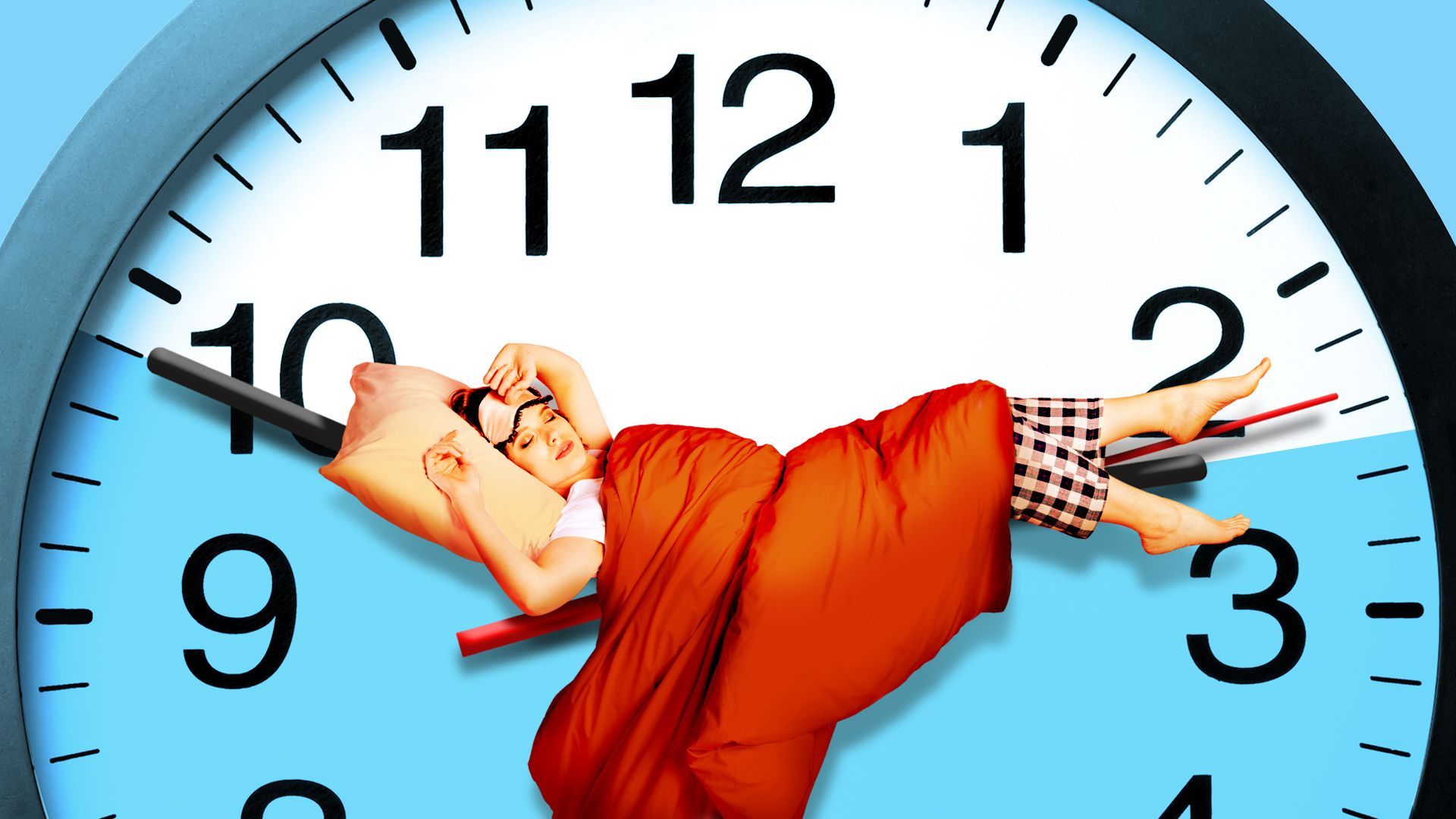
Illustration: Sarah Grillo/Axios
A small group of people around the world truly don't need more than four to six hours of sleep a night, thanks to a rare gene.
Why it matters: Very few people are natural short sleepers, but deeper study of the way their bodies and brains work offers valuable lessons for all of us.
The big picture: Short sleepers are a window into what life looks like when you get enough sleep, says Ying-Hui Fu, a neuroscientist and sleep researcher at UC San Francisco.
- She's a co-author of the landmark study on short sleepers that identified their unique gene.
Zoom in: When we sleep, our bodies go through a series of tasks that are essential to keeping us going mentally and physically.
- That includes generating energy for the next day, eliminating toxins and solidifying memories.
- For most of us, that process takes around 8.5 hours, Fu says. We often don't get all of those hours, so our recovery hovers around 90% or lower.
But naturally short sleepers are exceptionally efficient with their overnight mental and physical recovery and tend to complete 100% of those tasks in four to six hours, she says.
- As a result, the dozens of short sleepers Fu has studied tend to be energetic, optimistic and healthy — and they have good memories.
Case in point: Michael Grillo, a retiree in Clinton, Conn., tells Axios he's been a short sleeper all his life.
- He's seen doctors and tried sleep aids, but his body never strayed from an average of 5.5 hours of sleep a night.
- "There's nobody else in my family like me," he says. "It's kind of a joke within my family, but it feels so naturally part of my biorhythm."
A life of short sleep means Grillo is always up in the wee hours of the morning when the rest of us are sound asleep.
- "I try to use the time productively," he says. "It's a quiet time. It's never a dull time."
- When he worked a corporate job, he'd often use the meeting-free time to catch up on work or plan the day.
- Now, Grillo listens to books and takes his dog for walks. He even taught himself to read music and is now learning how to play the ukulele.
Zoom out: Short sleepers' boosted mental and physical health underscores how key sleep is to health, Fu says.
- "It makes perfect sense," she says. "When sleep efficiency and quality is better, it can help prevent and dramatically delay disease."
What's next: Short sleepers are hard to study — in part because, while there are many people who think they don't need lots of sleep, very few naturally function that way, the Wall Street Journal reports.
- But researchers, including Fu, say there's a great deal more we can learn from this population — including whether there's a way for the rest of us to sleep less without jeopardizing our health.
"My long-term goal is to someday learn enough so we can manipulate the sleep pathways without damaging our health," Fu told the Journal. "Everybody can use more waking hours, even if you just watch movies."
