U.S. warned Israel against targeting Hezbollah in Beirut after deadly strike

Add Axios as your preferred source to
see more of our stories on Google.
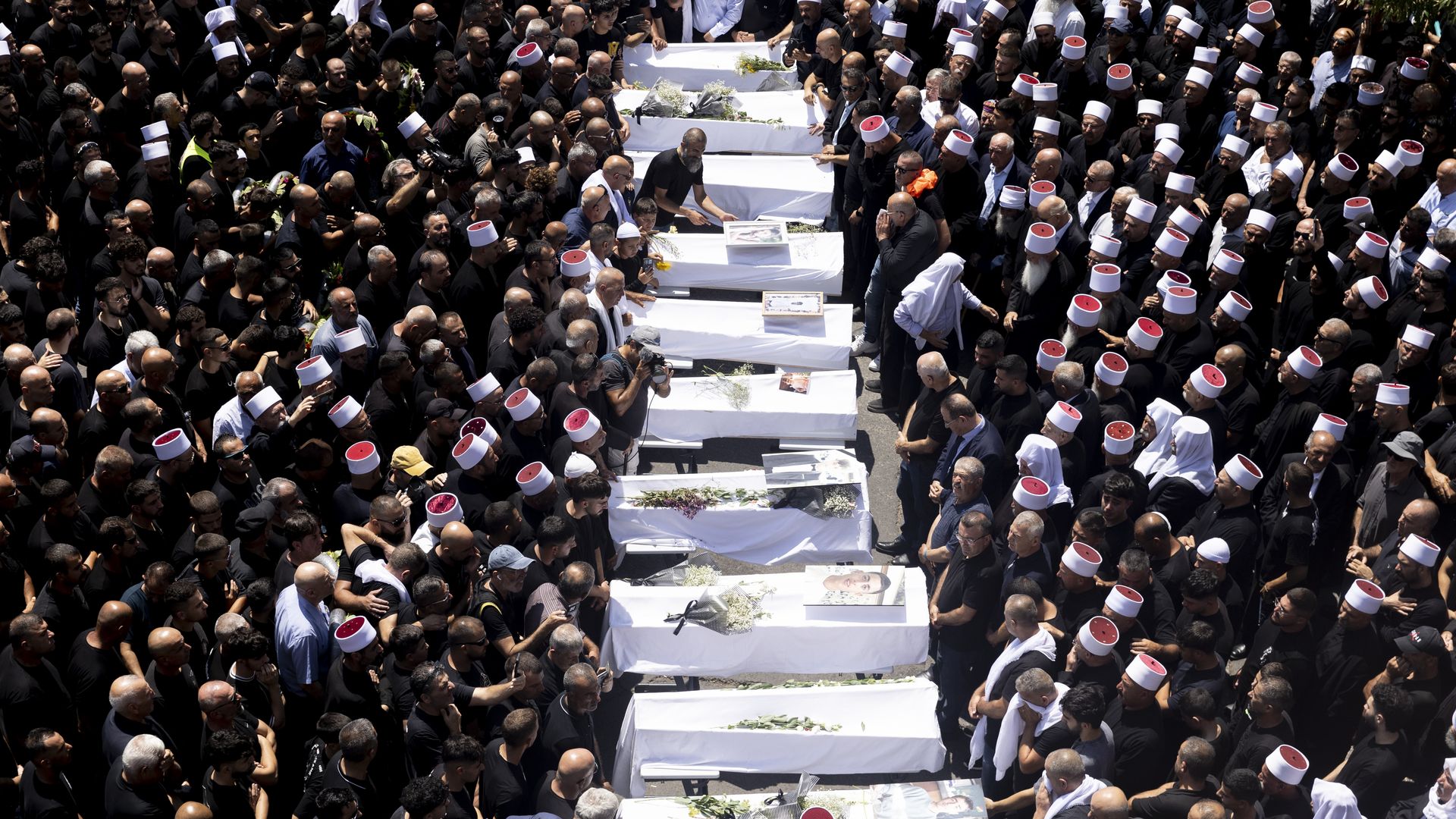
Mourners attend a funeral held for 10 of the victims of yesterday's rocket attack on July 28, 2024 in Majdal Shams, Golan Heights. Photo: Amir Levy/Getty Images
The Biden administration warned Israel if it hits Hezbollah targets in Beirut in response to a deadly strike on the Golan Heights on Saturday "the situation would likely spiral out of control," according to one Israeli official and one U.S. official.
Why it matters: The Israeli security cabinet convened on Sunday to discuss the military response to the rocket attack that killed 12 children and teenagers, including an option to conduct strikes in Lebanon's capital, Israeli officials said.
- Israel blamed Saturday's deadly strike on Hezbollah and U.S. officials, including Secretary of State Antony Blinken, said it is the U.S. assessment that Hezbollah fired the rocket. Hezbollah denied responsibility.
The big picture: Israel Defense Forces have conducted airstrikes on Hezbollah positions and command centers in Lebanon since Oct. 8 of last year after Hezbollah launched rockets into Israel in support of the Oct. 7 Hamas attack on Israel.
- Israel and Hezbollah both said they conducted strikes overnight Saturday into Sunday after the Golan Heights attack.
- But Israel has so far not targeted Hezbollah in Beirut.
- U.S. and Israeli officials agree that an all out war between Israel and Hezbollah would cause huge destruction on both sides and could lead to a regional war.
Behind the scenes: On Saturday, President Biden's senior adviser Amos Hochstein spoke to Israel's Minister of Defense Yoav Gallant and told him Israel has the right to defend itself against Hezbollah, but must avoid an all out escalation and minimize civilian casualties, an Israeli official said.
- The Israeli official said Hochstein expressed concern that if the IDF strikes Beirut, Hezbollah would respond by firing long-range missiles at Israel, which would likely lead to even further escalation.
- "We definitely think an IDF strike on Beirut is a potential red line for Hezbollah," a U.S. official said.
- The White House declined to comment on its private diplomatic talks with Israel.
What they're saying: White House National Security Council spokesperson Adrienne Watson said in a statement on Sunday that the attack on the Golan Heights was conducted by Lebanese Hezbollah.
- "It was their rocket, and launched from an area they control. It should be universally condemned," she said.
- Watson stressed the U.S. supports Israel "against all Iran-backed threats, including Hezbollah."
- She said the Biden administration is also working on a diplomatic solution along the Israeli-Lebanese border "that will end all attacks once and for all, and allow citizens on both sides of the border to safely return to their homes."
State of play: The Israeli security cabinet after a three hour meeting on Sunday authorized Prime Minister Benjamin Netanyahu and Gallant to decide on the scope and the timing of the Israeli response, the Prime Minister's Office said.
- Israeli officials said the Israeli security cabinet and the IDF want a much stronger response against Hezbollah than anything that has been done so far, but they also want to avoid an all-out war.
- The IDF thinks a strong Israeli response would likely lead to several days of high-intensity fighting with Hezbollah that would be difficult to contain, the Israeli officials said.
- "It is clear that both sides are going to take one step further than they have taken so far but it isn't clear whether they can avoid falling into the abyss," one Israeli official said.
What to watch: An escalation between Israel and Hezbollah would likely freeze negotiations over the Gaza hostage and ceasefire deal, Israeli officials said.
- Mossad director David Barnea met on Sunday in Rome with CIA director Bill Burns, Qatari Prime Minister Mohammed Bin Abdul Rahman al-Thani and Egyptian spy chief Abbas Kamel to discuss the updated Israeli proposal.
- "At the meeting, the sides discussed the document with the clarifications regarding the draft agreement that was conveyed from Israel. The negotiations on the main issues will continue in the coming days," the Israeli prime minister's office said.
