DOJ watchdog slams Barr for sharing non-public info with Trump on 2020 probe

Add Axios as your preferred source to
see more of our stories on Google.
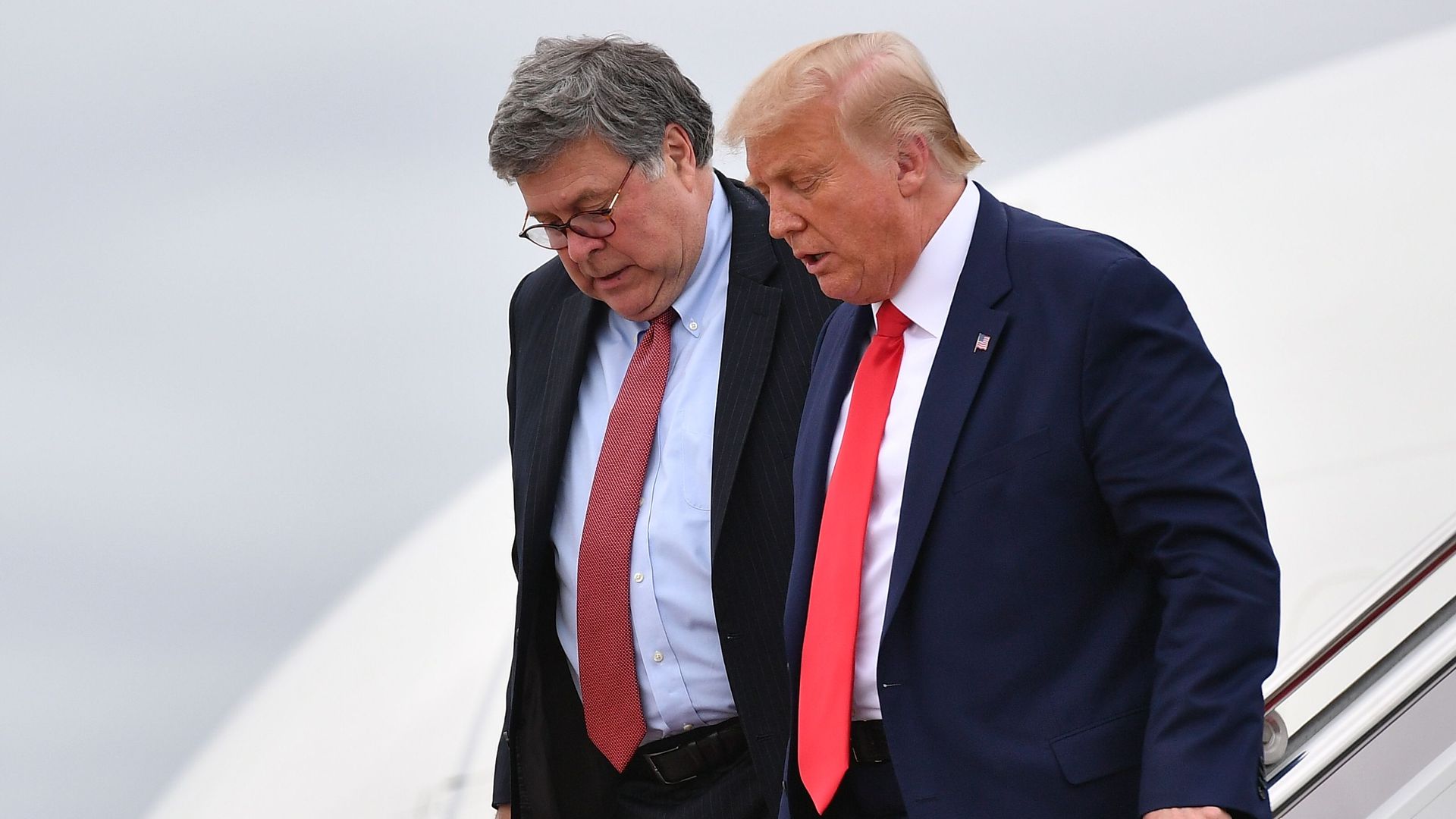
Former President Trump and former Attorney General William Barr in Maryland in September 2020. Photo: Mandel Ngan/AFP via Getty Images
The Department of Justice's Inspector General's Office (OIG) criticized former Attorney General Bill Barr on Thursday for disclosing non-public investigative information with former President Trump about the department's probe into possible 2020 election fraud.
Why it matters: Barr's disclosure did not breach any of the department's policies but it "was certainly not consistent with his own guidance to the department," the watchdog said in a new report.
- The Justice Department's internal policies typically prohibit officials from commenting on ongoing investigations so as to not taint its investigative process.
Context: The information pertained to the department's investigation into alleged election crimes in Luzerne County, Pennsylvania, over nine mail-in military ballots that were discarded.
- The watchdog said that Barr told Trump on Sept. 23, 2020, at a White House event that some of the recovered ballots were "marked for Trump," which was not public information at the time.
- The next day, as the DOJ's investigation was ongoing, Trump revealed the information on a national radio show.
Flashback: Around the time, Trump was perpetuating baseless election fraud claims to support his efforts to overturn election results in his favor.
- Barr had maintained in public at the time that the DOJ would work impartially while investigating allegations of fraud in the election. He later disclosed that the department had not uncovered evidence of widespread voter fraud that would change the outcome of the election.
- The Justice Department concluded its investigation into the discarded ballots in January 2021, finding "insufficient evidence to prove criminal intent" on the part of a former Luzerne County Elections Bureau employee.
What they're saying: The OIG said Barr providing this information to Trump "created the risk that the President would use the Department's non-public investigative information to advance his own political aims — a risk that was in fact realized when President Trump referenced the ballots on a national radio show the next morning."
- The disclosure "was certainly not consistent with Barr's own Election Year Sensitivities guidance to be 'particularly sensitive' to safeguarding the Department's reputation for fairness, neutrality, and non-partisanship," it added.
Zoom in: The report concluded Barr did not violate any departmental rule, as current policies appear to generally leave what information can be shared with the president up to the attorney general's discretion.
- However, it recommended that the department update its "White House communications policy to clarify what information can be disclosed to the White House in situations where the policy permits communication about a contemplated or pending civil or criminal investigation."
The other side: Barr, who has said he will vote for Trump this year, did not sit for a voluntary interview with the inspector general's office despite being invited to do so on multiple occasions.
- After he resigned as attorney general, Barr sent the office a 3-page letter defending his actions around the Luzerne County probe.
- "In my view, the steps taken in the case of Luzerne County to protect the integrity of election [sic] did not threaten harm to a candidate and were not a partisan matter. They redounded to the benefit of all voters and enhanced public confidence," it reads.
Yes, but: The OIG said Barr's letter "did not address certain issues that the OIG became aware of during the investigation."
- Among those issues, it wanted to know why Barr wanted to include that some of the discarded ballots were cast for Trump in official public statements from the U.S. Attorney's Office for the Middle District of Pennsylvania (MDPA).
Between the lines: Initial public statements from the MDPA incorrectly stated that all nine ballots were marked for Trump. In reality, only seven were.
- The OIG also said the statements included "an injection of partisan considerations that multiple career prosecutors told us was not relevant to and had 'no bearing on' the criminal investigation."
Go deeper: J.D. Vance wrote foreword of upcoming book from Project 2025 architect
