Why a union boss addressed the Republican National Convention

Add Axios as your preferred source to
see more of our stories on Google.
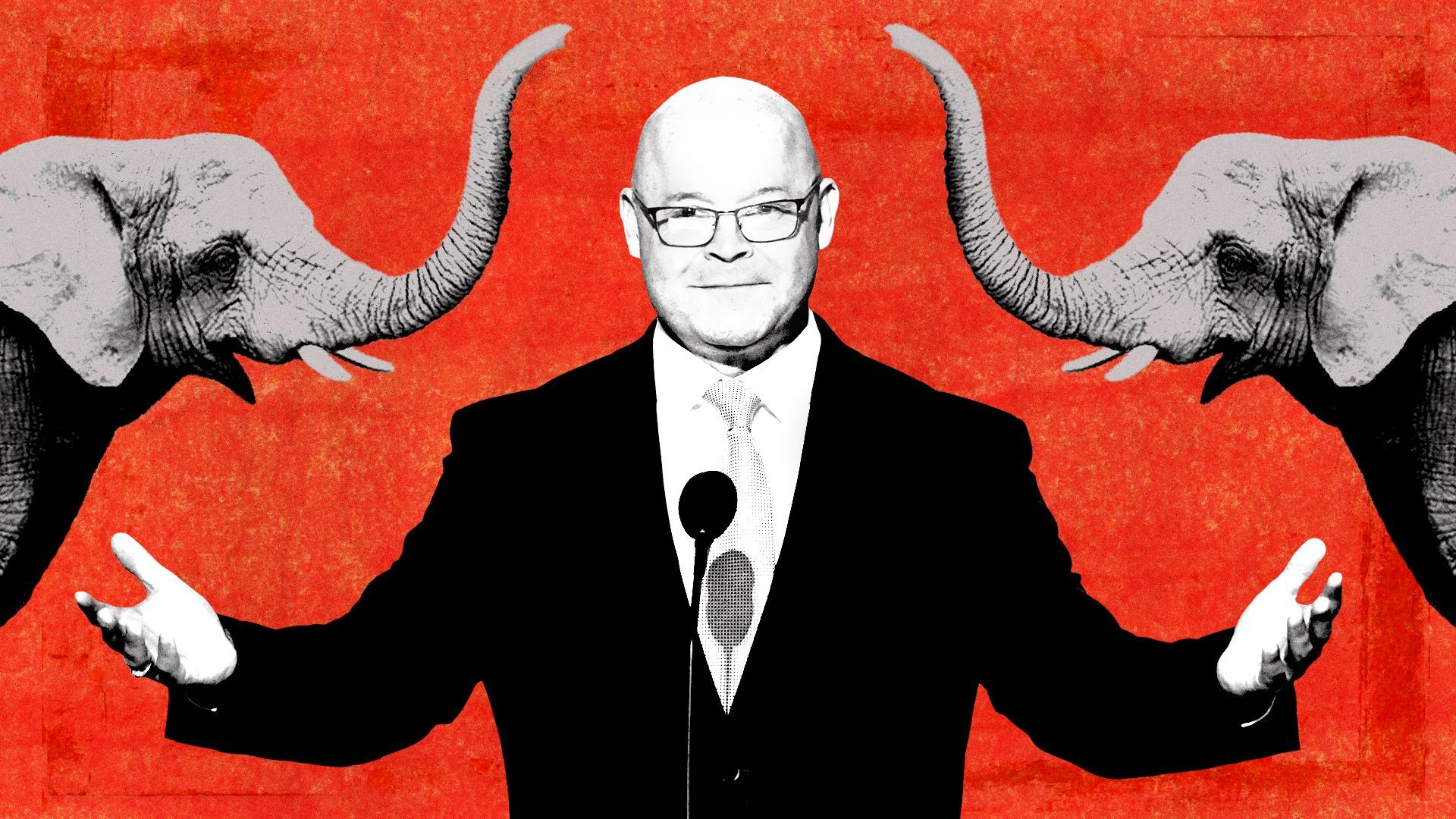
Photo illustration: Shoshana Gordon/Axios. Photo: Andrew Caballero-Reynolds/AFP via Getty Images
Teamsters president Sean O'Brien's speech at the RNC this week highlights the lengths the Republican party, with no track record of supporting labor, will go to appeal to working-class voters.
Why it matters: It's not at all clear that pressure from O'Brien — or the ascension of a populist like Sen. J.D. Vance (R-Ohio) to the ticket — will actually translate into any real action on labor policy.
The big picture: O'Brien's speech was "an enormous coup" for the GOP, says John Logan, a labor historian at San Francisco State University.
- "They are going all out to get the votes of blue-collar workers, especially in the upper-Midwest because they know that Biden has zero chance of winning unless he carries Pennsylvania, Michigan and Wisconsin."
- Vance made a very explicit run at the working-class vote in his speech this week — and has branded himself as an anti-business populist. The Ohio senator showed up at a UAW picket line last fall.
The other side: For O'Brien, too, there are a handful of explanations for why he'd want a Republican audience:
Republicans are in unions. Though Democrats have traditionally grabbed most union support at the leadership level, nearly 40% of registered voters who are union members are in the GOP, per a 2023 Pew survey.
- Back in 2016, union leaders were caught off guard by their members' support for Donald Trump.
- O'Brien was first and foremost talking to his GOP members, says Patricia Campos-Medina, executive director for the Worker Institute, part of Cornell's ILR school. "He was being responsive to his membership."
- The union boss told CNN something similar this week: Teamsters have a diverse membership, he said. "We've got a lot of Republicans, we've got a lot of Democrats, we've got some Independents. So we have an obligation to do our due diligence and just not serve one part of our membership."
Labor reform needs GOP support. Biden has been able to put a lot of pro-labor moves into place — except in Congress.
- "The partisanship is not working," O'Brien told CNN. We need bipartisan support to make change, he said.
Pascal's wager. This is the idea, explained by Axios' Felix Salmon, that leaders are more vocal about supporting Trump because they want favorable treatment if he's elected, and fear him carrying a grudge.
- We saw that in action Thursday night, when Trump called for the firing of another union boss — UAW president Shawn Fain — who's openly criticized the former president in the past.
- They don't fear that kind of backlash from Democrats.
Zoom out: As Vance noted in his RNC speech, the union vote's been in play at least since former President Bill Clinton signed NAFTA into law, and pushed for China's entrance into the WTO. Two choices that led to an exodus of manufacturing jobs from the U.S.
- "That's how we began losing places like Michigan and Ohio," says Campos-Medina, who recently was a Democratic candidate for the Senate in New Jersey and has served as a political director for unions.
- Democrats "were not seen as fighting for workers," she says.
Reality check: Most other major unions have endorsed President Biden.
- And there's little indication that the pro-worker rhetoric coming out of the RNC will translate into policy — in Trump's first term, his policies were broadly viewed as anti-labor.
- (His first Secretary of Labor nomination was a fast-food CEO opposed to raising worker wages, for example. The National Labor Relations Board during his administration also weakened labor laws.)
Some Democratic and labor officials are ticked off and feeling betrayed that O'Brien spoke at the RNC at all since Biden has so strongly supported unions.
- "I think workers ultimately lose out if Republicans win this year, and that [O'Brien] would go down in history being in some way associated with that, it's horrifying," says Matthew Hoffman, a Teamsters member who works as a school office manager in Los Angeles and signed on to a petition protesting O'Brien's affiliation with the Republican party.
The bottom line: Both parties are fighting for workers — their votes at least.
