Anduril CEO: U.S. "addicted" to expensive and irreplaceable weaponry

Add Axios as your preferred source to
see more of our stories on Google.
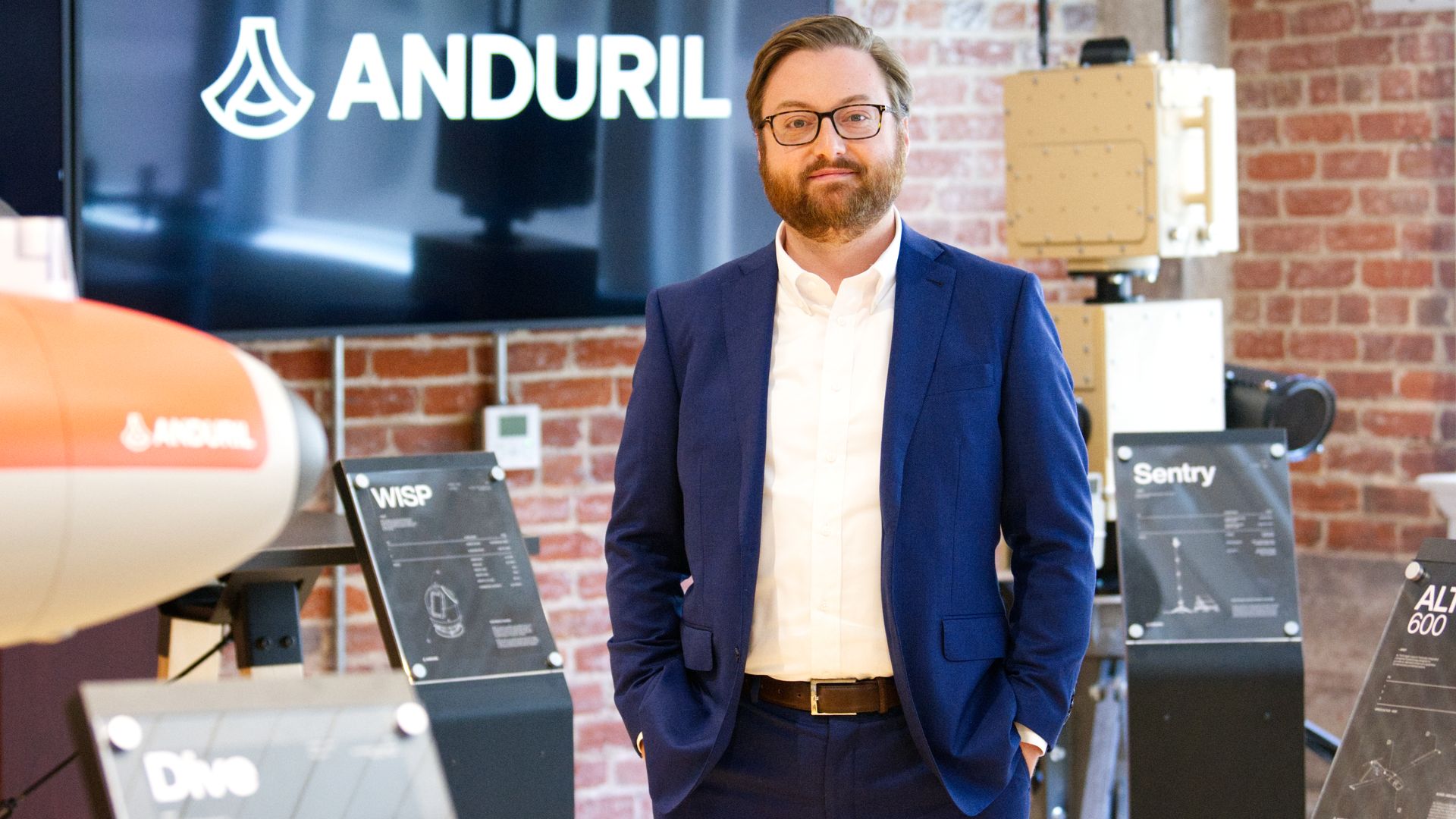
Brian Schimpf, seen among Anduril Industries products in Washington. Photo: Colin Demarest/Axios
Keeping abreast of the evolving defense landscape requires talking to those shaping it.
- Our first conversation is with Brian Schimpf, the chief executive at Anduril Industries.
- We chatted recently at the company's offices in Washington. He had a cold brew coffee; I had a Celsius energy drink.
Why he matters: Schimpf leads what may be the splashiest defense contractor of the moment.
Q: When will wars be waged solely by robots?
A: My take is never. The argument for that is: Wars are about accomplishing some political end. That is the objective, and that is about forcing humans to capitulate in some way. That is ultimately what most wars are fought over. So I think in that end, there's always a human dimension to warfare.
Q: What's the biggest challenge the defense industry faces? What can be done to alleviate it?
A: We have a military that is addicted to exquisite, very high-end, very irreplaceable systems. These are becoming increasingly unaffordable. The timelines to field them are becoming longer and longer and longer.
- That is causing, in many ways, an over-concentration of the industrial base and making it so the U.S. cannot be as responsive as it needs to be to changes in warfare.
Q: What's a national security trend we aren't paying enough attention to?
A: Allies and partners, I think, are probably the most underserved part of what the U.S. national security strategy needs to take into account.
- The way they fight, the way they operate, what they can afford, and the problems they have to tackle are very different than what is the U.S. problem.
- They face a much more defensive and short-range problem. So the equipment and technology that [the U.S. builds] is not always fit for purpose for what they need, and they can do with much cheaper systems that can actually start to solve their problems.
- But it's nobody's job to sort of equip Poland or Estonia or Finland or Sweden, right? It's their own job. But they are often utilizing the fact that America has led the way on technology development. Nobody's looking at what is the technology that they need to be successful for their national security needs.
Q: How many emails do you get a day? And how do you deal with them?
A: I get a shockingly few number of emails a day because Anduril is not an email company. But I get thousands of Slacks a day.
- That one is very much about consuming the right information in very high quantities, and it's something I happen to be really good at. But we are fortunately not an email-heavy culture. In fact, everyone I know in tech has basically written off email as too old school.
Q: What's your secret to a successful overnight flight?
A: Don't do them is the No. 1 secret. If you have to? Sleep every minute you can because you're just going to be miserable no matter what.
Q: What time do you wake up? What does the morning routine look like?
A: I wake up around 6:30 or 7am with my two small children, ages 3 and 5.
They get up at 6:30-7 every morning, and I actually really try to spend time with the kids in the morning because they're generally in a pretty good mood — kind of sit with them, eat breakfast. It's actually a pretty nice routine. Then I head off to work, 7:30, 8 o'clock. It's great.
Q: What's a piece of gear or tech you can't go without?
A: I have an extremely boring answer, which is obviously my iPhone. But I've gotten obsessed with having chargers that actually work on airplanes and don't blow the circuit out. I have found one, and it's incredible.
Q: What are you currently reading, or what's a book you'd recommend?
A: A book I finished recently that I really enjoyed was "Stranger in a Strange Land," by Robert Heinlein. It's a great sci-fi book, and it kind of is exploring if Martian society was real, and different versions of society and how that plays out. It was a really interesting book.
- I've been trying to plow my way through all the classic sci-fi novels. That one was high on the list.
Q: What advice would you give your younger self?
A: It's pretty cliche, but what's worked out for me has been: Just get on the biggest opportunity, the fastest rocket ship, and just work on hard problems. It turns out that's really fun. It's really exciting. You meet very smart people, who are actually learning with you. It's a really great time.
