Analysis: Poverty rates much higher in nation's most Latino cities

Add Axios as your preferred source to
see more of our stories on Google.
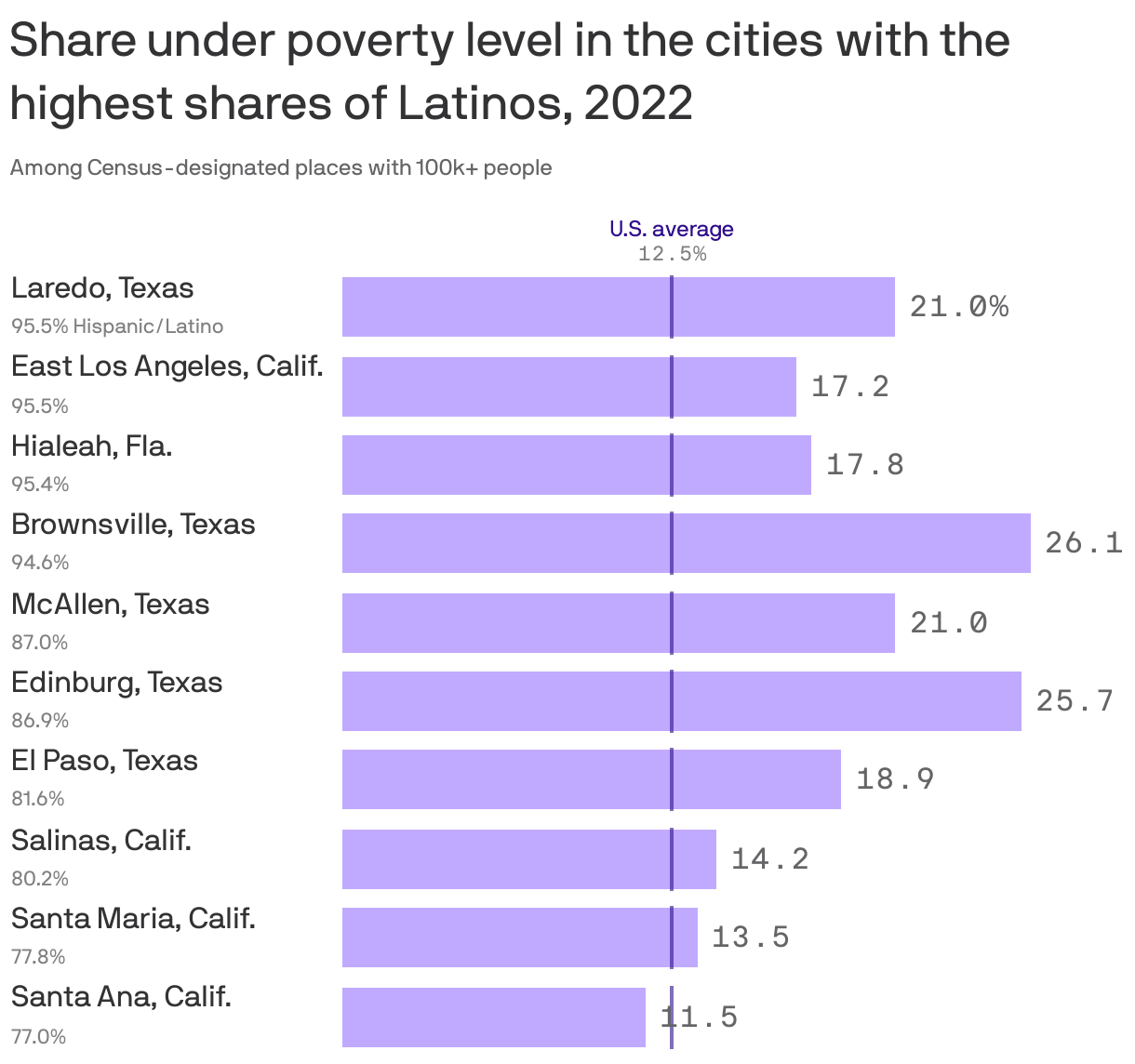
Ten of the country's communities with the largest share of Latino residents have a poverty rate that's 50% higher than the national average, an Axios review of the latest census estimates has found.
Why it matters: The latest data shows millions of Hispanics continue to struggle economically despite overall declines in U.S. Latino poverty rates.
- Latinos make up 19% of the population and are set to form a plurality of the country's population by midcentury, but experts say a lack of discussion on Latino poverty is allowing inequalities to fester and grow.
Zoom in: An Axios analysis of 10 census-designated places with 100,000 or more residents with the highest percentage of Latinos had an average poverty rate of 18.7%.
- That's well above the nation's overall poverty rate of 12.5% and higher than the 17.2% for all Latinos, based on the Census Bureau's 2022 5-year estimates.
By the numbers: East Los Angeles, an unincorporated community, and Laredo, Texas, had poverty rates of 17.2% and 21%, respectively. Both communities have the nation's highest percentage of Latino residents at 96%.
- Hialeah, Florida, a city near Miami where 95% of residents are Latino, had a poverty rate of 17.8%
- Brownsville, a South Texas city where 95% of residents are Latino, had a poverty rate of 26.1%
- Edinburg, another South Texas city where 87% of residents are Latino, had a poverty rate of 25.7%.
What they're saying: High cost of living, lack of access to health care and fewer resources plague cities like these, Diana Caba, vice president for community and economic development for the Hispanic Federation, tells Axios.
- Caba said to combat those factors, communities leaders need to push financial literacy, building wealth strategies and financial engagement.
- "Without access or that path to economic mobility, (we're) just going to perpetuate that cycle."
The intrigue: Only one community in the top ten most Latino cities, Santa Ana, California, had a poverty rate below the national average of 11.5%.
- In recent years, the city has seen a growth in college-educated Latinos and new Hispanic-owned businesses moving into the community just southeast of Los Angeles.
Zoom out: Latinos in recent years have significantly grown in their workforce participation rate and graduated from college in higher numbers, helping drive the overall decrease in the Hispanic poverty rate.
- The percentage of Latinos in poverty hovered around 22% for much of the 1970s but shot up to 29% in the 1980s as the population kept growing.
- It hit its highest mark in modern times in 1994 — 30.7% — following the recession of the early 1990s and a spike in new migration from Mexico after the Mexican peso devaluation crisis.
Yes, but: The persistence of poverty in the nation's most Latino cities shows poor and low-wage workers aren't getting the needed attention from elected officials, William Barber of the Poor People's Campaign tells Axios.
- "We continue to neglect poverty in these areas, whether it's Central California, or Appalachia, or the (Mississippi) Delta."
- Barber said poverty is falsely seen as a marginal issue that affects few people but will continue to be passed down to the next generation unless people demand it be addressed.
Subscribe to Axios Latino to get vital news about Latinos and Latin America, delivered to your inbox on Tuesdays and Thursdays.
