Charging limits could help fix a big EV headache

Add Axios as your preferred source to
see more of our stories on Google.
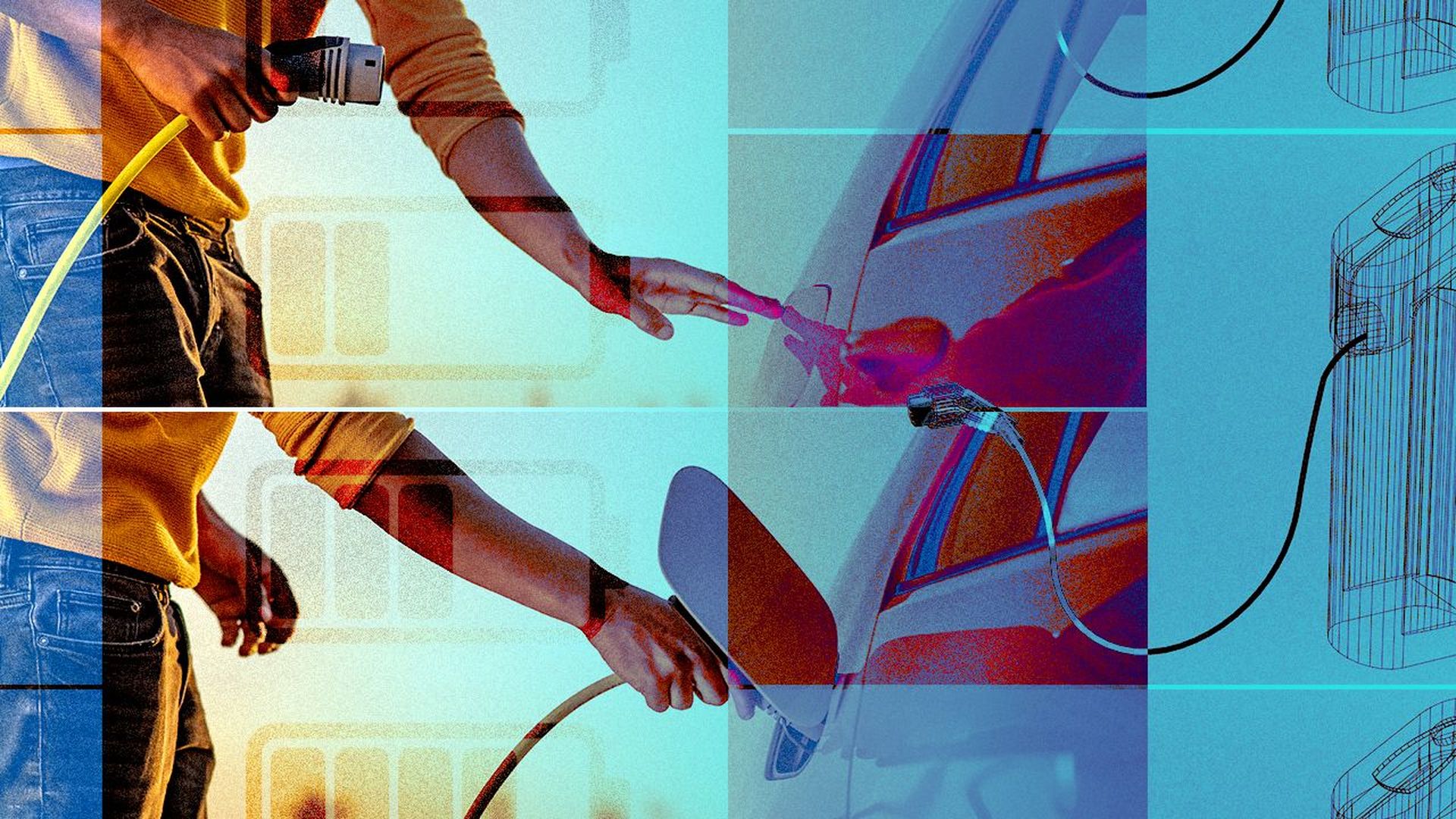
Illustration: Natalie Peeples/Axios
While electric cars are becoming more common, social norms about vehicle charging are still being established.
Why it matters: EV knowledge gaps have befuddled new owners trying to figure out proper etiquette at public charging stations.
Friction point: One of EV owners' biggest complaints is about others "hogging" space at crowded charging stations by leaving their car plugged in even after their battery has been fully charged.
- Another gripe: people who snag the highest-output chargers when their car can't accept power at the fastest rates.
- It's like driving a Prius 50 mph in the left lane — all it does is tick off other motorists.
Yes, but: It's usually not malice driving such behavior. People just don't know any better.
Driving the news: To ease congestion at popular charging stations, charging network operator Electrify America is testing a strategy that would automatically end customers' charging sessions when their battery hits 85%.
- Why 85%? It's close to the threshold when charging automatically slows down anyway to protect batteries from overheating.
- Adding that final 15% means you'll be waiting much longer, potentially blocking access for another driver.
- And, under EA's plan, you'll incur a fine if you loiter too long at some stations.
Zoom in: The pilot is underway at 10 of EA's busiest charging locations in Southern California.
- These neighborhood stations tend to support the daily charging needs of EV owners who don't charge at home, Rachel Moses, Electrify America's senior director of marketing and sales, tells Axios.
- That could be because they don't have a charger at home, or because they want to take advantage of free charging services that came with their car.
- Highway charging sites are not subject to the 85% cutoff, Moses noted, because some drivers need 100% battery range to reach their destination on long trips.
How it works: The plug will automatically shut off when the car's battery reaches 85%.
- If you unplug and try to plug back in, the charger won't restart.
- You'll get a 10-minute grace period to move your car, after which you'll be hit with "idle fees" of 40 cents per minute.
Between the lines: All EVs have their own charging curve, which can be affected by temperature, battery health and how full the battery is.
- When a car gets plugged in, it draws electricity slowly at first, then ramps up to its maximum charging speed, before slowing dramatically as it nears full capacity.
Zoom out: Charging stations have different speeds too.
- A bank of chargers typically offers an array of power levels, ranging from 50 kW to 350 kW.
- If you know how fast your car can accept electricity, you should select the appropriate charger.
- Most EV owners have no idea, though, so they naturally choose the "fastest" plug available.
The catch: Your car won't charge any faster than the rate it's designed to handle.
The intrigue: Drivers have long been conditioned to "fill up" their tank.
- Naturally, they're going to feel shortchanged if a charger cuts them off at 85%.
- Chargeway founder Matt Teske, whose company's mission is to simplify charging, suggests EV companies should market their cars' range at 80% capacity, with a "bonus battery" that offers an extra 20% for longer trips.
- Instead of feeling cheated, consumers would perceive a "win," he tells Axios.
The bottom line: There's an arms race among automakers to offer longer and longer driving ranges for their EVs, so it's unlikely they'll voluntarily scale back their pronouncements.
- But they have an obligation to educate people more about EV charging.
- In the meantime, charging limits could nudge drivers' behavior in the right direction.
