Climate change disrupting housing markets, insurance industry

Add Axios as your preferred source to
see more of our stories on Google.
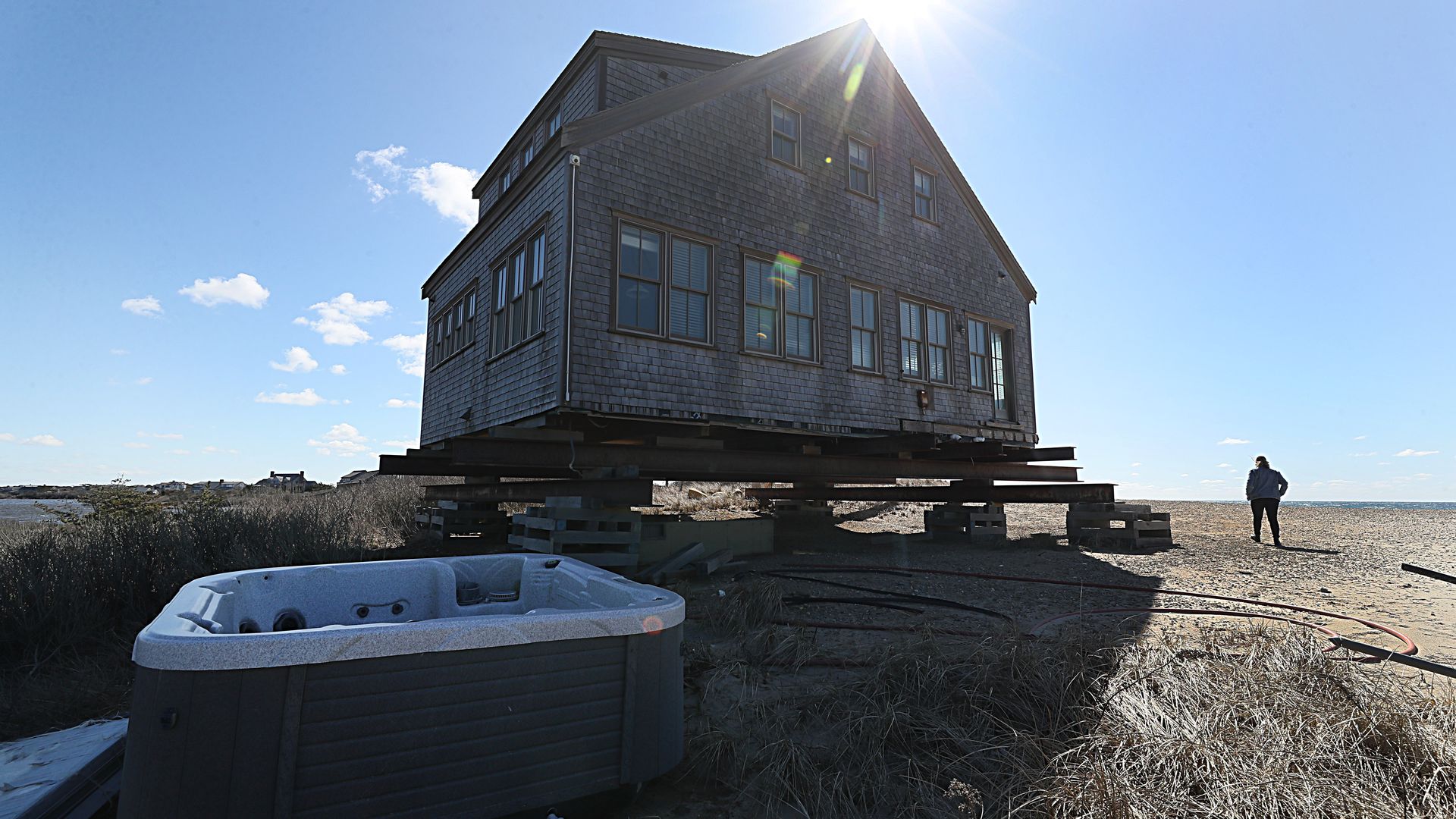
A home in Cisco, Mass., in March that was designated to be demolished after erosion made it impossible to save. Photo: Suzanne Kreiter/The Boston Globe via Getty Images
A house on the New England island of Nantucket that was valued at $1.9 million but recently sold for $200,000 has brought U.S. coastal erosion concerns into focus.
Why it matters: Climate risks bring the "potential for widespread property value declines in coastal areas" and "constitutes a major economic threat," per Alice Hill, an expert on energy and the environment at the nonprofit Council on Foreign Relations.
- Hill noted in an email Thursday that 40% of the U.S. population lives in a coastal county.
Driving the news: The late June sale of the $200,000 Nantucket home comes months after a house valued at $2.2 million on the same street sold for $600,000. Another last October had to be demolished due to "extreme erosion" along the Massachusetts island's southwest shoreline, the Nantucket Current reports.
- Only "a couple of waterfront areas" are experiencing extreme erosion on Nantucket, and property values "are going up across the island," said Shelly Lockwood, a Nantucket real estate broker who helped develop a coastal resilience class for local agents on erosion and rising sea levels.
The big picture: Sea-level rise, a tangible effect of climate change, is accelerating across the U.S., per Christopher Hein, a coastal geologist at the Virginia Institute of Marine Science, William & Mary.
- What's happening in Nantucket, a popular place to have summer houses among celebrities and billionaires, can be seen across the U.S.
- In the Outer Banks of North Carolina in May, officials had to close a stretch of beach after a sixth house collapsed into the sea due to erosion.
- Other coastal erosion hot spots include parts of California, like Dana Point, south of Los Angeles, and Plum Island, northern Mass.
- A new economic model from Duke University found that tax incentives for high-income property owners, coupled with federal subsidies for storm and flood damage mitigation, have driven coastal property prices higher despite rising climate risks, per a March study.
Threat level: Sea-level rise will allow waves from storms to reach higher up on beaches or dunes, causing more erosion, said Hein, a Wakefield associate professor of marine science, via email.
- The rise will accelerate the drowning of low-lying lands, per Hein.
- Hill said climate change brings more extreme weather. That puts property insurance companies at greater risk of loss and they may need to raise premium rates to remain profitable.
- She noted property insurers lost money in 18 states last year. To stay profitable, they can raise premiums to cover increased losses, though not all hikes are due to climate change (like recent Midwest increases related to hail damage).
Between the lines: Several factors can influence the sensitivity of a section of coast to sea-level rise and storms and, thus, its rate of erosion, per Hein.
- For instance, southwestern Nantucket is low-lying with relatively loose sand. It's vulnerable to the exposure of waves, particularly during storms along the Atlantic-facing coast, according to Hein.
- In New England and along much of the East Coast, nor'easters are the most common storms, leaving northeast-facing coasts most exposed, Hein said.
- The science is still unclear on whether nor'easters are growing in frequency and/or magnitude with climate change, but Hein said if this proved to be the case it would pose additional risks for erosion.
- If "erosion rates are at all factored into housing values ... then you would expect to see differential impacts" on housing values, Hein said.
The bottom line: Hill noted that the past decade has seen the hottest years on record.
- "Human-caused pollution will drive further temperature increases," she said.
- "With more heat, comes more severe storms and accelerating sea-level rise, both of which lead to increased storm surge and coastal erosion," Hill added.
- "This can occur in places that have not yet experienced significant erosion like rocky coasts, estuaries and inland areas along coastal rivers, and historically stable cliffs."
What we're watching: Martin Smith, a professor in environmental economics at Duke University who co-developed the model that found coastal property values were increasing, said in a statement that it's "not a matter of if, but when coastal communities approach complete inundation."
- He added: "The question is: are there more effective ways to manage coastal areas in the next few decades that could smooth this transition?"
- Hein said he wasn't aware of any examples of any "true local collapse" in housing values due to erosion or storms in the U.S. and the indications are that "we remain in a state of resisting erosion" through "pricey approaches "such as beach nourishment and shoreline hardening."
- Realtor Lockwood said while many current owners are "having a hard time wrapping their heads around the decline in value their homes," she believes the market will overcome challenges.
- Lockwood told Boston.com on Tuesday that the solution for some owners has been to "pick up houses and move them."
