America's wage boost: There are fewer low-wage workers in the U.S. now

Add Axios as your preferred source to
see more of our stories on Google.
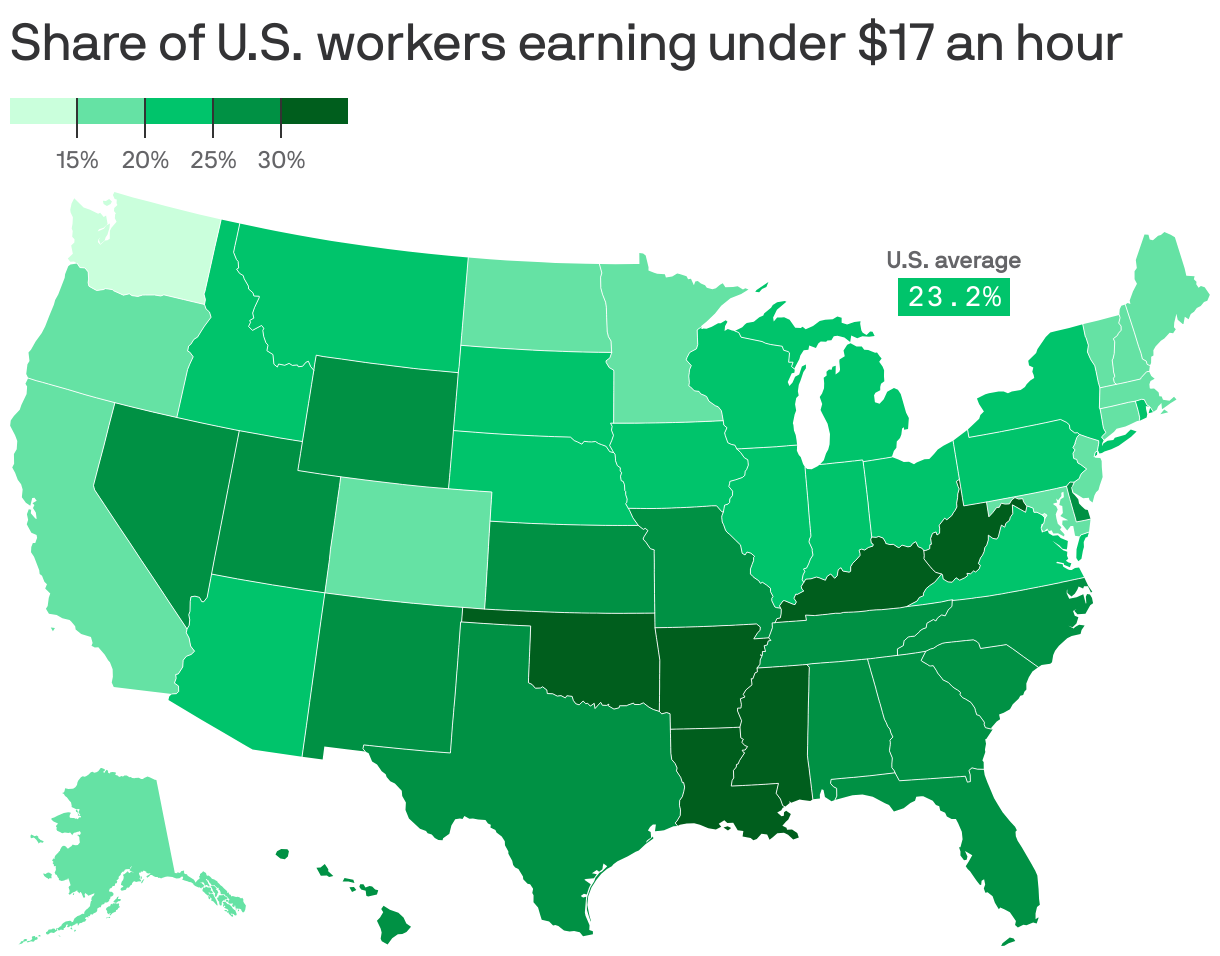
Just 13% of workers in the U.S. are now earning less than $15 an hour; two years ago, that number was 31.9%, per new data from Oxfam.
Why it matters: Even accounting for inflation — $15 an hour in 2024 has the same buying power as about $14 in 2022 — this is remarkable progress.
- It is, of course, meaningful for the millions of Americans who need (and typically spend) every additional dollar they earn.
Zoom in: Oxfam revised its definition of a low-wage worker this year, from those earning less than $15 an hour to those earning less than $17.
- Fewer than 1 in 4 workers in the U.S. now fall into that category, the group says. That's more than 39 million people, including 34 million who are over age 20, according to the report. (In 2022, many more workers — 52 million — earned less than $15 an hour.)
- Oxfam's report, released Wednesday, analyzes both Census Bureau and Labor Department data to look at the state of low-wage workers in the U.S.
The big picture: Wages are higher now in part because of inflation, and a strong labor market where lower-wage employees are still in high demand. But it's also due to the work of advocates who pushed for minimum wage increases for more than a decade.
- Plus: Pandemic-era benefits helped these workers be more choosy about finding better-paying jobs coming out of the record unemployment of 2020.
- "Because people had more money, they were able to hold out for higher-paying positions," says Kaitlyn Henderson, a senior researcher at Oxfam, who wrote the report.
Zoom in: The states with the highest proportion of low-wage workers include those like Mississippi, Oklahoma and Texas, which go by the federal minimum of $7.25 an hour — that low-wage floor pulls down pay for other lower-wage earners.
- Other states have far higher minimum wages. Washington state's minimum wage is $16.28, for example, and only about 11% of its workforce is earning less than $17 an hour, per Oxfam.
Things have changed so much that Fight for 15, the group founded more than a decade ago to raise the minimum wage to $15 an hour, changed its name this year to Fight for a Union.
- Sen. Bernie Sanders (I-Vt.) recently introduced a bill that proposed raising the federal minimum wage to $17 an hour by 2028.
Reality check: Though wages are up, low wages are still, well, low.
- These folks are facing much higher prices for essentials like food and housing.
- Oxfam hardly sees these numbers as acceptable — the report is titled "The Crisis of Low Wages." The group is advocating for increases to the minimum wage and other changes.
- And under the hood, there are huge inequities in these numbers: 33% of low-wage workers are Hispanic, and 32% are Black. Women are also overrepresented.
