One-third of U.S. military could be robotic, Milley predicts

Add Axios as your preferred source to
see more of our stories on Google.
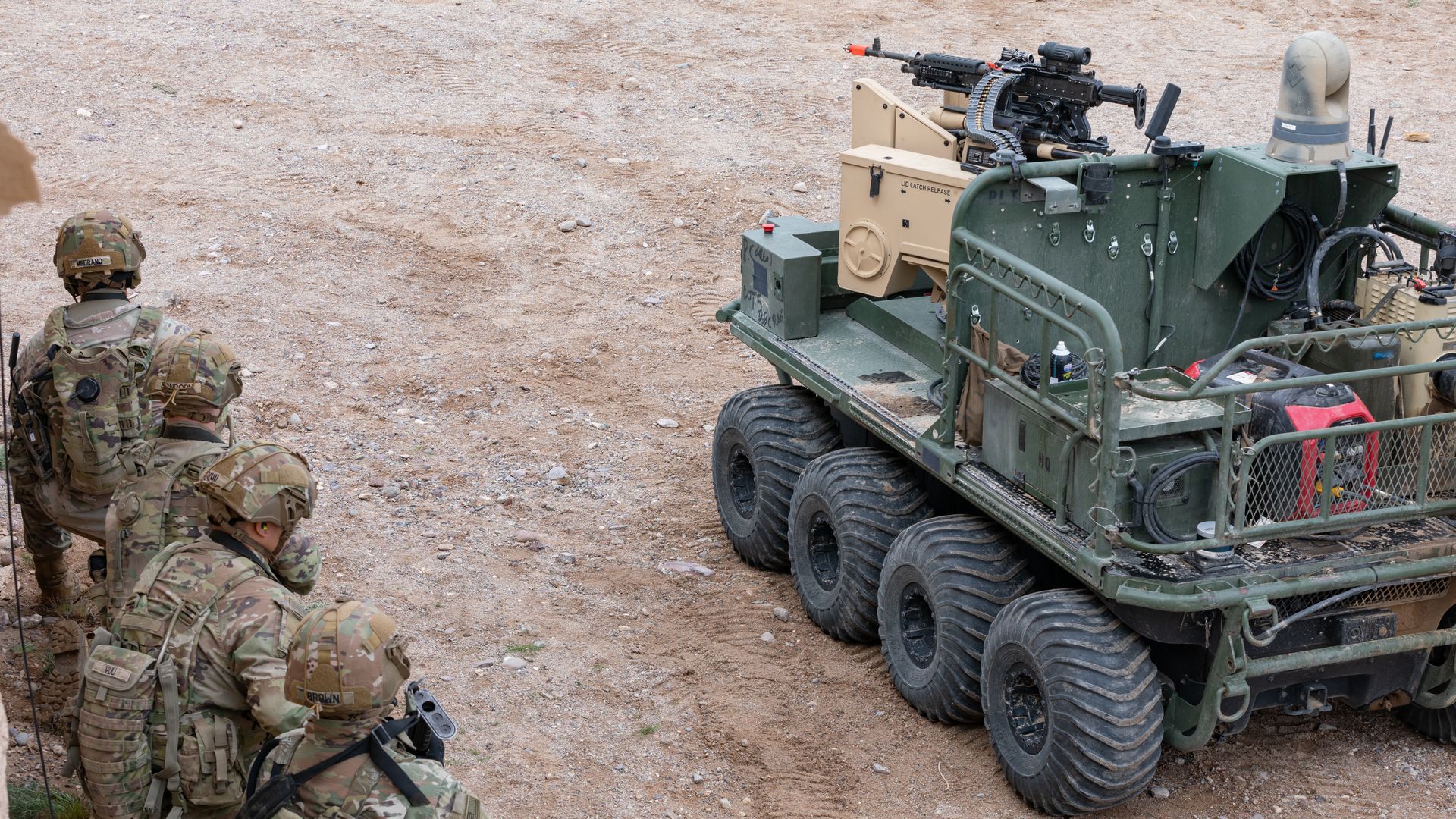
Troops work alongside an all-terrain uncrewed transport vehicle at Fort Irwin, Calif. Photo: Samarion Hicks/DVIDS
Robots and other smart machinery will comprise up to one-third of the U.S. military in the next 10-15 years, retired Army Gen. Mark Milley, a former chairman of the Joint Chiefs of Staff, said at an Axios event today.
Why it matters: Such widespread adoption of unmanned and artificial intelligence-fueled tools of war would be a major reshaping of the force — one that would also raise serious ethical questions.
What they're saying: "It'll be a fundamental change, and I would argue that other nations' militaries are going to be similarly designed," Milley said at Axios' Future of Defense event.
- The number of human troops, he added, "will probably be reduced as you move toward robotic systems."
Catch up quick: Militaries have for years tinkered with armed drones, robo-dogs, mechanical mules and more. They now look more viable than ever, with an alley-oop from a digital-first defense industry.
- The Army is experimenting with what's known as human-machine integrated formations, where soldiers fight alongside automatons.
- The Air Force is seeking so-called "collaborative combat" aircraft that can fly alongside human pilots to collect intelligence, confuse enemy electronics and even blow up targets.
- The Navy is in pursuit of a hybrid fleet, with unmanned surface and underwater vehicles augmenting the firepower of sailors and Marines. One pioneer is Task Force 59 in the Middle East.
Friction point: A crew-less tank or pilot-less fighter jet paired with ultra-fast decision-making software stokes fears of killer robots. But safeguards are in place.
- U.S. policy requires a human to pull the trigger. And robotics have wider applications: schlepping supplies far from the front lines, for example, or hauling injured fighters off the battlefield.
- "I lean toward humans in the loop," Milley said of weapons oversight. "But I think this is going to be something that people are going to have to come to grips with here in the next decade or so."
Bottom line: "The country that optimizes those technologies for military use is going to have a very significant — and potentially decisive — advantage in an armed conflict," Milley said.
