Rift between press and Biden team deepens over age story

Add Axios as your preferred source to
see more of our stories on Google.
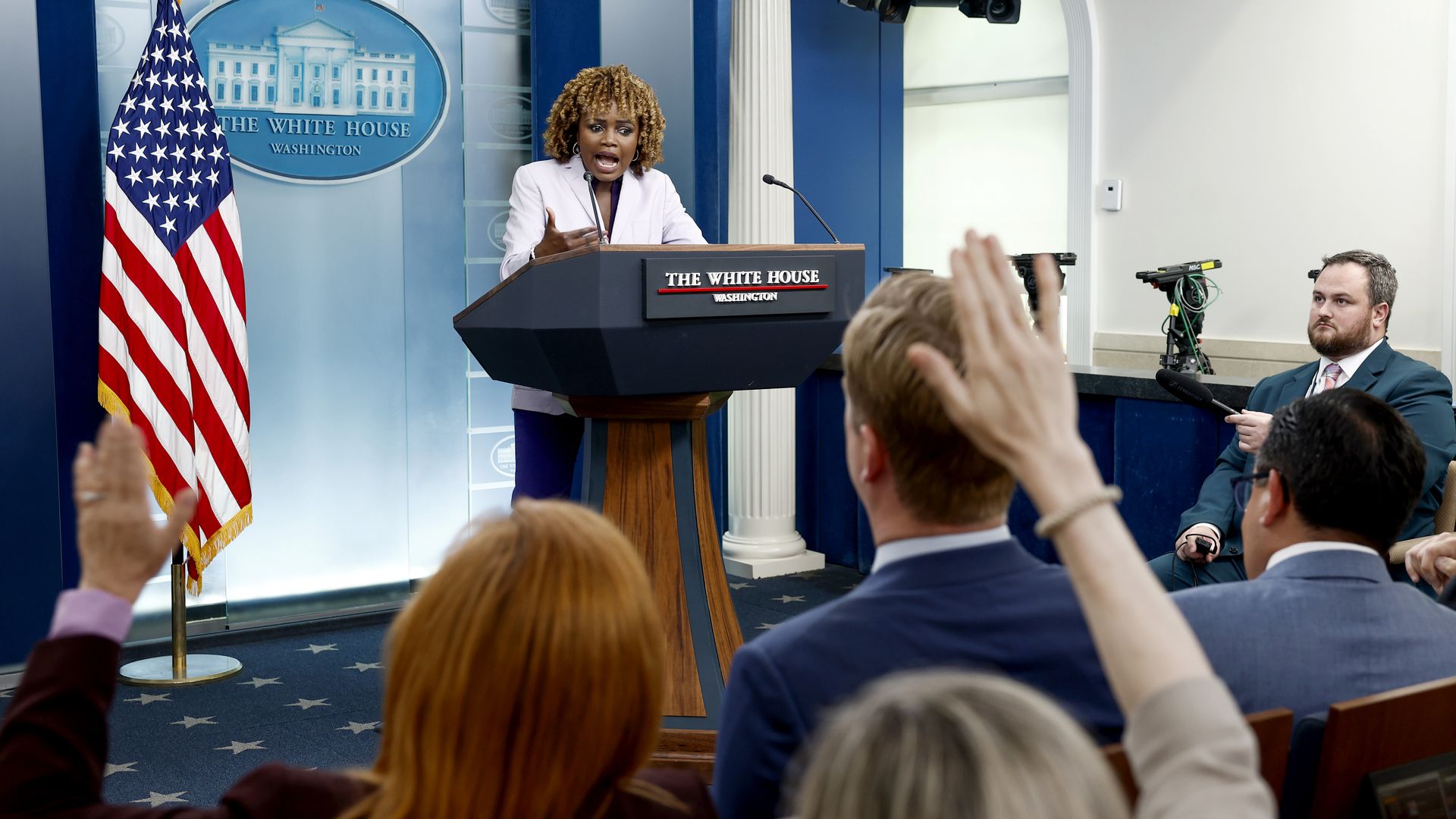
White House Press Secretary Karine Jean-Pierre speaks during a daily news briefing at the White House yesterday. Photo: Anna Moneymaker/Getty Images
A testy exchange between reporters and White House press secretary Karine Jean-Pierre Monday highlighted growing tensions between the press corps and the White House over coverage of Joe Biden's age.
Why it matters: Biden's debate performance amplified reporters' existing frustrations about a lack of transparency and access to the president.
- The increased coverage of the issue, and Democrats' opinions about it, validated the White House's longstanding belief that the press is overly focused on Biden's age to fill a controversy vacuum in the wake of Trump's 2020 election loss.
Catch up quick: For months, reports have highlighted tensions between the Biden White House and the press, specifically The New York Times.
- The conflict is rooted in clashing views of the best way to support democracy, according to a half dozen White House reporters Axios spoke with about the issue.
- Washington reporters see their role as asking tough questions to get at the truth from whoever is in power, regardless of party.
- The Biden team views Trump's threat to democracy as so great that the media should concentrate coverage on Biden's opponent rather than his age.
Zoom in: The exchange between Jean-Pierre and reporters in the White House press briefing room Monday highlighted that conflict and shed light on other challenges.
- Reporters in the room were frustrated that Jean-Pierre refused to confirm whether a Parkinson's expert visited the White House eight times between last July and March, a revelation made via public visitor logs cited by The New York Times.
- Several White House reporters Axios spoke with noted that Jean-Pierre's handling of the question felt unnecessarily deflective.
- Instead of assuring the press they would get more details later, Jean-Pierre argued that providing details about the purpose of the visits would be a security and privacy issue.
- The White House later Monday released a letter from the president's doctor stating that Biden has never been diagnosed with or treated for Parkinson's and that the expert regularly visited the White House "as part of this General Neurology practice... in support of the thousands of active-duty members assigned in support of White House operations."
- Meanwhile, White House officials felt the reporter's tone in questioning the press secretary was unprofessional.
Between the lines: White House reporters Axios spoke to generally agreed that Jean-Pierre's predecessor, Jen Psaki, was skilled at handling those types of questions in a less evasive way. "We were spoiled with Jen," one told Axios. "She made that first year and a half a joy."
- Some reporters have speculated that Jean-Pierre isn't as read in on Biden's inner circle as her predecessor, although White House sources have argued that isn't the case.
- Others have wondered whether Jean-Pierre's background as a political operative and not a longtime political communicator plays a role.
Zoom out: Outside of the briefing room, a separate dust-up between a Biden campaign communicator and a journalist also spilled over publicly.
- In her Sunday column, New York Times op-ed columnist Maureen Dowd wrote that Biden campaign spokesperson TJ Ducklo asked her to remove the word "goodest" from her story. Ducklo argued that the word Dowd said Biden uttered during an interview with ABC's George Stephanopoulos was later removed by ABC in its transcript of the event.
- These types of exchanges between reporters and communications staff are typically kept private. Dowd included it to show how difficult it has become to interpret Biden's speech. The discrepancy, she wrote, is "a harbinger of tense times between a White House in bunker mode and a press corps in ferret mode."
Between the lines: Reporters cite Ducklo and his counterpart at the White House, Andrew Bates, as having more aggressive communication styles than the rest of their team when dealing with journalists, although both get credit for being responsive.
- While it's not uncommon for the press and representatives of those in power to have combative exchanges, their bulldog approach to defending the president is seen by some in the press as a reflection of the Biden camp's overly protective tactics for defending the president on the age issue.
- Several reporters alleged the White House leverages allies to debunk reports they don't like on social media. A Wall Street Journal story from early June citing Republicans detailing Biden's signs of "slippage" was noted by one source as an example where the White House called reporters to privately seed pushback about the story.
- More recently, the White House went around its normal processes and drafted questions for Biden's first post-debate interview with a Black radio station last week.
What they're saying: In a statement, Bates defended Jean-Pierre, arguing she "takes hard questions day in and day out, giving thorough answers and representing President Biden and his agenda for the American people with grace and integrity."
- He argued the president has done more press gaggles than almost any other president and noted that Biden has "proudly fought for the rights of journalists in the world and spoken forcefully about the 'critical' role of the press in American democracy — rather than slander them as 'enemies of the people.'"
- "In line with those values, his team reinstated daily press briefings and works hard to be informative and factual, including by releasing more documentation on policy than at any time in American history," he added.
- We also take care to listen to reporters as they honor their important role of seeking more information. Joe Biden has always said that it is fair for reporters to ask about his age and has always confidently put his values and agenda to the American people."
The bottom line: Biden's debate performance elevated conservative critiques that many reporters ignored signs of cognitive decline, Axios' Jim Vandehei and Mike Allen reported.
- That dynamic has made reporters particularly sensitive to any tactics used by Biden's press minders to deflect questions around his age or agility.
- It has also reaffirmed Biden officials' beliefs that the press is overly focused on what they see as clickbait age stories rather than on coverage of Trump's threats and lies.
Editor's note: This article has been corrected to reflect that it was ABC's transcript of Biden's interview with George Stephanopoulos (not of the debate) that, Ducklo argued, omitted a word Dowd said the president had uttered.
