Schools ban phones, but do the policies work?

Add Axios as your preferred source to
see more of our stories on Google.
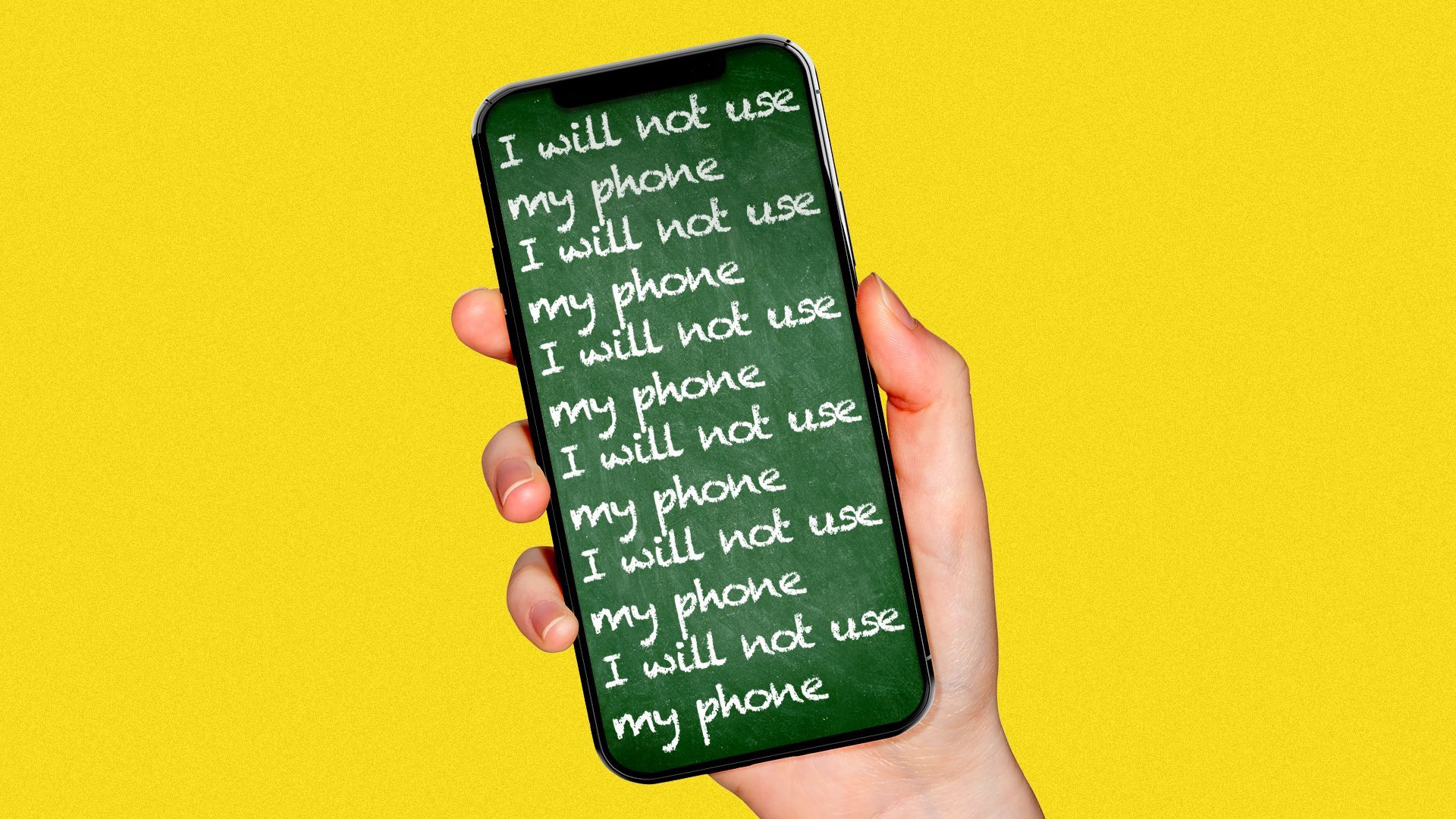
Illustration: Sarah Grillo/Axios
Cities, states and school districts are passing sweeping bans on cellphones in schools, aiming to get kids to pay attention during class and socialize with their peers IRL.
Why it matters: School cellphones policies are a difficult flashpoint: On one hand, the phones can be a useful learning tool and essential parent lifeline; on the other — well, they're a pretty obvious distraction.
Driving the news: It's suddenly gotten trendy to ban phones in school or make students lock them in a Yondr pouch — sometimes just in classrooms, but increasingly everywhere in school buildings throughout the day.
- Florida and Indiana were the first states to restrict phone use in schools. California and New York may soon follow.
- Los Angeles voted to enact a ban that'll start this spring. New York City — the nation's largest school district, with 1.1 million students — plans to follow suit.
- The Phone-Free Schools Movement, founded by three moms, aims to make the policies spread.
What they're saying: "They're not just a distraction. Kids are fully addicted now to phones," NYC schools chancellor David Banks recently said on "Good Day New York."
- "I have talked to hundreds of principals around the city who have said, 'Take the phones.'"
- "I've talked to parents around the city, who I thought were going to be the biggest folks to push back. They've said, 'We recognize it as well.'"
State of play: Parents are actually the biggest obstacle to cellphone bans in schools — they want to be able to reach their kids and keep track of them.
- Students (naturally) don't want to give up their phones, but many agree that no-phone policies help them stay focused.
- Teachers and administrators are thrilled with the government-mandated restrictions — but worry about being turned into phone cops, policing their schools for contraband.
Where it stands: "In California, a high school teacher complains that students watch Netflix on their phones during class. In Maryland, a chemistry teacher says students use gambling apps to place bets during the school day," per the Associated Press.
- But teachers are also trying to show kids how to use the internet safely and wisely, and phones in the classroom could help.
- Florida's law mandates lessons for students in "how social media manipulates behavior."
Case study: Orange County, Florida, was one of the first districts to ban phones throughout the school day — not just during class time, per the New York Times.
- Before the ban, "students rarely looked up from their devices as they walked down school hallways," the Times reported. "Some teenagers covertly filmed their classmates and spread the videos on apps like Snapchat."
- "We saw a lot of bullying," Marc Wasko, the principal of Timber Creek High School in Orlando, told the paper. "We had a lot of issues with students posting, or trying to record, things that went on during school time."
- Since the ban, students "now make eye contact and respond" when the principal greets them, and "teachers said students seemed more engaged in class."
- The downside: the school seems more prisonlike, with students going to the front office for permission to make calls and a security officer patrolling school grounds in a golf cart, confiscating phones during lunch hour.
Yes, but: Smartwatches and laptops can provide similar distractions to cellphones.
Case study #2: In Gorham, Maine — where there's no official ban on phones — high school students came to the administration to request voluntary sequestering of phones during class time.
- There are now "phone hotels" in each classroom where students leave their devices at the beginning of class.
- "They police themselves," Heather Perry, superintendent of the Gorham Public Schools, tells Axios. "This is their idea, they wanted it."
- The practice has "been wonderful," Perry said. "The students have reported feeling good about it, less distracted, more engaged."
Between the lines: The debate over phones in schools is tied to the debate over whether social media is causing depression and other mental health problems in children.
- A new book by NYU social psychologist Jonathan Haidt, "The Anxious Generation," argues that the new "phone-based childhood" is extremely harmful, with social media a major culprit.
- He recommends keeping smartphones away from kids til high school, giving them flip-phones in middle school instead.
- His influential article last year in The Atlantic, "Get Phones Out of Schools Now," argued that phones "impede learning, stunt relationships, and lessen belonging."
Even one of Haidt's many critics — Michael Rich, the pediatrician who founded the Digital Wellness Lab at Boston Children's Hospital — agrees that "smartphones have no business in schools."
- While he thinks kids should be allowed to have smartphones because they're an integral (and helpful) part of modern life, they're "only a distraction" for the main tasks at school, which include didactic learning, he tells Axios.
- "One of the things I find really upsetting is going by a school playground seeing a bunch of kids all on their phones," says Rich.
- The only exception? Lessons in using cellphones: "Schools need to help kids learn to use these powerful tools in ways that are effective."
The other side: There should be a middle ground in which phones are allowed in the classroom for pedagogical purposes, but not for others, argues Peter Gray, a research professor at Boston College who specializes in child psychology and the value of play.
- "The internet is the most powerful educational tool we have, and the phone us allows us to carry the internet in our pockets," Gray tells Axios. "I wouldn't want the phone taken away from me."
- He opposes Haidt's recommendation that parents delay giving phones to their children.
- "If we think we're going to solve the problem by taking cellphones away from kids, we're not," Gray said. "If anything, were adding to their anxiety."
Fun fact: Phone restrictions for schools are a rare policy with bipartisan support, endorsed by both Republican governor Ron DeSantis of Florida and Democratic governors Gavin Newsom of California and Kathy Hochul of New York.
The bottom line: It's clear that nobody has figured out the right role of phones in schools, which is essential now that these devices are such an integral part of our lives.
