Post-debate bumps are real, but no guarantee

Add Axios as your preferred source to
see more of our stories on Google.
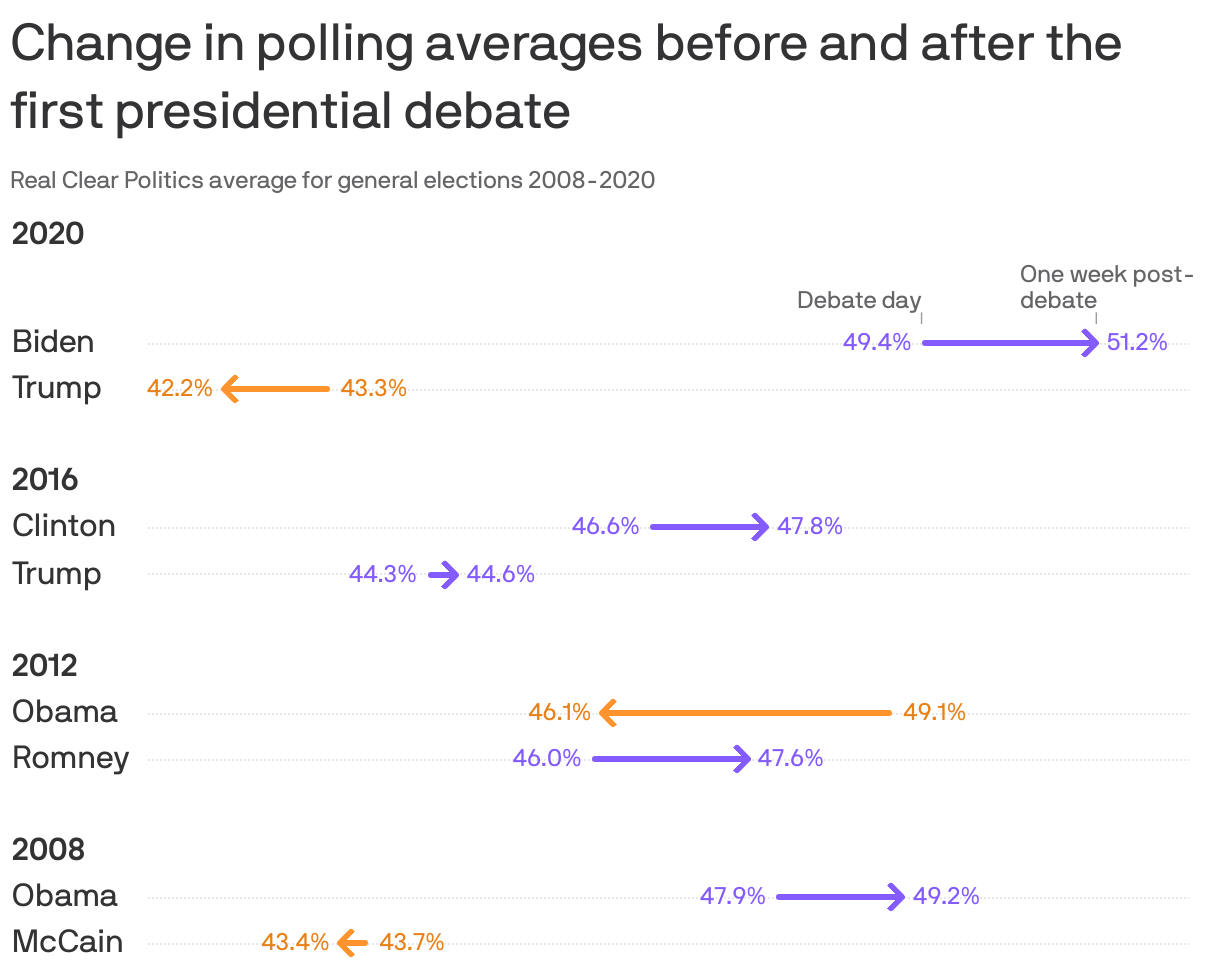
The biggest post-debate polling bump in the last four presidential cycles helped Mitt Romney, the Republican nominee in 2012, make up an average of 4.6 percentage points in national polls.
- But Romney's lead over then-President Obama didn't last.
Why it matters: A good (or bad) first debate can show up in the polls a week after the debate, according to the Real Clear Politics average of national polls.
- It doesn't seal the fate of either candidate, however.
- Obama recovered from an uninspired debate effort in 2012 and built a healthy lead in the national polls, which translated into a victory on Election Day.
- In 2020, Joe Biden increased his lead over then-President Trump after their first messy meeting with a net gain of nearly 3 points, after coming into the debate with a 6-point advantage.
Flashback: After Trump's first showdown with Hillary Clinton in 2016, watched by a record 84 million viewers, Clinton saw a net gain of about 1 point nationally, adding to her lead.
- That polling dynamic persisted until Election Day, when Clinton had a 3.2-point average advantage nationally.
- But Trump shocked many political observers, and some inside his campaign, by winning more electoral votes while losing the popular vote by 2.1 points.
- When Obama was a rising Democratic star in 2008, he saw a slight polling uptick after his first debate with Sen. John McCain (R-Ariz.). Obama held on for victory that November.
Zoom out: Debates don't happen in a vacuum, and other events influence voters' opinions.
- McCain's suspending of his campaign in late September 2008 because of the global financial crisis arguably affected that race more than the debate.
- The pandemic loomed large in the Trump-Biden race in 2020.
A solid performance in a second debate can help voters forget about a subpar first one, as then-President Reagan showed against former Vice President Walter Mondale in 1984.
Zoom in: The big question for both campaigns Thursday night is how they might recover (if warranted) without another debate scheduled until Sept. 10.
- Both candidates are sitting on huge piles of cash, with Trump and the Republican National Committee starting June with $171 million in their accounts, compared to $157 million for the Democrats.
- That has set up a summer ad campaign in which each side will be able to match the negative messaging from the other.
