U.S. and Israel resolve weapons supply problems, but 2,000-lb. bombs still on hold

Add Axios as your preferred source to
see more of our stories on Google.
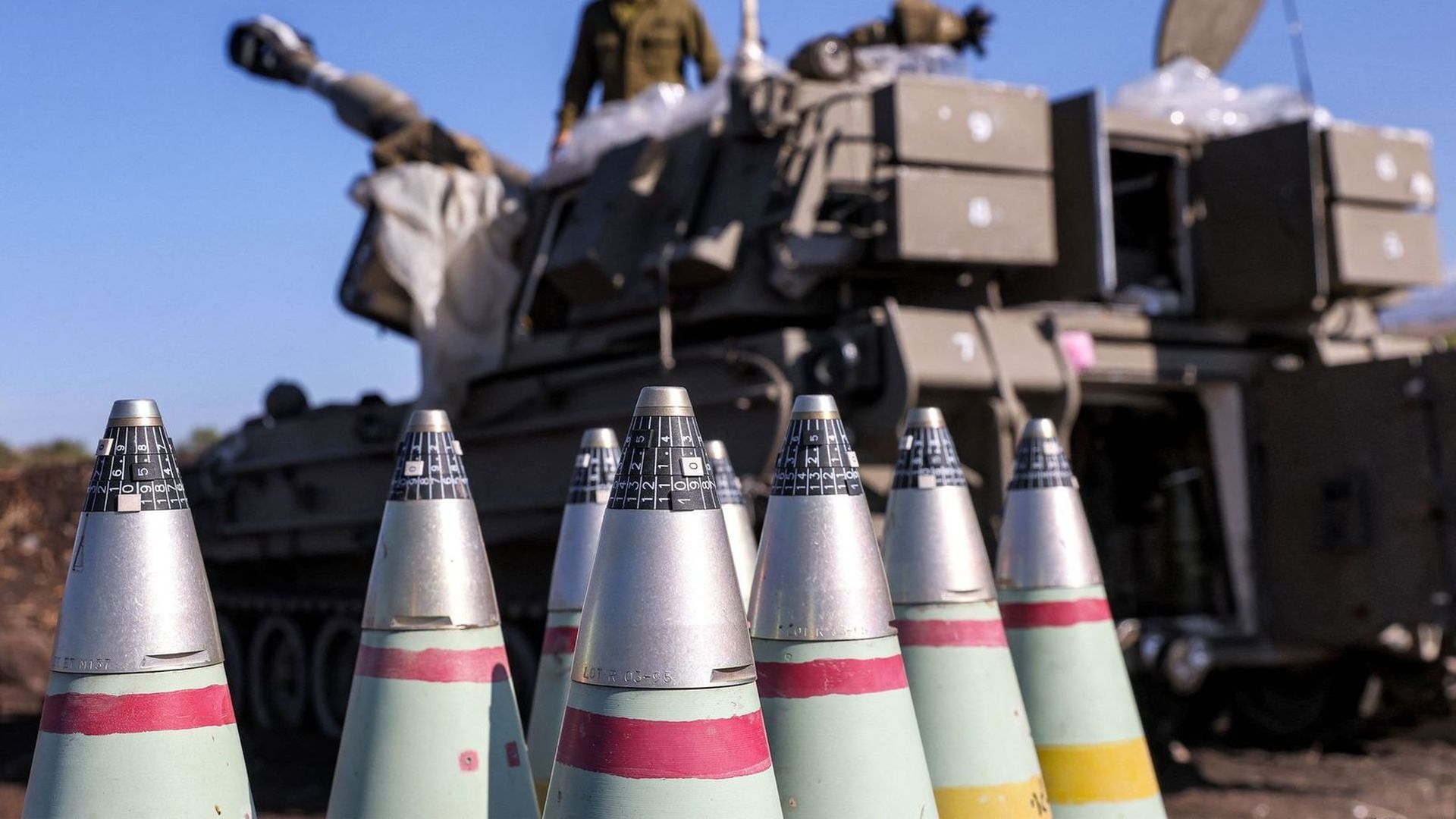
The tips of 155mm artillery shells are pictured near a self-propelled howitzer deployed at a position near the border with Lebanon in northern Israel on Oct. 18, 2023. Photo: Jalaa Marey/AFP via Getty Images
The U.S. and Israel resolved some of the problems that have slowed down U.S. weapons shipments to Israel but the delivery of bombs put on hold by President Biden before Israel invaded Rafah is still under review, U.S. and Israeli officials said.
Why it matters: The supply of U.S. weapons to Israel has become a significant source of tension between the Biden administration and the Israeli government after Israeli Prime Minister Benjamin Netanyahu accused Biden of withholding weapons from Israel.
- The issue turned into a confrontation between Netanyahu and his Defense Minister Yoav Gallant who believes the prime minister's public fight with the White House caused significant damage to the efforts to resolve the supply issues, according to an Israeli official.
- Some of Gallant's aides claimed Netanyahu released the video as an attempt to sabotage the minister's visit to Washington this week for the prime minister's own political reasons. Netanyahu denied that was his reason.
Driving the news: U.S. weapons supplies to Israel were the main topic in Gallant's meetings with White House national security advisor Jake Sullivan, Secretary of State Antony Blinken and Secretary of Defense Lloyd Austin.
- A team of experts from the Ministry of Defense arrived in Washington with Gallant to discuss with a U.S. inter-agency team each of the arms shipments that are in process, a U.S. official told reporters.
- U.S. officials said in recent days that the delays in delivering those weapons and munitions were partly due to Israel's changing needs. At the beginning of the war, Israel asked for larger quantities of weapons, but in recent months their requests decreased as Israel shifted its strategy in Gaza.
The U.S. officials also claimed the U.S. sent Israel "off the shelf" weapons at the beginning of the war and could expedite their transfer without notifying Congress.
- In recent months, there were fewer weapons available and the weapons had to go through a long approval process, they said. The weapons shipments were also incorrectly prioritized, they added.
However, senior U.S. officials admit part of the problem was that some officials in the Biden administration interpreted President Biden's decision to freeze a shipment of 2000-lbs bombs as a signal that each arms shipment was to be scrutinized more thoroughly before it was approved.
What they're saying: Gallant said after his meeting on Wednesday with Sullivan that they made "significant progress, obstacles were removed and bottlenecks were addressed, in order to advance specifically the topic of force build-up and munition supply that we must bring to Israel."
- Senior Israeli officials said the arms shipment obstacles that worried Israel before Gallant's visit have been removed, except for the 2000-lbs bomb shipment.
- A senior U.S. official told reporters in a call that the Israeli and U.S. teams went through lists of hundreds of weapons that Israel ordered and are waiting to be shipped, clarified where each of them was in the process and resolved any misunderstandings that existed.
- "We have made progress in reaching an understanding regarding where things were and prioritized things according to Israel's needs. Every bureaucratic system has bottlenecks. We worked on solving them," the U.S. official said.
- The official added that experts from both countries will continue to be in close contact in the future to make sure the process is not stalled again.
- "There were shipments of weapons that left for Israel last week, there are shipments of weapons that will go to Israel next week. It is clear to the Israelis that there is only one weapons shipment that is being delayed as a matter of policy," the official said.
Behind the scenes: Senior U.S. and Israeli officials said the 2000-lbs bomb shipment was not resolved during Gallant's visit and that it is still under review.
- U.S. and Israeli officials said Netanyahu's accusations were one reason for the continued review.
- During the visit of Israeli minister Ron Dermer and national security advisor Tzachi Hanegbi to the White House last Thursday, Biden's advisers told them Netanyahu's video harmed the efforts to release the bombs shipment.
- Two U.S. officials said Biden's advisers told Dermer and Hanegbi the shipment would not be released now because "the President was not taking orders from Netanyahu."
- The Prime Minister's Office and the White House declined to comment.
What to watch: "The delivery of the heavy bombs remains in dispute and the reasons for this are clear. The Americans told us this during the visit," a source close to Gallant said, alluding to Netanyahu's video.
- A U.S. official told reporters discussions will continue to try and find a solution regarding the 2000-lbs bombs.
- "We still have concerns about these bombs," the U.S. official said.
