"Corporations have to do more:" Inside the Biden team's inflation bully pulpit


Add Axios as your preferred source to
see more of our stories on Google.
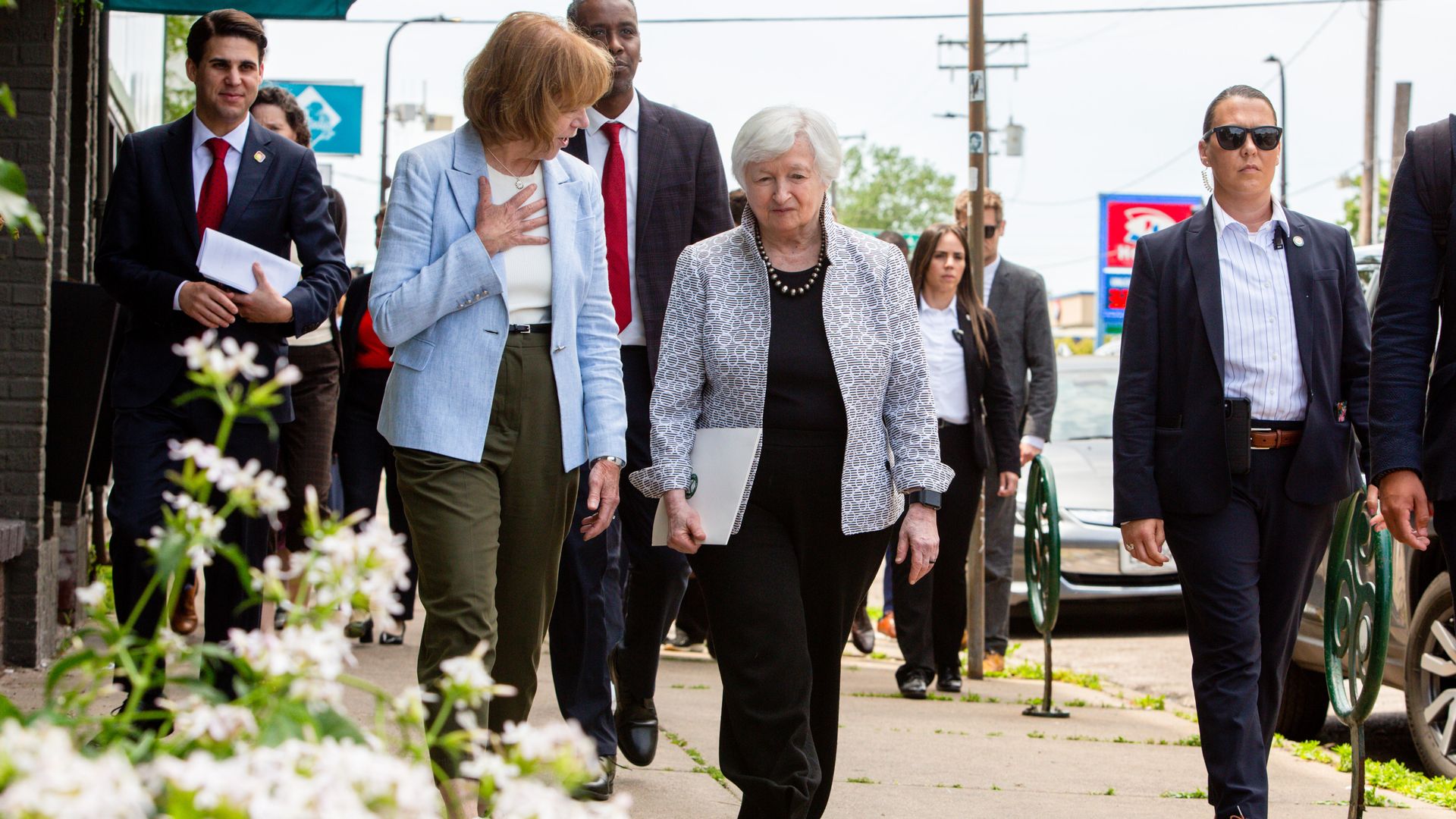
Treasury Secretary Janet Yellen on a trip to Minnesota this week where she met with Target CEO Brian Cornell. Photo: Nicole Neri/Bloomberg via Getty Images
The Biden administration is making a not-so-subtle push to encourage companies to exercise pricing restraint, using both carrots and sticks.
The intrigue: Companies that announce splashy price reductions can expect public praise from the highest levels of government. For those that don't, attacks on sky-high profit margins, so-called junk fees, and the like.
Driving the news: Treasury Secretary Janet Yellen had lunch with Target CEO Brian Cornell on Tuesday and "recognized actions" by Target and others to cut prices for milk, bread and diapers, according to the meeting's readout.
- In recent weeks, the administration has applauded Target, Walmart and other grocery chains for beginning to "answer the President's call to lower prices for household goods."
In a speech last week, top White House economist Lael Brainard said grocery store margins, for one, remain elevated relative to pre-pandemic times.
- "Some grocery stores are answering the President's call and lowering prices on thousands of items," Brainard said. "This is a start, but corporations have to do more to bring their prices down."
Between the lines: The price cuts highlighted by the White House alone are not enough to bring down the monthly inflation figures closely watched by economists.
- But the Biden camp is elevating these announcements, hoping that there is an effect at the micro level and that inflation-weary American voters take notice.
The big picture: The finger-pointing at corporate America plays well to Democratic voters that are more inclined to be skeptical of big business.
- The latest Axios Vibes Survey by The Harris Poll shows a slim margin for what overall Americans see as the cause of inflation: 41% of overall respondents say the government is more to blame, while 39% point the finger at corporate America.
- There is, predictably, a partisan split given the choice between corporations and politicians: Most Republicans (68%) blame the government. Just one-third of Democrats say the same, with the majority blaming businesses. Independents are split 50-50.
The other side: Some companies are pushing back on the Biden administration's "greed-flation" narrative.
- "Companies have been absorbing the economic realities of inflation, including cost of ingredients, packaging and other input costs like labor and transportation," David Chavern, head of the Consumer Brands Association, tells Axios. "It's critical that we get the economic facts right and avoid political rhetoric."
- "Brands are leaning into the fact that times are tough for some consumers," says Stephen Wyss, a partner at accounting firm CohnReznick who works with consumer brands.
- "I think it's reading the room and building a promotional strategy around it. I don't think it's a result of a politician saying, 'You have to lower your prices,'" Wyss said.
The bottom line: Businesses in a range of industries are facing pressure from their own customers and the White House to curtail price increases — which may provide inflation relief heading into the election.
Go deeper: The next inflation-cooling force: Consumers are revolting against high prices
