Ex-Meta experts at AI-biotech startup offer tool to create new molecules

Add Axios as your preferred source to
see more of our stories on Google.
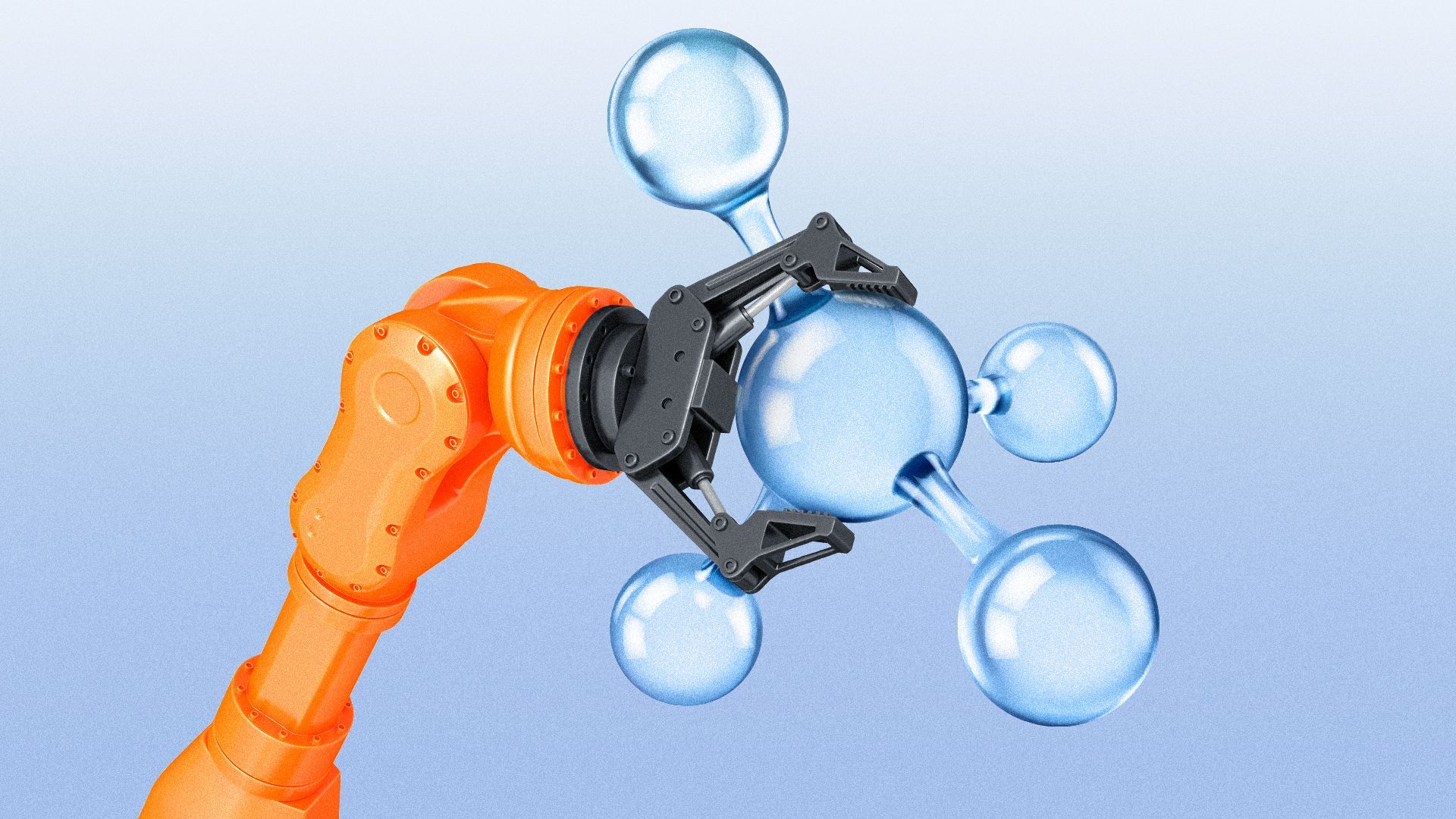
Illustration: Gabriella Turrisi/Axios
An AI-meets-biotech company launching Tuesday is releasing a tool to help scientists craft entirely new molecules in a process they say mirrors half a billion years of evolution.
The big picture: Researchers are pushing hard to try to use AI to create new molecules in order to engineer better medicines, biofuels and materials.
- AI tools are now being developed in an effort to more quickly determine a protein's structure, generate biological molecules with enhanced functions and design new gene editors.
Driving the news: EvolutionaryScale — a startup founded by several AI researchers who used to work at Meta — is building a language model similar to those that power AI chatbots that can be prompted to design new proteins.
How it works: A protein's function in a cell is often determined by its structure.
- Those forms develop over billions of years, "passing through a vast evolutionary sieve" that filters proteins by their "sequences, structures and functions," the EvolutionaryScale team writes in a preprint paper posted on their site on Tuesday.
- The largest version of the new generative AI model — called ESM3 — was trained on data from 2.78 billion natural proteins: their amino acid sequences, the 3D atomic structures that arise from those sequences and the resulting functions of the proteins.
- The model then predicts patterns in that data and leverages it to design new proteins with specific functions.
What they found: When the model is prompted with sequences, structures or functions, it "finds creative solutions to complex combinations of prompts, including solutions for which we can find no matching structure in nature," the researchers write.
Zoom in: The team asked the AI model to generate a new green fluorescent protein (GFP) — a light-emitting protein found in jellyfish and coral that has been developed into a powerful molecular biology tool to mark and track proteins and other molecules in cells.
- It came up with a new fluorescent protein that was then compared to a database of known proteins. The sequences of the new AI-generated fluorescent protein and the existing fluorescent protein most similar to it were just 58% identical.
- The generation of a protein that different from existing ones "appears to be equivalent to simulating over 500 million years of evolution," they write.
What they're saying: "We think ESM3 makes a meaningful step toward tools that can allow you to design biology from first principles — to engineer biology," EvolutionaryScale co-founder and chief scientist Alexander Rives told Axios.
What's next: EvolutionaryScale is partnering with Amazon Web Services and Nvidia, and the new AI model will soon be available to their select customers, the company said.
- The model is also available for non-commercial use through an API, and the code and weights will be released for a smaller open version of ESM3, Rives said.
Between the lines: Responsibility concerns loom as biotech-speeding AI advances. Rives and more than 160 other researchers earlier this year called for setting principles governing the "responsible development of AI for protein design."
- They said the potential benefits of current AI-generated protein design tools outweigh the risks.
- But "this is a field that's moving very rapidly and we feel it's important to be thinking ahead about the potential for these models," Rives said.
What to watch: Ultimately these tools will need to prove their worth to the pharmaceutical industry and other sectors that have long grappled with slow, expensive development pipelines.
- "There is rightly a skepticism in the pharmaceutical industry around AI. Historically, computation has not had the impact that has been promised," Rives said.
- "A big part of that is just that it hasn't been able to affect the fundamental economic equation."
- But Rives expects new predictive AI tools that allow for more "rational engineering approaches" will "affect this equation in a very real way."
