Axios Explains: Christian nationalism on the march

Add Axios as your preferred source to
see more of our stories on Google.
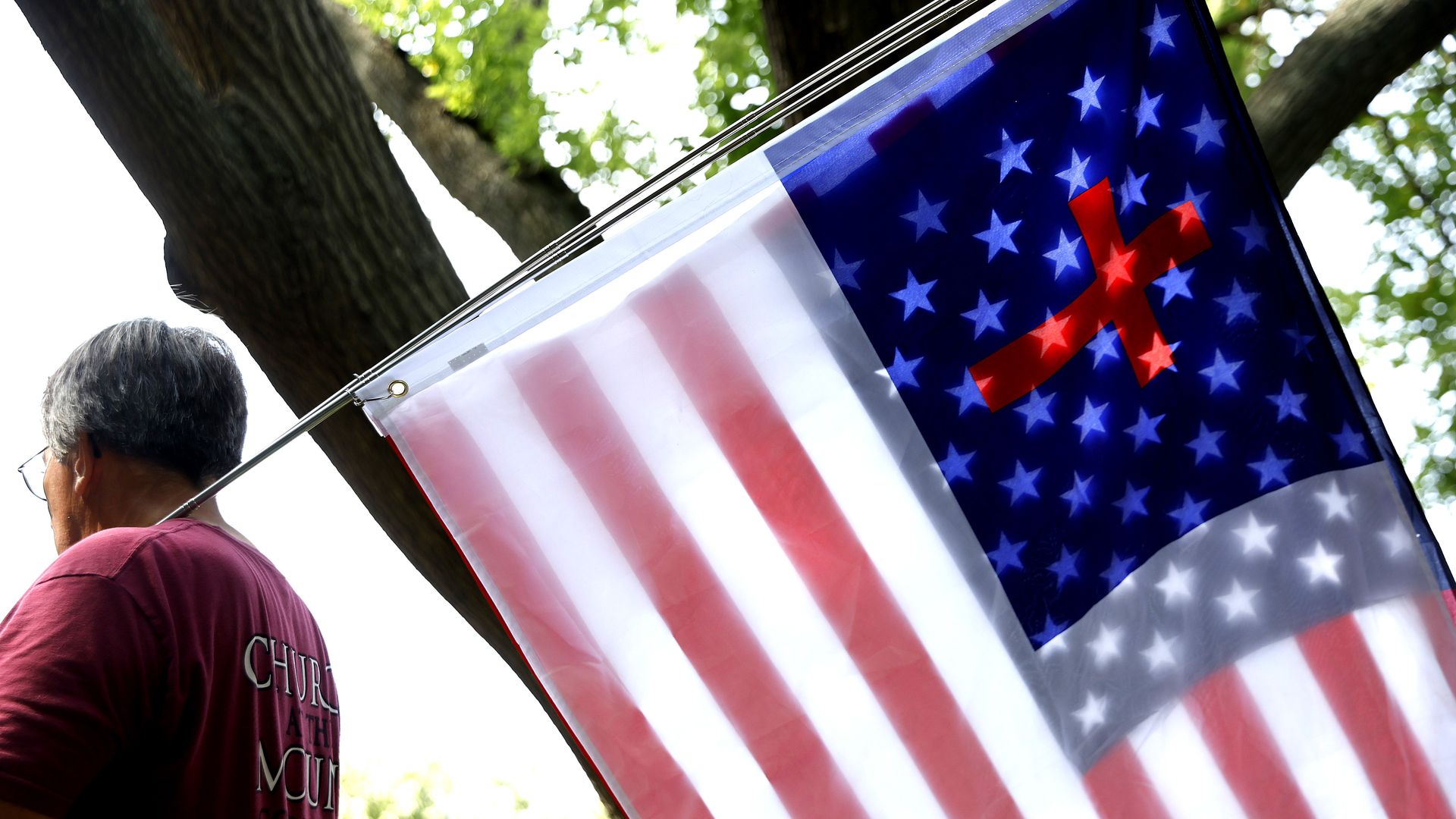
A U.S. and Christian Flag are sandwiched together as supporters of the 1776 Restoration Movement rally on July 18, 2022 in Washington, D.C. Photo: Chip Somodevilla/Getty Images
A new Louisiana law requiring the Ten Commandments to be posted in classrooms is drawing new scrutiny to Christian nationalism, a once-fringe movement steadily gaining political power in the U.S.
Why it matters: Christian nationalism seeks to establish a country governed by a fundamentalist interpretation of the Bible. Adherents and allies of the movement have aligned themselves with Donald Trump and the Republican Party.
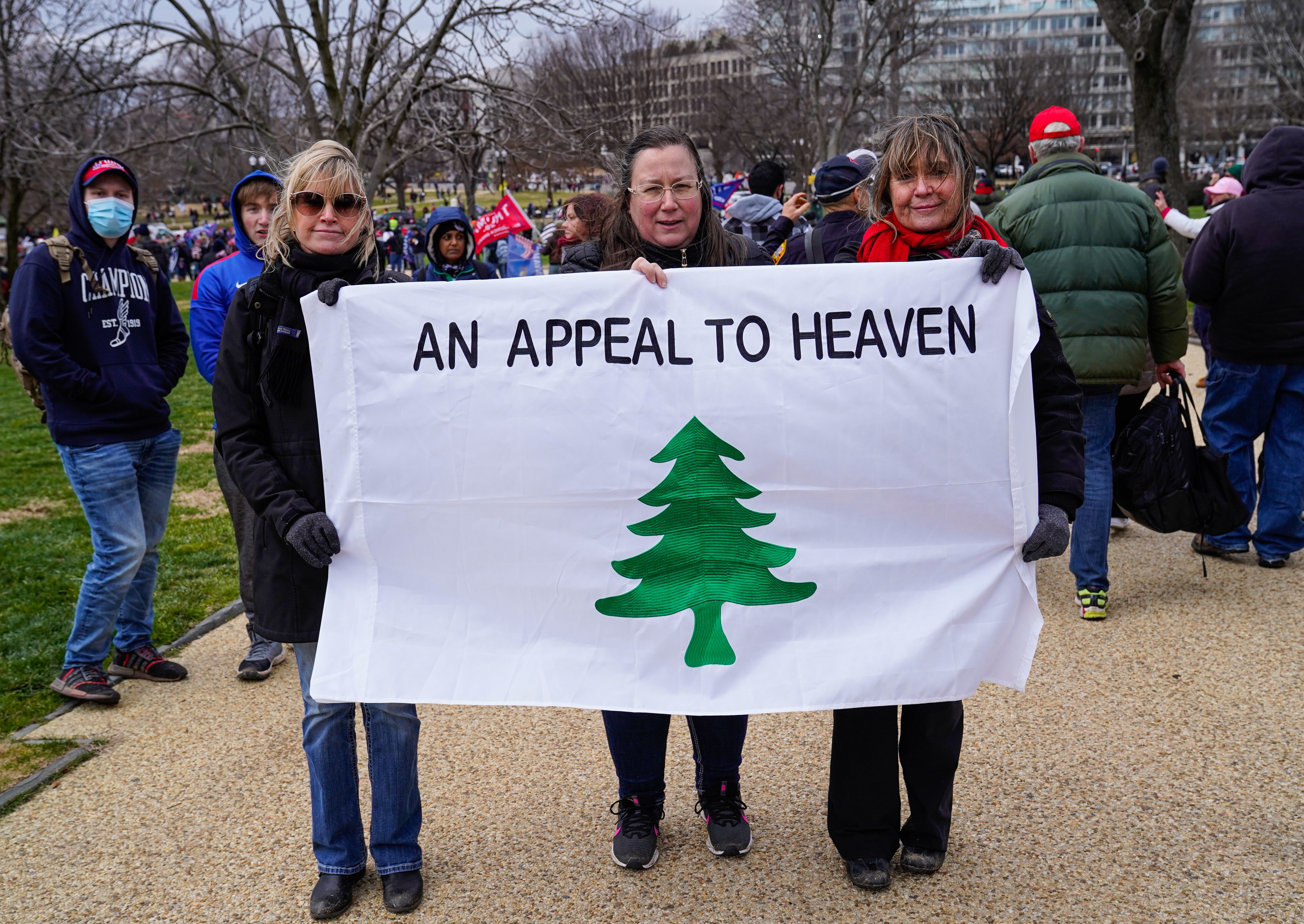
Zoom in: The "Appeal to Heaven" flag flown outside Supreme Court Justice Samuel Alito's home last summer — originally a Revolutionary War symbol — is linked to Christian nationalism.
- So, too, is the Alabama Supreme Court ruling in February that defined frozen embryos as children — temporarily causing IVF clinics in the state to halt treatments.
- Alabama Supreme Court Chief Justice Tom Parker cited the Bible in his legal opinion and declared on a Christian podcast that "God created government."
State of play: Key figures in the Republican Party have openly espoused Christian nationalist beliefs once dismissed outside the mainstream, challenging long-held ideas about the separation of church and state.
- Trump's former budget director Russ Vought, a potential candidate for chief of staff, has led efforts to infuse Christian nationalist ideas into planning for a second Trump administration, according to Politico.
- House Speaker Mike Johnson (R-La.), who displays the "Appeal to Heaven" flag outside his office, has called the separation of church and state "a misnomer."
- Rep. Marjorie Taylor Greene (R-Ga.) has referred to herself as a "proud Christian nationalist."
What Christian nationalism is
Christian nationalism is a set of beliefs centered around white American Christianity's dominance in most aspects of life in the United States.
- Many adherents believe U.S. laws should be based on Christian values, and that God has called on Christians to exercise dominion over all areas of American society.
- Many say the U.S. was founded as the "Promised Land" for white European Christians, and falsely believe the founding fathers sought to create a Christian nation, Robert P. Jones, president and founder of the nonpartisan Public Religion Research Institute, tells Axios.
- Some believe opponents of Christian nationalism aren't just fellow Americans who disagree with their policies in a pluralistic society, but are evil — possibly demonic — and should be confronted with violence.
What Christian nationalism is not
- Christian nationalism doesn't encompass all evangelicals who believe they must accept the teachings and beliefs of Jesus Christ in order to enter Heaven.
- The movement doesn't involve all Christians who endorse a fundamentalist interpretation of the Bible and live their private lives based on those principles.
- It also doesn't necessarily include Christians who openly pray in public and seek to center "moral values" in government and public life.
How we got here
- The movement got its early start after the 1954 Brown vs. Board of Education ruling and the desegregation of public schools. Some Christians thought school integration was "unbiblical" and started private schools for white students.
- During the Cold War, Christians saw tensions with the Soviet Union as a religious battle. Hal Lindsey's 1970 bestselling book, "The Late Great Planet Earth," sought to use Biblical prophecy to explain global events and later influenced U.S. policymakers.
- An extreme group of Christian nationalists later formed the New Apostolic Reformation to advocate the "Seven Mountains Mandate" — a plan to colonize Earth for God in response to growing LGBTQ and people of color advocacy.
- The Seven Mountain Mandate calls for Christians to lead government, family, religion, business, education, media, arts and entertainment — and for their policies to reflect "the Kingdom of God."
The big picture: Christian nationalism has become prevalent in some deep-red states at a time when the nation overall is becoming more diverse and less religious.
- The growth of the movement is catching many secular Americans, people of color, and moderate Christians by surprise.
- Some evangelicals critical of the movement have been forced to leave church communities and conservative circles.
The intrigue: Some leaders of megachurches who have endorsed Christian nationalism have transformed their churches into shrines to Trump, according to Tim Alberta's "The Kingdom, the Power, and the Glory: American Evangelicals in an Age of Extremism."
- American flags drown altars, and Christianity is indistinguishable from American nationalism in some services.
- Pastors who refuse to preach on cultural issues and support Trump are expelled. Alberta reports that attendance has skyrocketed for those who turn sermons into pro-Trump speeches.
- Some Christian nationalists use racist language to describe Latino immigrants, while others have threatened violence against them.
Between the lines: Despite its growing influence on conservative education, immigration and health care policies, about two-thirds of Americans reject or are skeptical about Christian nationalism, according to a PRRI survey in February.
- Still, Republicans in states like Texas, South Carolina and Utah are pushing laws to require the Ten Commandments in public schools or voucher programs to publicly fund Christian schools.
- Trump has explicitly appealed to his Christian nationalist base, vowing in speeches to defend Christian values from "the radical left."
