As Biden lags in key states, big questions for Democrats


Add Axios as your preferred source to
see more of our stories on Google.
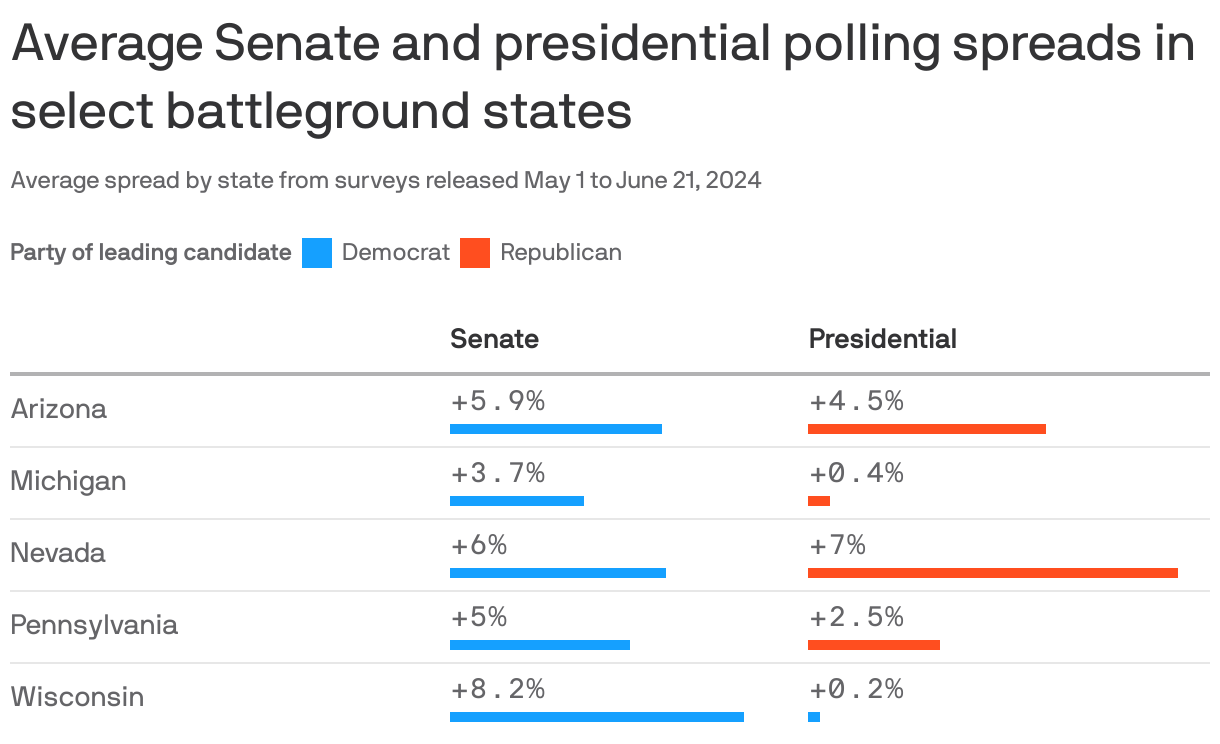
Democratic Senate candidates continue to run ahead of President Biden in battleground states, a polling spread that presents acute challenges — and opportunities — for both parties.
Why it matters: The mixed messages suggest there's a slice of the electorate that is frustrated with Biden but sticking with the party on the state level.
- It also raises critical questions for the 2024 election: Whether Democrats can fix the lack of enthusiasm for Biden — or whether he'll drag down other Democrats on the ballot.
Zoom in: It's another indication that 2024 will be exceedingly close, with a difference-making bloc of voters open to arguments from both parties on the best way to move the country forward.
- Republican and Democratic operatives expect the gaps to narrow, but they aren't certain by how much.
What we're watching: In the Trump era, split-ticket voting has appeared all but dead, but some voters now are hinting they may want more checks and balances than the take-no-prisoners approach of the last eight years.
- If that sentiment holds it could present two interesting dynamics on Nov. 5:
- Biden could be forced to rely on strong state candidates to win.
- Or Trump could win without carrying some of his Senate candidates across the line.
Reality check: In the last two presidential elections, only a single Senate candidate — out of 69 races — won a state that their presidential nominee lost. Her name: Sen. Susan Collins (R-Maine).
- Both the Biden and the Trump campaigns will use their millions of dollars to pummel each other in swing states and to help harden voters' opinions about both candidates and their parties.
State of play: In the five battleground states where there are also Senate races, Biden and the Democratic candidate are up in both only in Wisconsin, according to Real Clear Politics averages of polls released since May 1.
In the other four — Arizona, Michigan, Nevada, and Pennsylvania — Trump leads, while the Republican Senate candidates have clear deficits.
- Michigan is effectively a toss-up on the presidential side, with Trump leading slightly based on Real Clear Politics' polling average, though Biden is narrowly ahead based on FiveThirtyEight's average.
What we're hearing: Some Democrats are taking an optimistic view of the polling gap:
- Sure, Biden might be (currently) unpopular in swing states, but the Democratic brand is holding up. That's good news, they say.
- Democrats also believe that once voters process Trump's potential return to the White House, they'll move more toward their Senate preference and go with Biden.
- "The campaign's investments today are designed to win what was always going to be a close election in November," a Biden campaign spokesperson said.
- "We're operating in a fragmented media environment and it's going to take intensive time and effort to reach the voters who are going to decide the election who are not paying attention yet."
- Tommy Garcia, spokesperson for the Democratic Senatorial Campaign Committee, said that "Senate Republicans' have a candidate quality problem. "We'll win because we have the better candidates."
Other Democrats have a darker view. It's hard to argue that polling is fundamentally broken — or unfairly skewed against Democrats — if multiple surveys show Democratic candidates maintaining persistent leads in toss-up states as Biden lags in them.
- That's an ominous position for any incumbent, especially when his opponent is so well-known.
- It could make it more likely that Biden will drag Senate Democratic candidates down with him, instead of them drafting for him.
The other side: Republicans plan to spend heavily to ensure there's no daylight between Democratic candidates and Biden. They also argue that their candidates are still relatively unknown.
"Our challengers are still building name ID, which is the reason they are lagging the presidential ballot at this point," said Mike Berg, a spokesman for the National Republican Senatorial Committee.
"Expect the horse race numbers to tighten significantly as Republican candidates begin advertising."
By the numbers: As recently as 2012, split-ticket voting used to be the norm. In Ronald Reagan's 1984 landslide, 16 Democrats won Senate races in states Reagan carried.
- In Obama's 2012 re-election, six Democrats won in states that Obama lost. Meanwhile, Republicans took one state Obama won.
- And that year, 21 of 33 Senate Democratic candidates outperformed Obama.
- In 2020, 15 Republicans out of 35 won a higher percentage of votes than Trump, but only Collins won in a state Trump lost.
