Why employers wind up with mouse jiggling workers

Add Axios as your preferred source to
see more of our stories on Google.
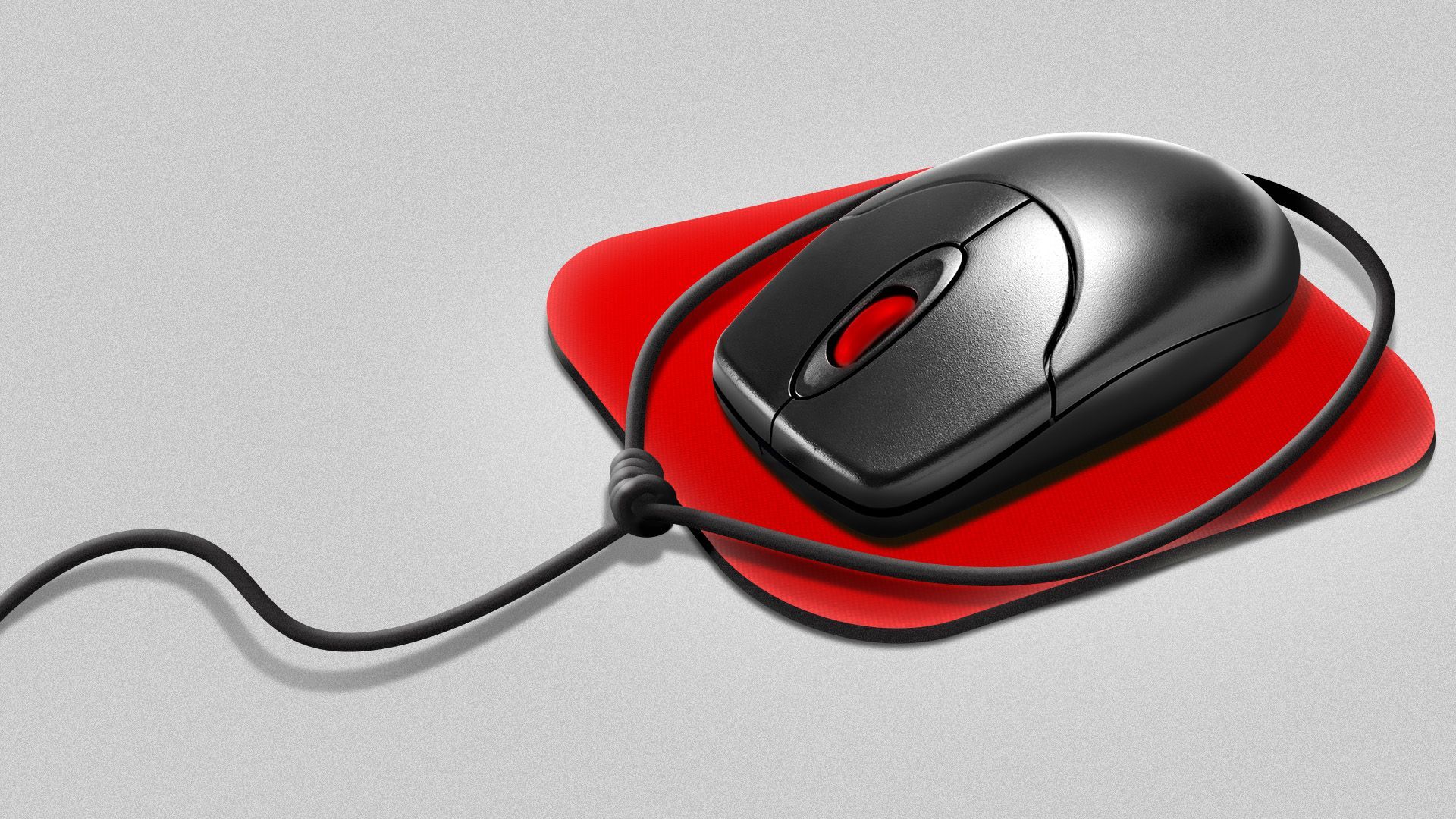
Illustration: Sarah Grillo/Axios
Wells Fargo grabbed headlines last week after firing workers from its wealth- and investment-management unit for using "mouse jigglers" to fake working.
Why it matters: Those knowledge workers are the latest casualty in the decades-long struggle for managers to measure employee productivity — an effort they often mess up.
The big picture: In some sectors of the economy, measuring productivity is straightforward. Auto manufacturers look at how many cars are produced per labor hour. Farmers might consider crop yields.
- But knowledge workers? Folks in engineering, finance, marketing (ahem even journalism!) are doing complex, creative, interdisciplinary tasks that are trickier to measure.
- Understanding a project's impact and an employee's contributions to it is harder than just counting time spent at desk or mouse movements per hour.
For example: An academic might publish multiple papers in a year; while another toils away at a breakthrough. A marketer produces an unforgettable ad campaign but always signs in late in the morning — while another never left his desk.
- Who was more "productive"? Keystrokes won't tell you.
Zoom in: Managers should be evaluating results — not "measuring activity," says Brian Elliott, a leadership adviser. The latter is "a weaker form of management."
- If you evaluate workers based on a certain metric — their presence in an office or time spent on a computer — you'll likely get more of the behavior you're measuring, says Elliott, a former executive at Slack.
- Workers who feel trusted by management are more apt to produce quality work, per research from i4cp, a human resource consulting firm.
Flashback: Remote surveillance is just the latest version of a boss looking out at the office floor to check that there are "butts in seats."
- These kinds of crude measures are part of a culture of "pseudo-productivity" that kicked off in the 1950s with the advent of office work, as Cal Newport writes in his latest book.
The bottom line: When technology enabled 24-hour connection to the workplace, pseudo-productivity evolved in ways that wound up driving worker burnout, like replying to emails at all hours or chiming in on every Slack message.
- And with the rise of remote work, this push for employees to look busy — and for managers to understand who's actually working — got even worse, Newport told me in a recent interview. "It just spiraled completely out of control."
