French freak-out: Why elections in France are rattling global markets

Add Axios as your preferred source to
see more of our stories on Google.
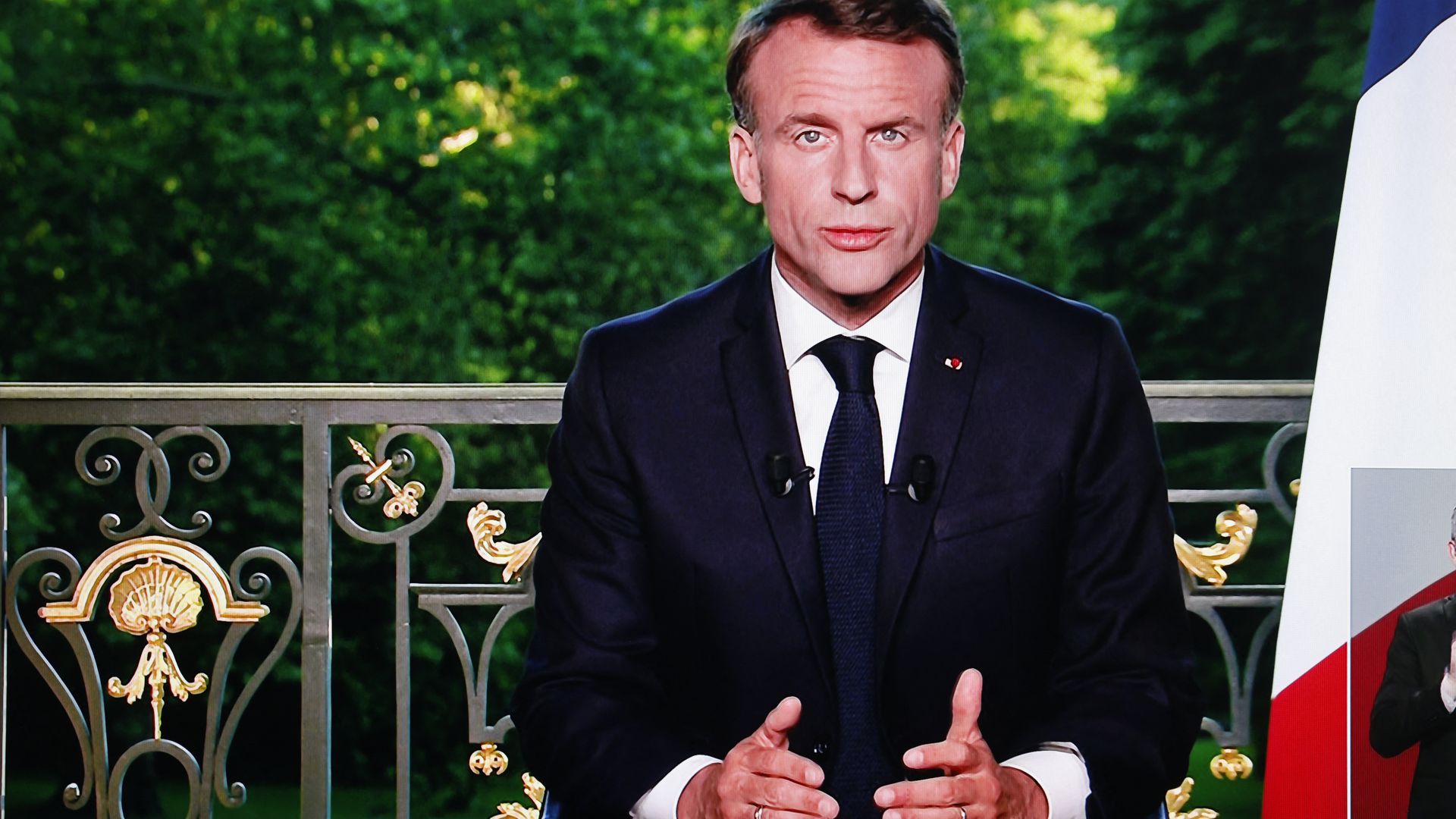
French president Emmanuel Macron addresses the nation Sunday, calling new elections in a surprise move. Photo: Ludovic Marin/AFP via Getty.
There's a new risk to the global economy, and it's coming from the heart of Europe.
The big picture: Investors are shedding French stocks and bonds as they see a chance the country's voters will make a decisive turn to far-right populism. This would likely mean wider fiscal deficits and new strains on European unity.
Driving the news: French president Emmanuel Macron on Sunday called a snap parliamentary election, which polling suggests could give the far-right National Rally party significant power in, or even outright control of, the French legislature.
- It could even set the stage for its leader, Marine Le Pen, to claim the presidency in 2027.
- Macron is making a high-stakes gamble that voters will reject rightist candidates when faced with a stark choice and that his party will be able to consolidate voters of the center-right and center-left in France's two-step voting process.
- Finance minister Bruno Le Maire warned that a French debt crisis is possible should Le Pen's party enact its agenda.


State of play: French government borrowing costs have soared relative to their German neighbors, with the gap at nearly 0.8 percentage point Friday morning — the widest since 2017 — from around 0.5 percentage point before the election announcement.
- French stocks are down 8.5% over the last month, compared to a 3.6% rise for the S&P 500.
- Financial stocks have been among the hardest hit, amid concern about the deficit impact of Le Pen's plan to vastly increase spending, wrote Susannah Streeter, head of money and markets, Hargreaves Lansdown, in a note.
- "There is also an expectation that a populist government would attempt to bring in more windfall taxes, restrictions on dividends and share buybacks," she wrote.
Between the lines: Beyond the near-term effects of a more populist government on fiscal and other policies, what makes the moment fraught is that France is so central to the broader European project, of which the German-French partnership is the core.
- It's one thing for Greece to have a fiscal crisis or for Hungary to elect far-right leadership, as both did in 2010. It's another for a European Union-skeptical party to take power in a large country so essential to that union.
Yes, but: Since the early 2010s crisis triggered by Greece's fiscal problems, a more expansive set of tools has been put in place to manage financial imbalances between eurozone nations. This could come into play if a new French government blows out its deficit.
- And, noted JPMorgan economist Greg Fuzesi, "political parties on the right who had previously been fiercely critical of the EU and its institutions have toned that criticism down."
- Still, he added, "the extent to which a possible Le Pen led administration would challenge the EU framework, as opposed to working within it," is "still unclear."
What's next: French voters go to the polls first on June 30 and again July 7.
