What makes gun bump stocks so deadly

Add Axios as your preferred source to
see more of our stories on Google.
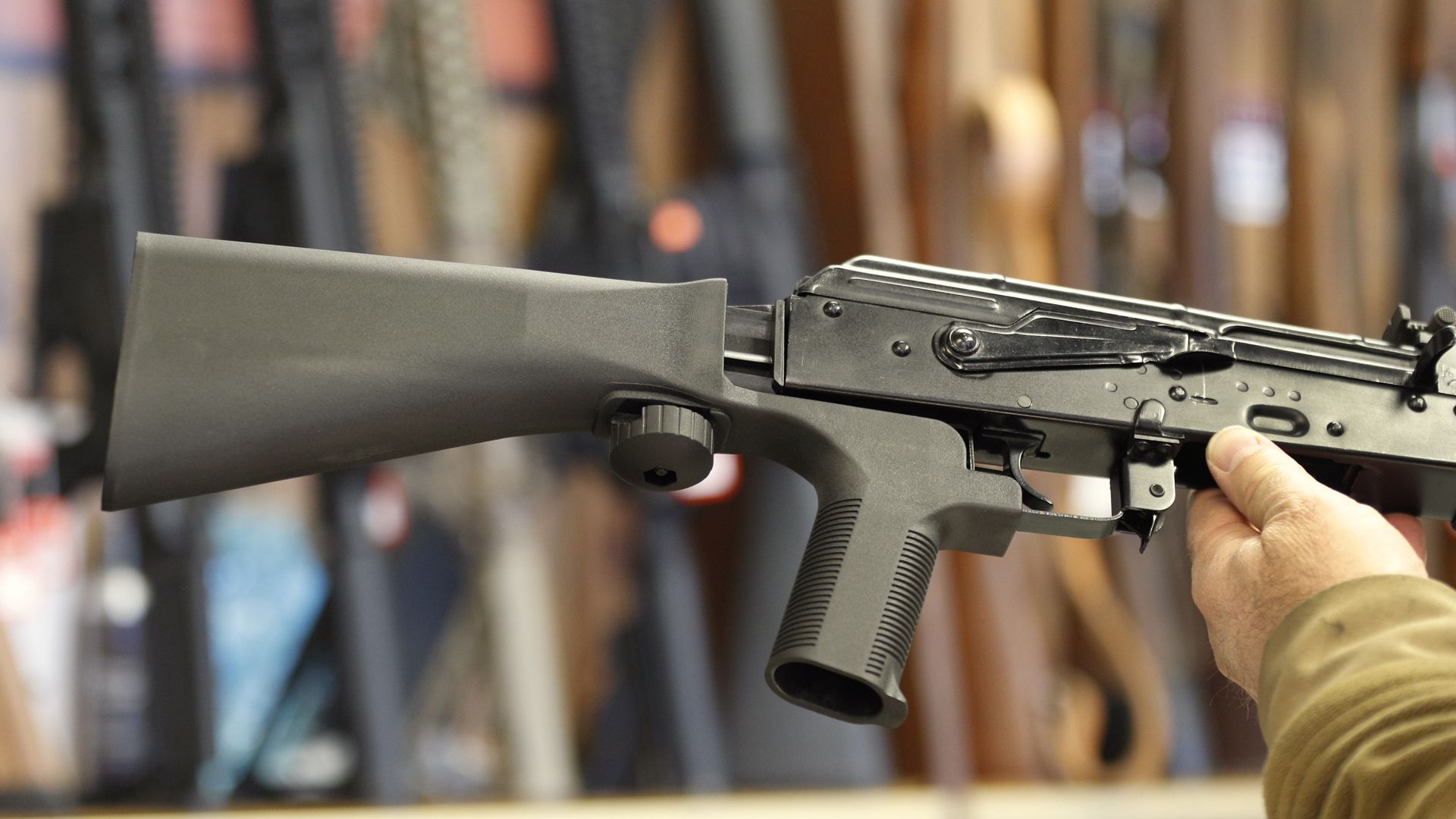
A bump stock attached to an AK-47 semi-automatic rifle in Salt Lake City, Utah, in 2017. Photo: George Frey/Getty Images
The Supreme Court in a 6-3 vote Friday threw out a Trump-era ban on bump stocks, attachments that allow semiautomatic weapons to fire at nearly the rate of a machine gun.
Why it matters: The plastic devices, which were used extensively in the deadliest mass shooting in U.S. history, will now be able to return to the market in states without their own bans, allowing consumers to mimic fully automatic firearms.
How bump stocks work
The attachments typically replace the standard stock on a rifle, such as a semiautomatic AR-15–style or AK platform firearm.
- The devices, invented in the early 2000s, use the power of the weapon's recoil to make it fire much faster.
- The shooter holds the bump stock to their shoulder as they would a regular stock. But when a shot is fired, the gun slides backwards and "bumps" off the stock back into the shooter's trigger finger, starting the rapid cycle over again.
Why were bump stocks banned?
The Bureau of Alcohol, Tobacco, Firearms and Explosives (ATF) banned bump stocks after the 2017 mass shooting in Las Vegas, which left 60 people dead and hundreds more injured.
- At least a dozen of the rifles the gunman used were modified with the devices, allowing him to shoot more than 1,000 rounds from a window at the Mandalay Bay hotel into a crowd of 22,000 people at a country music festival.
How did the ban work?
In the aftermath of the shooting, then-President Trump directed the ATF to craft a "rule banning all devices that turn legal weapons into machineguns."
- The agency finalized a rule in 2018 that made clear that machine guns, which are banned under the National Firearms Act of 1934, included bump stocks.
- Bump stock owners were given 90 days to destroy or turnover their devices.
- Michael Cargill, a Texas gun store owner, sued the ATF over the rule, and the Supreme Court ruled in his favor Friday.
What the Supreme Court said
Justice Clarence Thomas, writing the majority opinion, said bump stocks don't convert a semiautomatic rifle into what the law defines as a machine gun.
- A machine gun is in part defined as "any weapon which shoots, is designed to shoot, or can be readily restored to shoot, automatically more than one shot, without manual reloading, by a single function of the trigger."
- "A bump stock does not convert a semiautomatic rifle into a machinegun any more than a shooter with a lightning-fast trigger finger does," Thomas wrote. "Even with a bump stock, a semiautomatic rifle will fire only one shot for every 'function of the trigger.'"
Justice Sonia Sotomayor, in a dissenting opinion, said the court had cast aside Congress's definition of a "machinegun" in making its ruling.
- "A bump-stock-equipped semiautomatic rifle fires automatically more than one shot, without manual reloading, by a single function of the trigger," she wrote. "Because I, like Congress, call that a machinegun, I respectfully dissent."
Why do people use bump stocks?
The device serves no other purpose other than to increase the fire rate.
- For example, it lowers accuracy, so wouldn't be practical while hunting, or in accuracy and precision competitions.
- Bump-firing can be achieved without the device, but the method is inconsistent and requires a certain amount of technique and unique shooting stances.
The ATF estimated there were 520,000 bump stocks in circulation by the time the agency banned them, per court records.
What's next for bump stocks
Justice Samuel Alito, who concurred with the court's decision in a separate opinion, said the "horrible" Las Vegas shooting highlighted the need to change the law, but that it's up to Congress to do that.
- "Now that the situation is clear, Congress can act," he wrote.
- After the decision, nonprofit Everytown for Gun Safety also urged lawmakers to pass legislation banning bump stocks, which it called "accessories of war."
Congress did attempt to ban bump stocks or increase regulations on the devices in the aftermath of the shooting, but those efforts were unsuccessful.
- The NRA supported the proposed regulations, but not an outright ban.
Go deeper: Gun suicides account for most firearm-related deaths in U.S.
