Blinken pressed Netanyahu to release frozen Palestinian funds

Add Axios as your preferred source to
see more of our stories on Google.
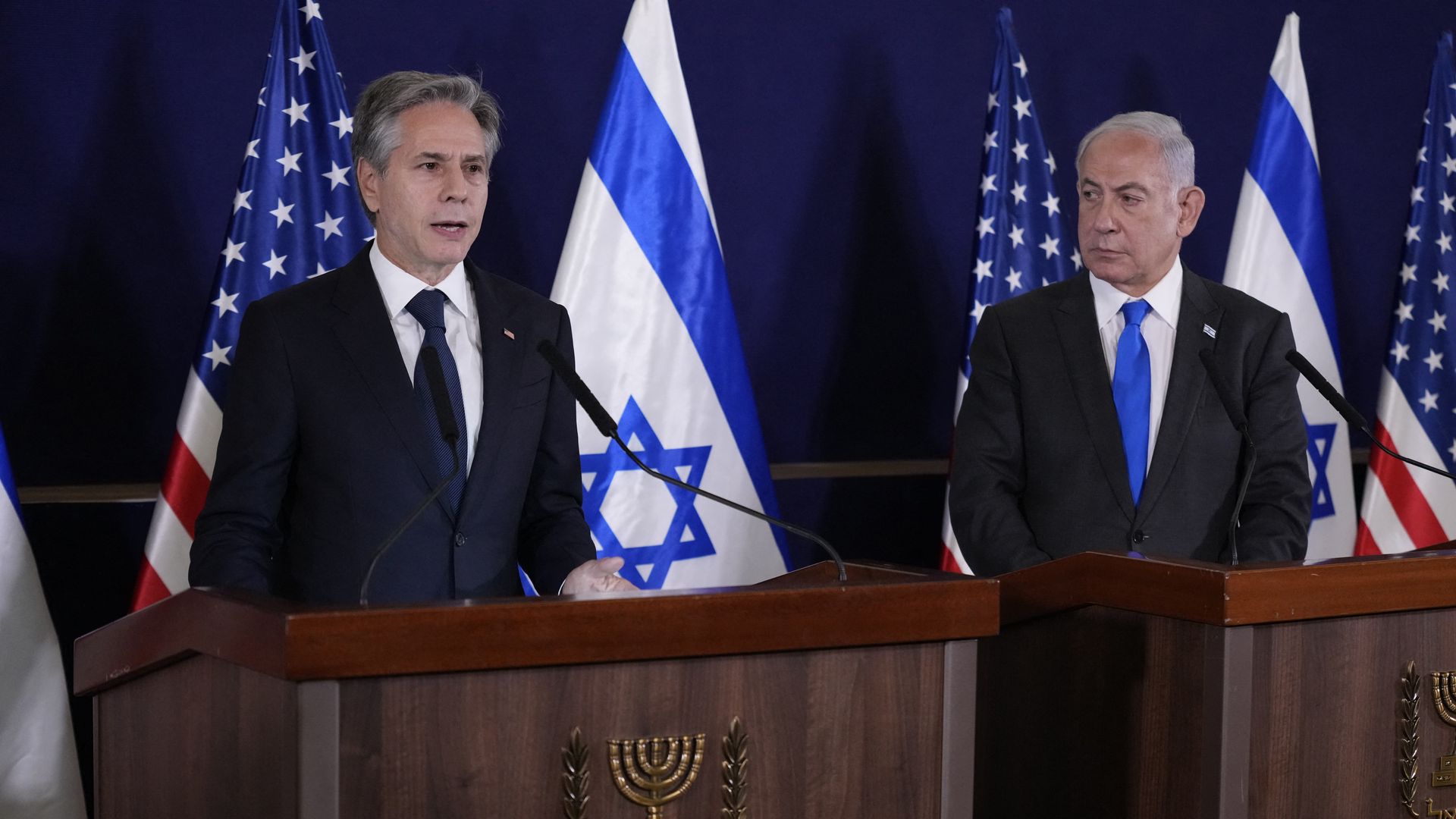
Israeli Prime Minister Benjamin Netanyahu (R) looks on as U.S. Secretary of State Antony Blinken gives statements to the media in Tel Aviv on Oct. 12, 2023. Photo: Jacquelyn Martin/POOL/AFP via Getty Images
Secretary of State Antony Blinken pressed Israeli Prime Minister Benjamin Netanyahu to release Palestinian tax revenues Israel's ultranationalist minister of finance Bezalel Smotrich froze in early May, three U.S. and Israeli officials told Axios.
Why it matters: The Biden administration is extremely concerned the Palestinian Authority could collapse if the tax revenues are not transferred soon, U.S. officials say.
- An economic crash could in turn lead to an escalation in the West Bank in addition to the war in Gaza and rising tensions between Israel and Hezbollah in Lebanon.
Catch up quick: Tax revenues Israel collects for the Palestinian Authority under an agreement between the parties are a major source of income for the PA, which is already in a deep financial crisis.
- After the Oct. 7 attack by Hamas on Israel, Smotrich suspended the transfer of all tax revenue funds to the Palestinian Authority.
- The issue was at the center of a very tough phone call between President Biden and Netanyahu last December.
- Biden asked Netanyahu to solve the issue and when the Israeli prime minister answered in a non-committal way, the President said: "this conversation is over" and hung up the phone.
- It took more than two months before Israel, Norway, the Palestinian Authority and the U.S. reached a deal to resume the transfer of the tax revenues.
Driving the news: But the deal didn't last long. In early May, Smotrich once again put a hold on the Palestinian tax revenues.
- He claimed it was because of the Palestinian Authority's legal campaign to convince the International Criminal Court's prosecutor to apply for arrest warrants against Israeli leaders.
- Two weeks later, after Norway recognized the state of Palestine, Smotrich demanded Norway give back the portion of Palestinian tax revenues it was holding in escrow as part of the agreement.
Behind the scenes: U.S. officials said the White House was furious about Smotrich's move not only because it further destabilizes the Palestinian Authority and the security situation in the West Bank, but also because he violated an agreement the U.S. negotiated and was party to.
- Blinken told Netanyahu during their meeting in Jerusalem on Monday that the tax revenue issue is highly important for the Biden administration and that he needs to fix it, the U.S. officials said.
- They added Netanyahu was again non-committal.
Blinken met on Tuesday in Jordan with Palestinian Prime Minister Mohammed Mustafa and briefed him on his discussions in Israel about the tax revenues, a Palestinian official said.
- The Palestinian official added that Mustafa asked Blinken to speed up the efforts to release the money and asked him to press Israel not to cancel its assurances for Israeli banks to conduct financial correspondence with Palestinian banks — a move that could destroy the Palestinian financial system.
- The State Department and the Israeli Prime Minister's office declined to comment.
The latest: The leaders of the G7 countries in a joint statement on Friday after their meeting in Italy called on Israel to stop "actions that weaken the Palestinian Authority" in the West Bank.
- "Maintaining economic stability in the West Bank is critical for regional security," they said.
- The G7 leaders called on Israel to ensure that correspondent banking services between Israeli and Palestinian banks remain in place, to release withheld Palestinian tax revenues and "to remove or relax other measures" to avoid further exacerbating the economic situation in the West Bank.
The big picture: U.S. officials say the suspension of the Palestinian tax revenues by Israel is hampering a U.S.-Saudi Arabia attempt to mobilize an aid package for the Palestinian Authority from the Gulf states.
- White House National Security adviser Jake Sullivan discussed the aid package with Saudi Crown Prince Mohammed Bin Salman during his last visit to the kingdom.
- The Saudis developed a plan that included Saudi Arabia, the UAE, Kuwait and Qatar giving $10 million to the Palestinian Authority budget every month, U.S. officials said.
- But all four Arab countries told the Biden administration they won't give any money to the Palestinian Authority before Israel releases the Palestinian tax revenues, U.S. officials say.
Editor's note: This story has been updated with a statement from G7 leaders.
