Local tipping point

Add Axios as your preferred source to
see more of our stories on Google.
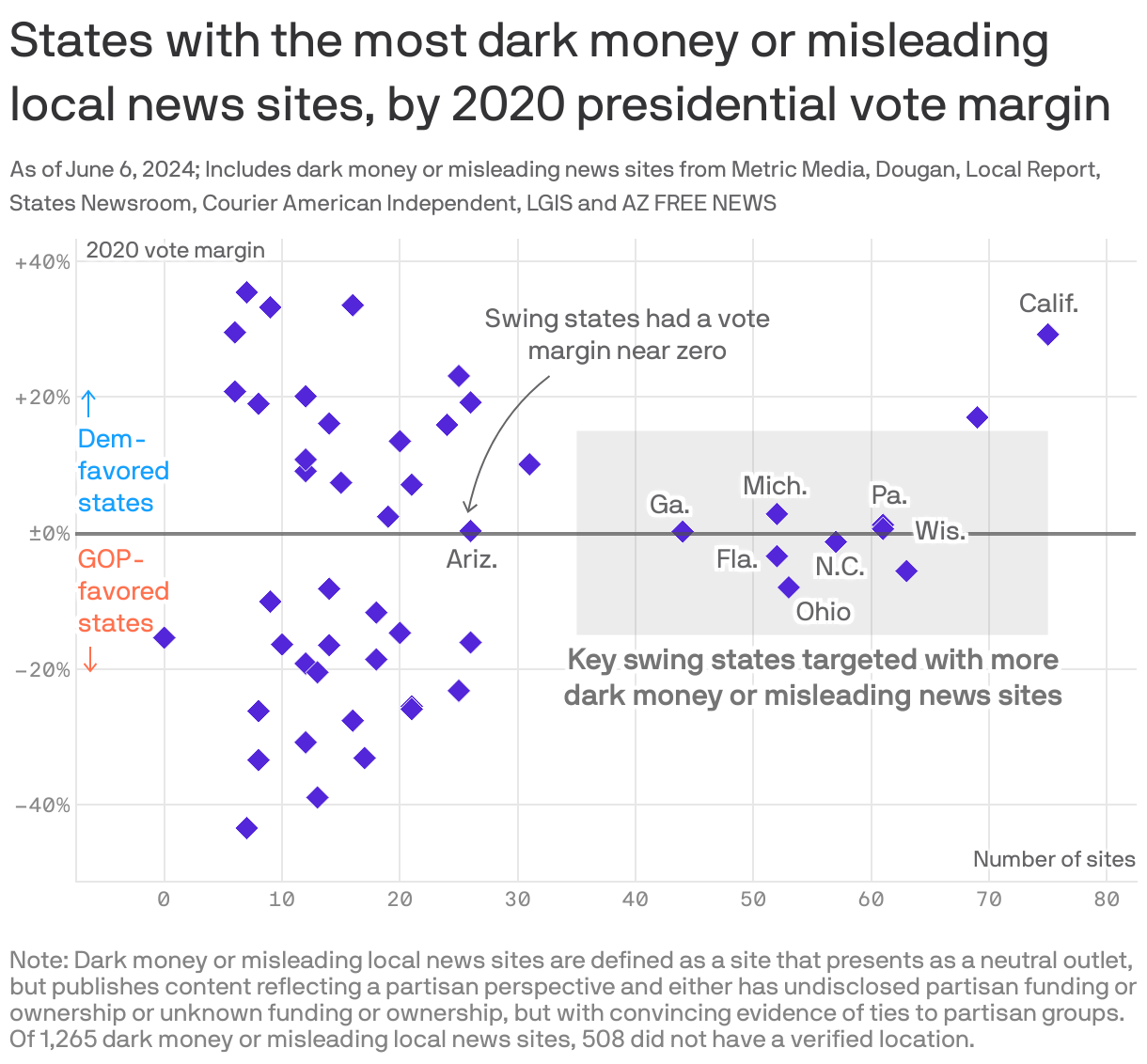
The number of partisan-backed outlets designed to look like impartial news outlets has officially surpassed the number of real, local daily newspapers in the U.S., according to a new analysis.
Why it matters: Many of those sites are targeted to swing states — a clear sign that they're designed to influence politics.
By the numbers: There are least 1,265 websites identified as being backed by dark money or are intentionally masquerading as local news sites for political purposes, according to a new report from NewsGuard, a misinformation tracking company.
- 🗞️ As of last year, there were only 1,213 daily local newspapers in the U.S. That number may have gone down significantly since, but the researchers who track that data have yet to release an updated figure for 2024.
- 🎯 Nearly half (45%) of the sites observed as part of the study were targeted to communities or regions in swing states, according to an Axios analysis of the sites. The most frequently targeted states are Illinois, Pennsylvania, Wisconsin, North Carolina, Ohio, Florida, Michigan and Georgia.
Zoom in: There are eight primary organizations that have been identified as supporting most of the sites identified — four lean conservative and four lean progressive.
- 🔴 The vast majority of the sites observed are backed by Metric Media, a conservative network traced backed to media entrepreneur Brian Timpone, who has links to conservative donors.
- 🔵 Some of the more strategic sites are run by groups that are more much explicit about their funding and motives, such as Courier Newsroom and States Newsroom.
The big picture: The rapid decline of local newspapers has left a void that partisan actors on both sides of the political spectrum are eager to exploit.
- The rise of artificial intelligence and new content generation tools have made it easier, faster and cheaper to build and market those outlets online.
🗞️ What to watch: Residents of battleground states, such as Pennsylvania, Illinois, Michigan and Ohio have been targeted by partisan papers masquerading as independent local news outlets.
