Hiring blows past expectations, showing lingering labor market heat

Add Axios as your preferred source to
see more of our stories on Google.
/2024/06/07/1717773101776.gif?w=3840)
Illustration: Brendan Lynch/Axios
Hiring is hot and wage growth is strong, indicating plenty of demand for workers.
Why it matters: The May jobs report is good news for workers who continue to benefit from a still-solid economy. But the numbers call into question the narrative of a cooling labor market.
- Meanwhile, the accelerating job and wage growth run counter to the type of economic conditions that might prompt the Fed to slash interest rates, especially as inflation looks like it might be harder to beat.
What they're saying: "Today's data undermines the message that other recent economic data have been giving of a cooling U.S. economy, and slams the door shut on a July rate cut," Seema Shah, chief global strategist at Principal Asset Management, wrote Friday in a note.
By the numbers: Payrolls increased by 272,000 in May, led by strong hiring in health care, government, and leisure and hospitality.
- That's a notable bounce back in hiring, which looked cooler last month. There were 165,000 jobs added in April, slightly fewer than initially estimated.
That came alongside a notable pickup in wages. Average hourly earnings rose 0.4% last month, double the prior month's pace.
- Wages by this measure are up 4.1% over the 12 months ending in May, likely outpacing inflation — though that data won't be released until next week.
What to watch: Treasury yields surged after the report's release, reflecting pared bets on Fed rate cuts.
- The yield on the two-year Treasury note — most sensitive to potential moves by the Fed — spiked as much as 14 basis points Friday, to 4.85%.
- The jobs report is among the last major pieces of economic data (along with the Consumer Price Index) released before the Fed's two-day policy meeting that begins next week. Officials have said they plan to hold rates at a high level until there is further evidence that inflation is cooling.
- "What this type of strong payroll print does is raise the hurdle a bit for the inflation downshift the Fed needs to see in order to cut," wrote analysts at Evercore ISI on Friday in a note.
The intrigue: "If last month's jobs numbers were indicative of a labor market cooling with certainty, this month's cast a little doubt on that certainty," NerdWallet's Elizabeth Renter wrote Friday in a note.
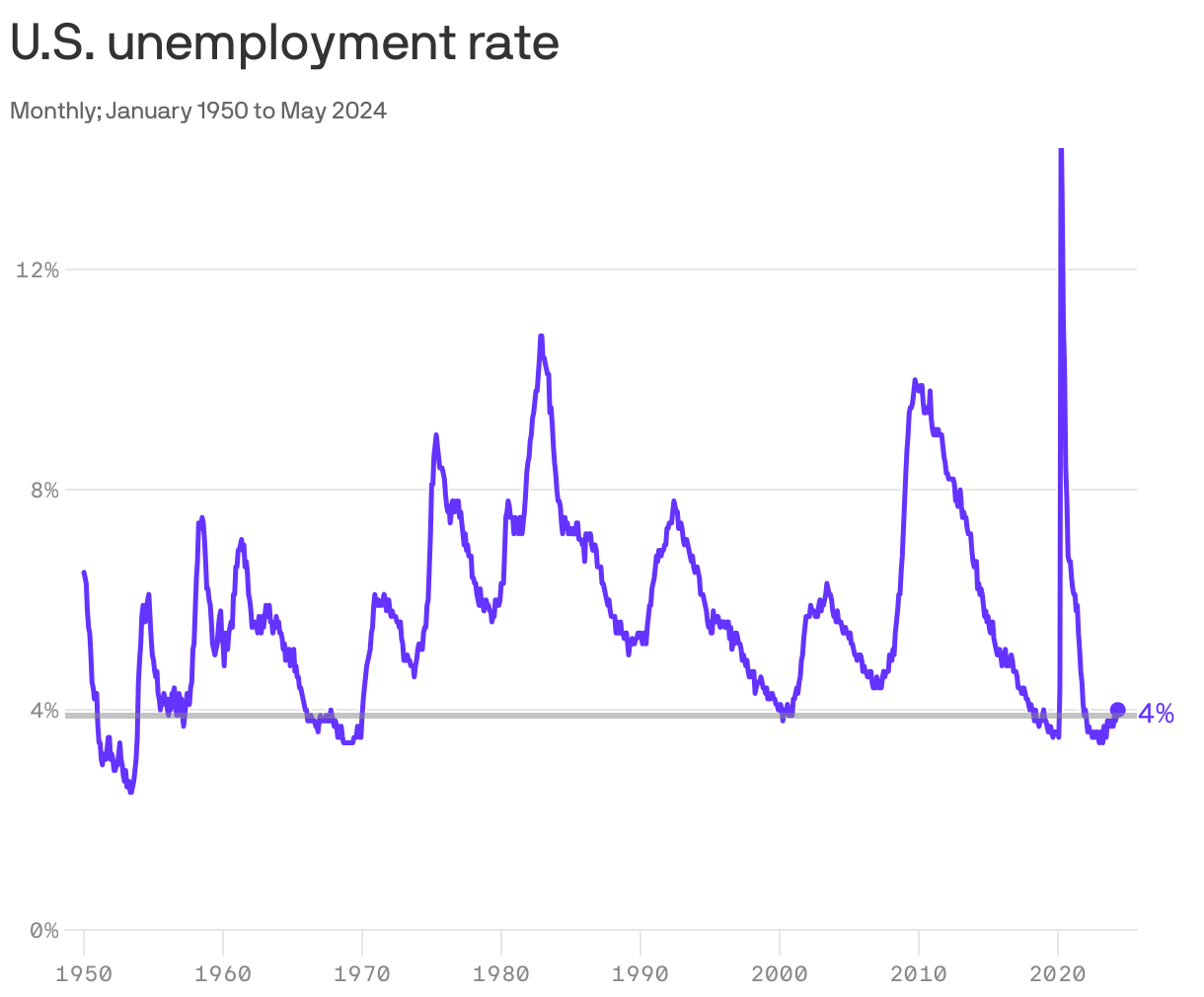
The unemployment rate has been on a historic run for more than two years. That ended last month.
- The jobless rate was below 4% for 27 straight months, tied for the record stretch last seen in the 1960s.
Why it matters: In May, the unemployment rate edged up to 4% — stoking some worries that the strong hiring figures are masking weakness underneath the surface.
Reality check: The unemployment rate is steadily rising, though it remains low by historical standards.
- Unrounded, the rate is 3.96% — prompting some to question whether this counts as the streak really being over.
The big picture: The jobs report is comprised of two surveys, one of businesses and one of households.
- The household survey is notably the weaker of the two, showing that employment plunged by 408,000. That, however, was largely concentrated in the age 16-19 cohort, which saw unemployment surge.
- The establishment survey that generates the payrolls figure is generally considered a more accurate and less volatile barometer.
The bottom line: "There's clearly heat left in the job market though household survey softness continues to be a concern," Glassdoor economist Daniel Zhao said today on X.
