Simple drones, complex problems

Add Axios as your preferred source to
see more of our stories on Google.
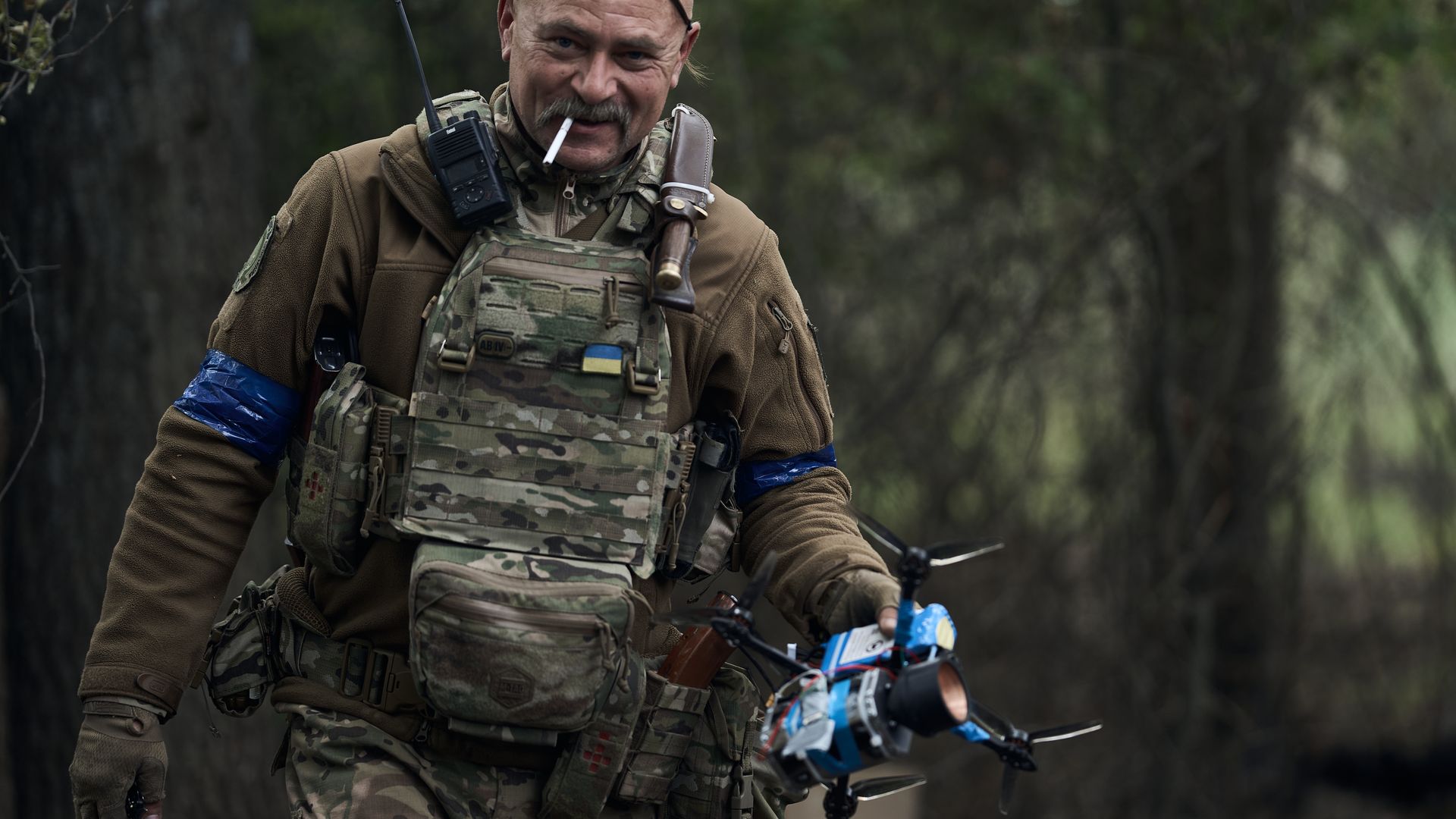
The popularity of MacGyvered drones is booming in Ukraine. Photo: Kostiantyn Liberov/Libkos/Getty Images
Fatal attacks on U.S. troops in the Middle East, harassment of ships in the Red Sea and the balance of power in Russia's war against Ukraine share a dangerous common thread: the rise of cheap drones.
Why it matters: This evolution of warfare, driven by accessible and inexpensive materials, is upending decades of U.S. military planning, spending and dominance.
- "The threat is complex, it is ubiquitous, and it is really transforming what the battlespace looks like," said U.S. Army Under Secretary Gabe Camarillo.
Zoom in: Here's where drones are already changing warfare.
- In Ukraine, skies teem with unmanned aerial systems that can guide shelling or act as bombs. Ukrainian forces reportedly withdrew U.S.-provided M1A1 Abrams tanks from the front lines because of the threat.
- Iran's Shahed series of drones was at the heart of its April bombardment of Israel. More than 300 drones and missiles were used in the strike.
- North Korean drones have crossed the border and menaced South Korea's capital. Seoul pledged to beef up countermeasures and established a centralized drone command.
- Houthi rebels are launching explosives-strapped drones to extend their reach into the waters off Yemen, where the U.S. and its allies are responding with far pricier munitions.
- Foreign-supplied drones, including the Mohajer, are fueling Sudan's bloody civil war.
Between the lines: Here's how they are changing warfare.
- Unmanned systems can range from toylike and mass produced to high-tech and precious. They can be used to surveil, relay information, deceive and attack, all while keeping the user out of harm's way.
- First-person-view drones popular in Eastern Europe can cost as little as $500. They are MacGyvered with cheap components and can wreck much larger targets, like tanks.
- Iran is arming nearby extremist groups and faraway Russian fighters with drones one expert likened to a "poor man's cruise missile." Constant barrages paralyze movement on the ground and exhaust air defenses.
- Contractors are pitching nimbler and more-portable drones — Teledyne FLIR Defense's explosive Rogue 1, for example — to U.S. buyers. Meanwhile, lawmakers are workshopping a drone corps for the Army.
- "The most expensive, complex systems, such as the U.S. Global Hawk or Reaper drones, are no longer the types of [unmanned aerial vehicles] that are being acquired in large numbers," said Seth Frantzman, an adjunct fellow at the Foundation for Defense of Democracies.
Zoom out: Unmanned systems have existed for many years but were considered an exclusive tool. That is no longer the case.
- Commercial drone use "came of age" in the Syrian civil war, said Samuel Bendett, an expert with the Center for a New American Security and the Center for Strategic and International Studies. Their applicability was further underlined by fighting in Nagorno-Karabakh.
- "The U.S. military has an unprecedented technological lead. But other countries are moving very quickly, in terms of adopting tactical capabilities, which are now way ahead of anything that NATO or even the United States has," Bendett said.
- "The Russians are officially claiming that they and the Ukrainians are ahead of the entire world when it comes to the application of tactical drones, FPVs, quadcopters."
What we're watching: The U.S. Defense Department is pouring cash into unmanned technologies.
- Its Replicator initiative, meant to hasten the fielding of thousands of drones to counter China's massive stockpiles, is expected to cost $1 billion in fiscal years 2024-25. AeroVironment's Switchblade 600, designed to destroy armor, is among the weapons sought thus far.
- The Air Force in April contracted Anduril Industries and General Atomics Aeronautical Systems Inc. for its effort to build robo-wingmen, or so-called collaborative combat aircraft.
The bottom line: "Prior to 2001, the United States was all about very expensive, exquisite, crewed platforms. Fighter jets, helicopters, you name it. Then from 2001 to 2020, we learned to fight with drones," said Brandon Tseng, a former Navy SEAL and cofounder of Shield AI.
- "Then from 2020 to now, and for the next 20 years, we're moving toward a world of intelligent, affordable drones."
