Zelensky urges allies to begin intercepting Russian missiles over Ukraine

Add Axios as your preferred source to
see more of our stories on Google.
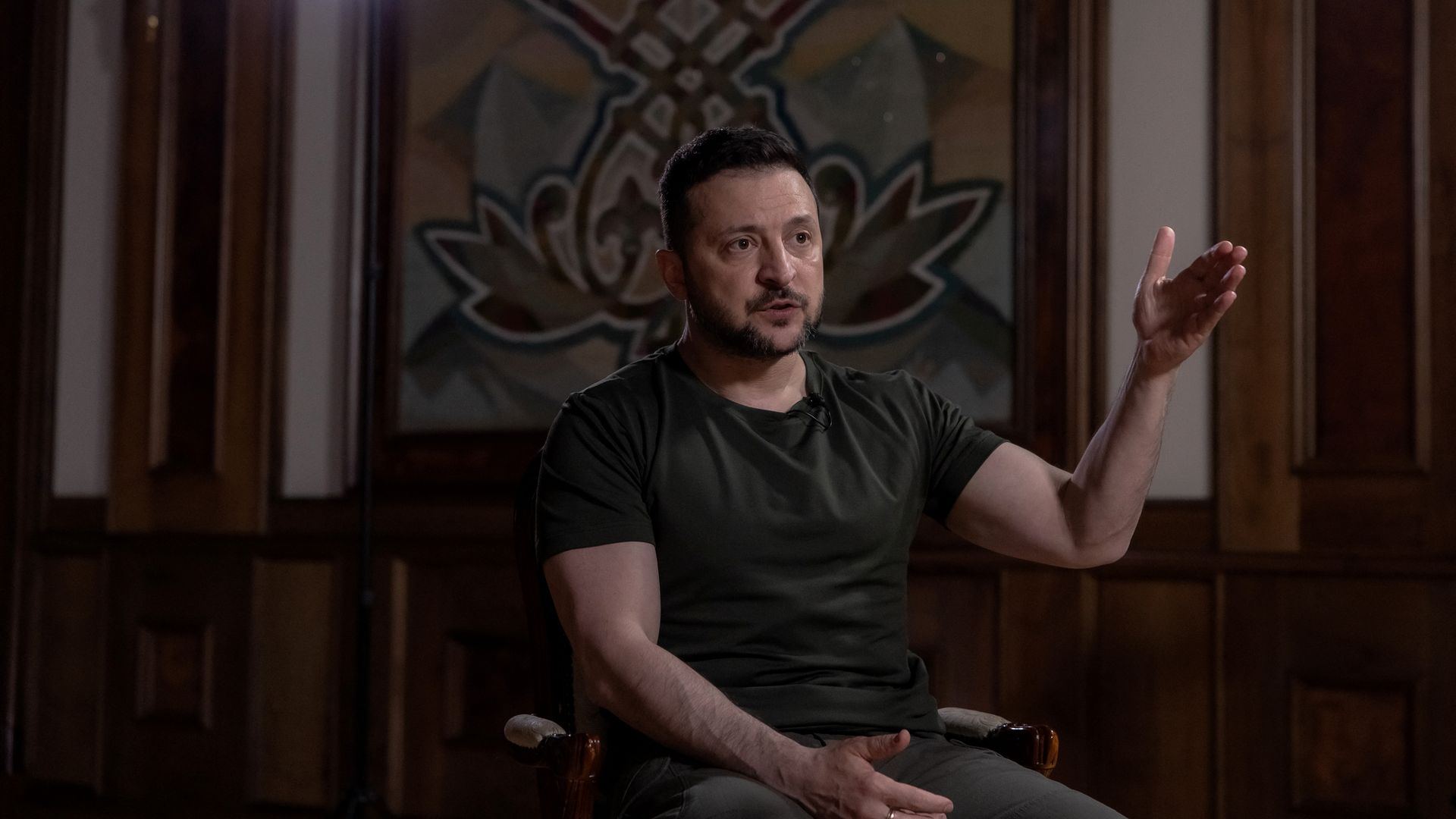
Ukrainian President Volodymyr Zelensky speaking during an AFP interview in Kyiv on May 17. Photo: Roman Pilipey/AFP via Getty Images
Slow decision making on the part of its allies has hindered Ukraine's ability to defend itself against Russia, Ukrainian President Volodymyr Zelensky said in an exclusive interview with Reuters on Monday.
Why it matters: Zelensky implored the U.S. and Ukraine's western supporters to become more involved in its defense by intercepting Russian missiles and other projectiles, which have have killed or injured hundreds of civilians in recent months.
- Zelensky also said Ukraine is pushing its allies to allow Kyiv to use Western weapons against Russian military equipment amassing near the border.
Context: Ukraine has been provided a large arsenal of Western weapons, including long-ranged missiles, but is not permitted to use them to strike targets in Russian territory.
- Western nations, particularly the U.S., have established such restraints over fears of escalation.
- Some have blamed this constraint for Russia's recent offensive in Ukraine's Kharkiv region. Without it, Ukraine may have been able to strike Russian targets organizing near its border beforehand.
Driving the news: Zelensky told Reuters that Western decisions to help Ukraine have so far been about year late.
- "But it is what it is: one big step forward, but before that two steps back. So we need to change the paradigm a little bit," Zelensky said.
- "We are negotiating with partners so that we can use their weapons against buildups of Russian equipment on the border and even [on] their territory," he said. "So far, there is nothing positive."
Zoom in: Zelensky called for Ukraine's allies to become more directly involved in the war but also said he understood why they are wary of escalating the conflict.
- "It's a question of will," he said. "But everyone says a word that sounds the same in every language: Everyone is scared of escalation. Everyone has gotten used to the fact that Ukrainians are dying – that's not escalation for people."
- On Russia's Kharkiv offensive, Zelensky said the situation was "under control," adding that "a week ago it was more difficult."
Threat level: Thousands of Russian missiles and Iranian-produced drones used by Russia have struck military and civilian targets across Ukraine since the start of Moscow's invasion more than two years ago.
- More recently, Russia's aerial attacks have decimated Ukraine's electrical infrastructure, leading to brown outs across the country.
- A Russian attack on a lakeside resort in Kharkiv on Sunday wounded scores of civilians and killed at least 11 others in Ukraine's second largest city.
- Five people were killed and nine others were injured later that day in Russian aerial attacks on two villages in Kupiansk district, Reuters reports.
Flashback: Ukrainian officials made a similar plea for Western interceptions after the U.S., U.K. and other nations helped thwart a massive Iranian missile and drone attack on Israel in April.
- In the barrage, Western militaries were able to easily destroy Iranian projectiles because the weapons had to cross through the airspaces of other countries, like Iraq and Jordan, to reach Israel.
- In the case of Ukraine, interception may require Western aircraft to enter Ukrainian airspace and risk attack by Russian aircraft and anti-air systems.
Between the lines: German and Polish officials have recently suggested that NATO could intercept Russian projectiles from Polish or Romanian territory but no concrete plans have been presented.
- Russian missiles have previously violated Polish airspace but they were not shot down by the Polish air force because there were no signs that the missiles were heading for targets in Poland.
The big picture: The European Union on Tuesday formally adopted a plan to aid Ukraine's defense by using interest generated by sovereign Russian assets frozen in Europe.
- German officials also signaled they were ready to support a U.S. proposal to use revenue from those assets to back $50 billion in aid to Ukraine, Bloomberg reports.
Go deeper: Ukraine says it foiled Russian plot to assassinate President Zelensky
