Toyota and Nissan developing next-generation EV batteries

Add Axios as your preferred source to
see more of our stories on Google.
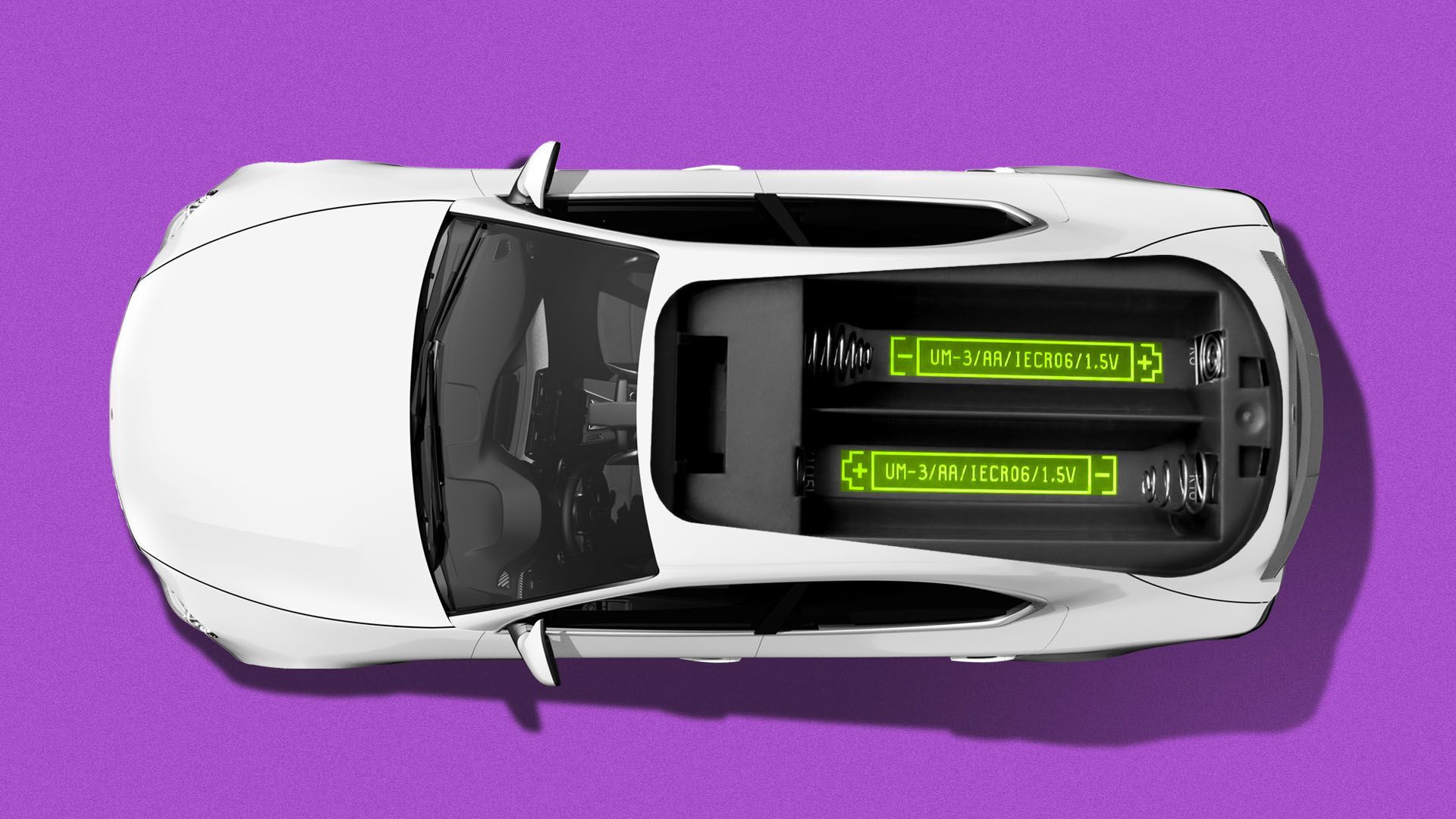
Illustration: Sarah Grillo/Axios
Automakers are growing increasingly optimistic that next-generation battery technology will solve the challenges holding back EVs from broader adoption.
Why it matters: Range limitations and the logistics of charging are big factors giving many consumers pause.
The big picture: Two Japanese automakers independently say they're poised to begin production of solid-state batteries.
- Nissan said in April that it's already begun construction of a pilot production line with plans to incorporate the new batteries into vehicles in the 2028 fiscal year.
- Toyota said last year that it has achieved a "technological breakthrough" in development and will have the batteries "ready for commercial use by 2027-28."
How it works: Solid-state batteries eliminate the liquid electrolytes that carry lithium ions between the anode and cathode in conventional EV batteries.
- Without liquid, batteries can charge faster and can be made lighter, giving them greater energy storage capacity.
Between the lines: Toyota said its first solid-state EVs will have more than 620 miles of range on a single charge — about double most current models.
- And solid-state batteries could eventually reduce charging times to below 10 minutes, McKinsey partner Raphael Rettig tells Axios.
- "The trade-off, until now, has been an expected shorter battery life," Toyota said. "However, recent technological advancements by Toyota have overcome this challenge and the company has switched its focus to putting solid-state batteries into mass production."
Reality check: Experts aren't convinced that solid-state batteries will be ready for prime time so quickly.
- The primary reason is their "huge safety risk" because they need to be packed together tightly, putting them under significant pressure, Rettig says.
- "I don't believe that solid state will become a major player in the volume EV segment before the middle of next decade," he says.
Yes, but: Experts aren't convinced that solid-state batteries will be ready for primetime so quickly.
- The primary reason is that solid-state batteries currently come with "a huge safety risk" due to the fact that they need to be packed together tightly, putting them under significant pressure, McKinsey partner Raphael Rettig tells Axios.
- "I don't believe that solid state will become a major player in the volume EV segment before the middle of next decade," he says.
What we're watching: Batteries currently make up about 30% to 40% of the cost of EVs, according to the Institute for Energy Research, making cost reductions critical to EV acceptance.
- Solid-state battery developers will need to prove that they can produce them safely and efficiently before they begin rolling out.
