Senate releases new $118 billion package for Ukraine, Israel, border

Add Axios as your preferred source to
see more of our stories on Google.
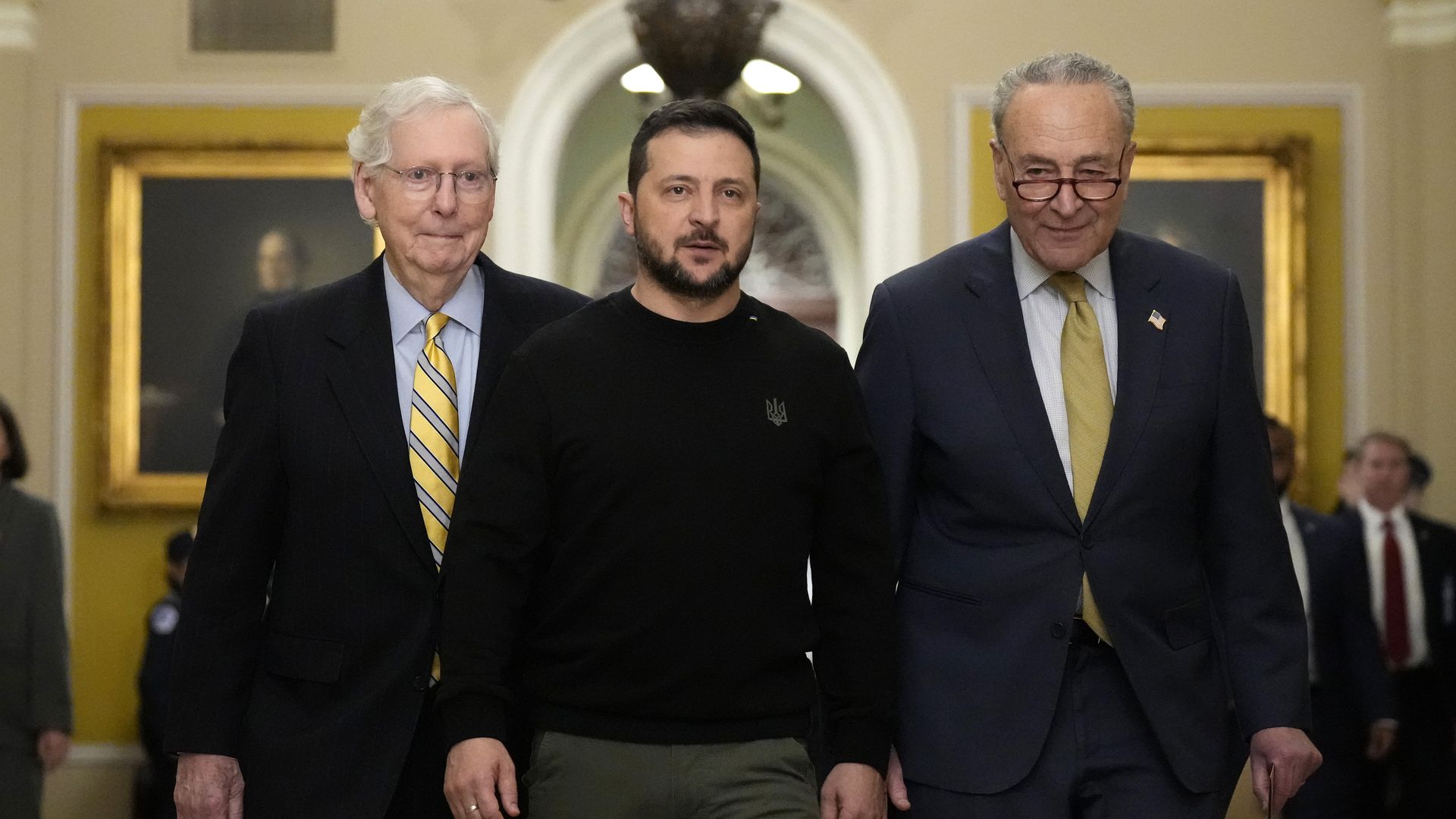
Ukrainian President Volodymyr Zelensky (C) walks with Senate Minority Leader Mitch McConnell (R-KY) (L) and Senate Majority Leader Charles Schumer (D-NY). Photo: Drew Angerer/Getty Images
The Senate appropriations committee released on Sunday the text of their sweeping $118.3 billion emergency spending package, which combines foreign aid with restrictive policy changes for the U.S.-Mexico border.
Why it matters: The bill's fate is highly uncertain, with the package held up for months as a bipartisan group of senators hashed out a border deal to appease Republicans. An initial vote is expected this week.
- Republicans are divided over whether to support additional aid for Ukraine and whether the newly negotiated border measures go far enough to stop illegal border crossings.
- Some progressive Democrats are expected to vote against what would be one of the most restrictive border bills of the century.
- Speaker Mike Johnson (R-La.) is undermining the effort further by planning a vote on an Israel-only aid package.
What to watch: Former President Trump and Johnson all but killed the bill's chances before it was finished being written.
- Johnson has called the deal "dead-on-arrival" in the House, and repeatedly criticized what he has heard about the deal.
- "The devil's in the details," Johnson told Fox Business on Friday. "We'll check it out. I'm not prejudging anything."
- Senate Republicans and staff will study the language closely — checking that all the "may"s and "shall"s create tough enough measures for them to get behind.
By the numbers: The package includes $60 billion for supporting Ukraine, $14 billion for Israel and $4.8 billion for the Indo-Pacific.
- An additional $10 billion is earmarked for humanitarian assistance for civilians in Gaza and the West Bank, Ukraine and other populations.
- Nearly $20 billion of the funds for Ukraine would go toward replenishing U.S. military weapons and equipment.
- The cost of the border policy changes comes to $20 billion for transportation for deportation, shelters, more than 4,000 new asylum officers, more border agents, anti-fentanyl trafficking efforts and other resources.
Zoom in: The funding will cover significant asylum and border policy changes over three years.
- It raises the standard for the first step of the asylum process, which could lead to more migrants being removed from the U.S. faster.
- It requires all asylum seekers be detained or placed in tracking programs until they pass that initial interview or are granted asylum in what would be an expedited 6 month process, in total.
- Most notably, the package includes emergency authority to automatically turn back illegal border crossers to Mexico — with no guarantee of seeking asylum — when the weekly average for encounters reaches 4,000 a day. The emergency action would be required at 5,000 encounters a day.
Zoom out: The bill also included a pathway to permanent status for Afghans evacuated and brought to the U.S. under humanitarian parole.
- It also adds another 250,000 work and family-based immigrant visas for the next five fiscal years.
- It also protects from deportation the children of H-1B visa holders who come to the country legally, but often "age out" by turning 18 before they are able to receive a green card because of long backlogs.
Go deeper: Read the bill text here.
