Nearly 200 Boeing 737 MAX-9 planes grounded globally after hole torn open midflight

Add Axios as your preferred source to
see more of our stories on Google.
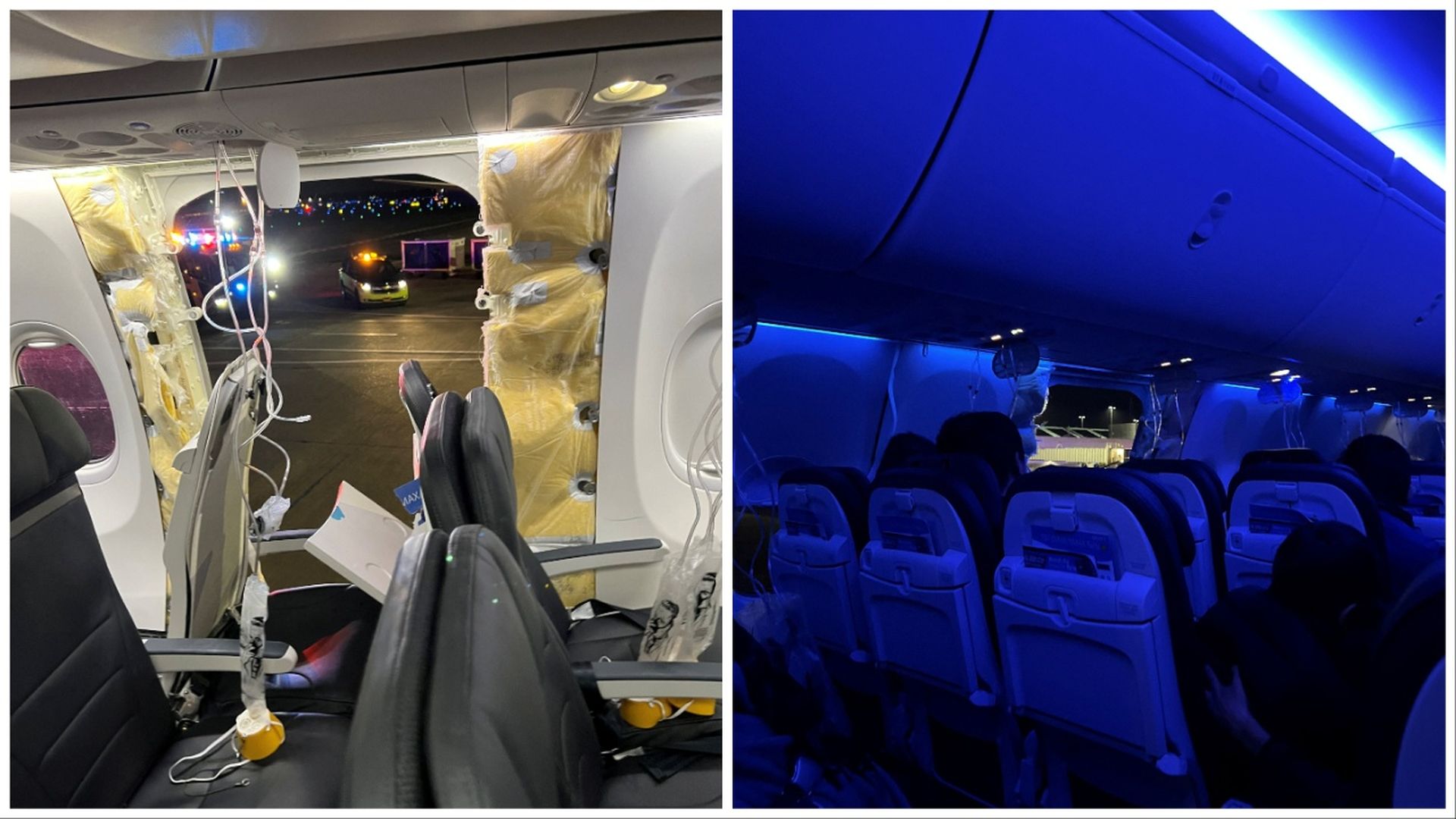
View from inside the cabin of the damaged Alaska Airlines plane. Photos: @strawberrvy/Instagram via Reuters
Alaska Airlines is grounding all 65 of its Boeing 737 MAX-9 aircraft after a harrowing in-flight emergency Friday night left a gaping hole in its fuselage, exposing passengers to the open air.
The big picture: The incident, which didn't end in injuries or fatalities, led the Federal Aviation Administration to require operators of about 171 airplanes worldwide to ground their planes until they were inspected.
- The requirement was issued as part of an Emergency Airworthiness Directive and inspections are expected to take four to eight hours per aircraft, the FAA said in a statement Saturday.
Details: Alaska Airlines Flight 1282 safely returned to Portland International Airport just minutes after takeoff Friday after part of the fuselage flew off for yet-unclear reasons.
- The flight reached a maximum altitude of about 16,000 feet, per aircraft-tracking site FlightAware.
- "There was a really loud bang toward the rear of the plane and a whoosh noise and all of the masks dropped," passenger Evan Smith told local news channel KPTV.
What they're saying: "Each aircraft will be returned to service only after completion of full maintenance and safety inspections," Alaska Airlines CEO Ben Minicucci said in a statement. "We anticipate all inspections will be completed in the next few days."
- Alaska is working with Boeing and the National Transportation Safety Board to figure out what went wrong, Minicucci added.
- Boeing said in a statement Saturday that it supports both the NTSB investigation and the FAA's decision and that Boeing "will remain in close contact" with its regulator and customers.
- "Safety is our top priority and we deeply regret the impact this event has had on our customers and their passengers," the company said.
Be smart: The episode appears to have involved a "plugged" rear exit door.
- "On the 737-9 MAX, Boeing includes a rear cabin exit door aft of the wings, but before the rear exit door," per FlightAware.
- "This is activated in dense seating configurations to meet evacuation requirements. The doors are not activated on Alaska Airlines aircraft and are permanently 'plugged.'"
Of note: It's the latest safety episode for Boeing's 737 MAX family, two members of which crashed in 2018 and 2019 due to problems with a system meant to correct for a nose-up tendency during certain maneuvers.
Between the lines: It's unclear at this point if this is a problem with the entire MAX-9 fleet, or an installation or maintenance issue with this particular aircraft.
Alex's thought bubble: The odds of something like this happening are astronomically low — but it's another good reason (in addition to sudden, unexpected turbulence) to always wear your seat belt on airliners, even when the sign is off.
Go deeper: Boeing urges airlines to inspect planes for possible loose bolt
Editor's note: This story has been updated with a statement from the FAA and Boeing.
