New COVID strain rises in U.S. ahead of holidays

Add Axios as your preferred source to
see more of our stories on Google.
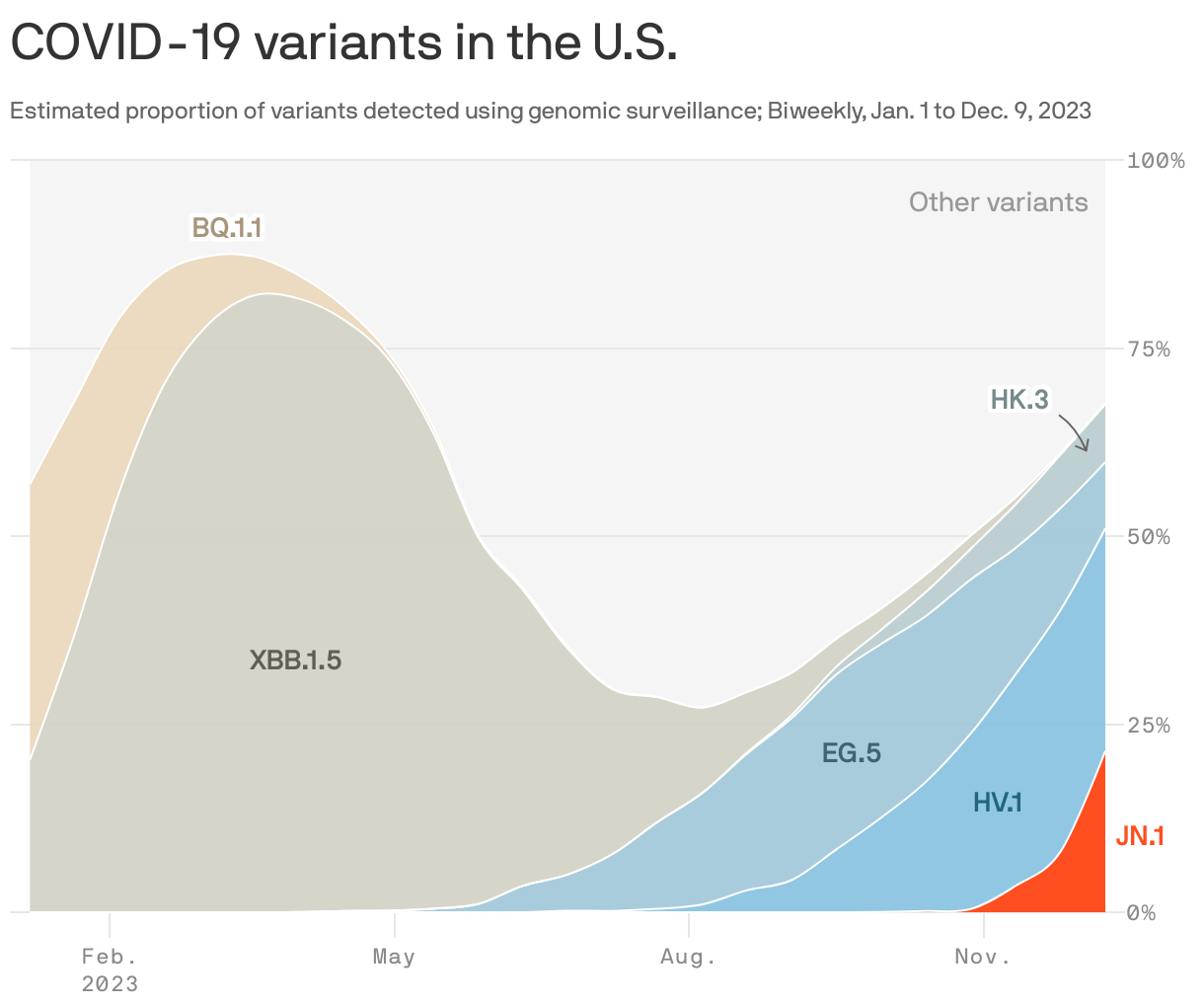
A fast-spreading new COVID-19 variant called JN.1 could drive a new wave of disease across the U.S. this holiday season just as other respiratory viruses are cresting, experts say.
The big picture: While the situation isn't as dire as last year, when a "tripledemic" of respiratory diseases swamped hospitals, JN.1 cases have more than doubled since mid-November and now account for 1 in 5 new infections, according to the Centers for Disease Control and Prevention.
- COVID modeler Jay Weiland estimated on Monday that JN.1 would become the dominant strain within a week and that daily new infections, now around 965,000, aren't close to peaking.
- The variant's emergence coincides with a jump in other respiratory viruses. Over four weeks, hospitalizations for influenza and RSV rose 200% and 60%, respectively, while pediatric emergency department visits for pneumonia have been rising since September, per a Dec. 14 CDC alert to providers.
Variant of interest
Catch up quick: COVID hospitalizations rose over the summer but settled down this fall, following a familiar seasonal pattern for the disease.
- Scientists in recent months had been monitoring a strain designated BA.2.86 that was notable for its large number of mutations and thought capable of evading updated vaccines and natural immunity.
- While the worst fears didn't materialize, the coronavirus continued to evolve and gave rise to JN.1, a closely related variant with a single difference in its spike protein. It was first detected in late August and is proving adept at evading immune defenses.
- "When I just look at the growth curve, it is rising quite sharply, and it seems to coincide with the Thanksgiving break in terms of timing," Shishi Luo, who heads infectious diseases for the genomic sequencing company Helix, told CNN.
- The World Health Organization classified JN.1 a variant of interest on Tuesday, but added it didn't post significant additional health risk.
- "Despite this, with the onset of winter in the Northern Hemisphere, JN.1 could increase the burden of respiratory infections in many countries," the WHO said in a statement.
Updated COVID vaccines developed to target an earlier omicron strain work against JN.1, according to research posted online last month by a Columbia University-led group that hasn't been peer-reviewed.
- But vaccine uptake in the U.S. remains woefully low, despite urgent pleas from federal health officials. Waning natural immunity from prior COVID infections could set many people up for another round of disease that could be exacerbated by holiday travel and more indoor gatherings.
- Even if the symptoms aren't severe, enough viral spread could put a significant new burden on health systems, particularly in the Northeast, where JN.1 appears to be most prevalent.
By the numbers: COVID hospitalizations have been ticking up, according to the CDC. The seven-day average from Dec. 3 through Dec. 9 was 3.1% higher than right after Thanksgiving
- As of early December, 22 states had "very high" COVID-19 wastewater levels as defined by the CDC, which compares current rates to baseline measurements at sites nationwide.
- New York State saw a 118% increase in COVID wastewater detection at 117 sites between Nov. 29 and Dec. 14.
What we're watching: Whether significant regional variations emerge. Data from Nov. 26 through Dec. 9 showed JN.1 prevalence was far greater in the Northeast than in the Midwest or West Coast.
- But many surveillance efforts have been shut off or slowed down since the pandemic ended earlier this year.
- If local tracking methods use different methodologies and are understating the real virus burden, we could be in for a potentially significant, if not necessarily deadly, wintertime wave.
