Israelis outline post-war Gaza strategy as U.S. ramps up pressure

Add Axios as your preferred source to
see more of our stories on Google.
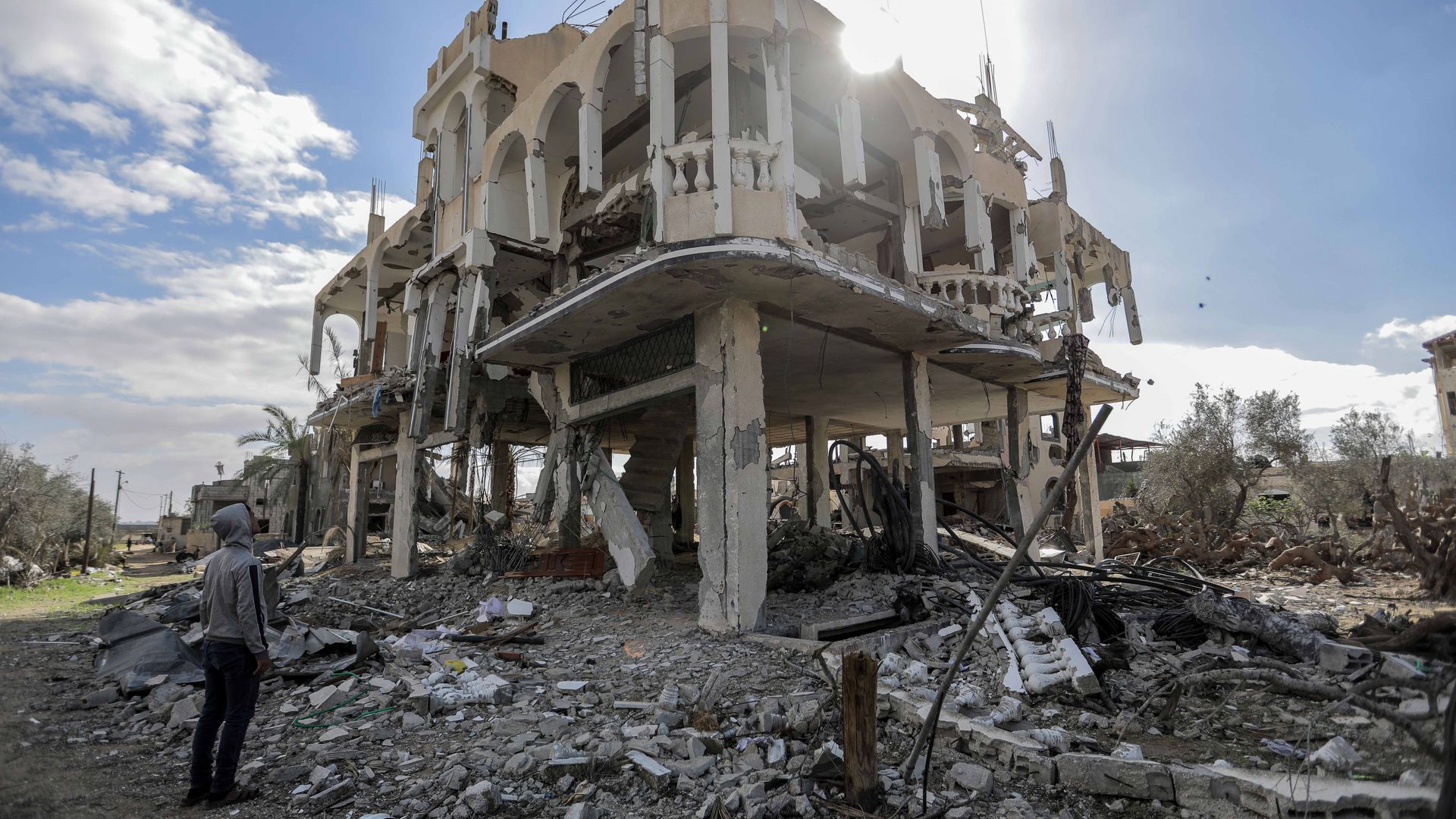
A Palestinian man examines the damage of a building in Khan Younis, Gaza, that was hit during an an Israeli airstrike last month. Photo: Ahmad Hasaballah/Getty Images
Top Israeli military officials are in Washington to show U.S. officials Israel's military strategy for Gaza, outline their plans to capture or kill Hamas leaders — and discuss the enclave's post-war future, three Israeli officials tell Axios.
Why it matters: The meetings come as President Biden is pushing for Israel's aggressive ground attack against Hamas to end within a few weeks — and warning Israeli leaders that they're losing international support for the war in Gaza.
- Israel officials say their ground attack soon will morph into lower-intensity fighting that will decrease civilian casualties and allow more humanitarian aid into Gaza.
- "We will continue to give military assistance to Israel until they get rid of Hamas," President Biden said Monday during a Hanukkah celebration at the White House.
- "But we have to be careful," Biden added. "The whole world's public opinion can shift overnight and we can't let that happen…we emphasize to our Israeli friends the need to protect innocent civilian lives."
Palestinian health officials say more than 18,000 people have been killed in Gaza since the Israel-Hamas war began Oct. 7. About 6,000 of those were Hamas militants, Israeli officials say.
Driving the news: Biden on Tuesday called on Israeli Prime Minister Benjamin Netanyahu to change his policy to find a long-term solution to the Israeli-Palestinian conflict.
- "I think he has to change, and ... this government in Israel is making it very difficult for him to move," Biden said, a reference to Netanyahu's far-right coalition.
- In a video released Tuesday, Netanyahu acknowledged there was "disagreement" between Israel and the U.S. over post-war Gaza. He reiterated his opposition to the Palestinian Authority overseeing the enclave, but the alternatives are unclear.
Zoom in: Maj. Gen. Eliezer Toledano, head of the Israeli Defense Forces' strategic branch, and Brig. Gen. Omer Tishler, deputy commander of the Israeli air force, briefed senior Pentagon and U.S. military officials on the war on Monday, Israeli officials said.
- The Israeli officials said the talks included details on how Israeli forces are trying to capture or kill Hamas leaders in the southern Gaza city of Khan Younis, where the IDF believes they're hiding.
- The Israelis also briefed their U.S. counterparts on Israel's post-war military plans, and how Israel is trying to minimize civilian casualties.
- Israeli officials claim there has been a decrease in civilian casualties in Gaza in the last few weeks, as the IDF changed some of its tactics from airstrikes to focus more on ground operations.
- On Tuesday the head of the Israeli ministry of defense policy branch, Brig. Gen. (Retired) Dror Shalom, talked with U.S. officials at the Pentagon, White House and State Department about Israel's post-war plan for Gaza, Israeli officials said.
What they're saying: "These are two visits that are very important for the coordination between the U.S. and Israel and the designing of the next steps in the war," a senior Israeli defense official said.
What's next: The visits to Washington take place ahead of a flurry of visits by senior U.S. officials in Israel starting Thursday, when National Security Adviser Jake Sullivan arrives in the country, U.S. and Israeli officials say.
- Israeli officials said that on Friday, Joint Chiefs chair Gen. Charles Brown will be in Israel to discuss the war. It will be his first visit there since he assumed office a week before Hamas' Oct. 7 attack on Israel.
- On Monday, Defense Secretary Lloyd Austin is expected to visit Israel for the second time since the war started. Israeli officials said he'll meet with Netanyahu, Minister of Defense Yoav Gallant and other senior Israeli officials.
- The Pentagon didn't immediately respond to a request for comment.
