The four intersecting risks that may hit the global economy

Add Axios as your preferred source to
see more of our stories on Google.
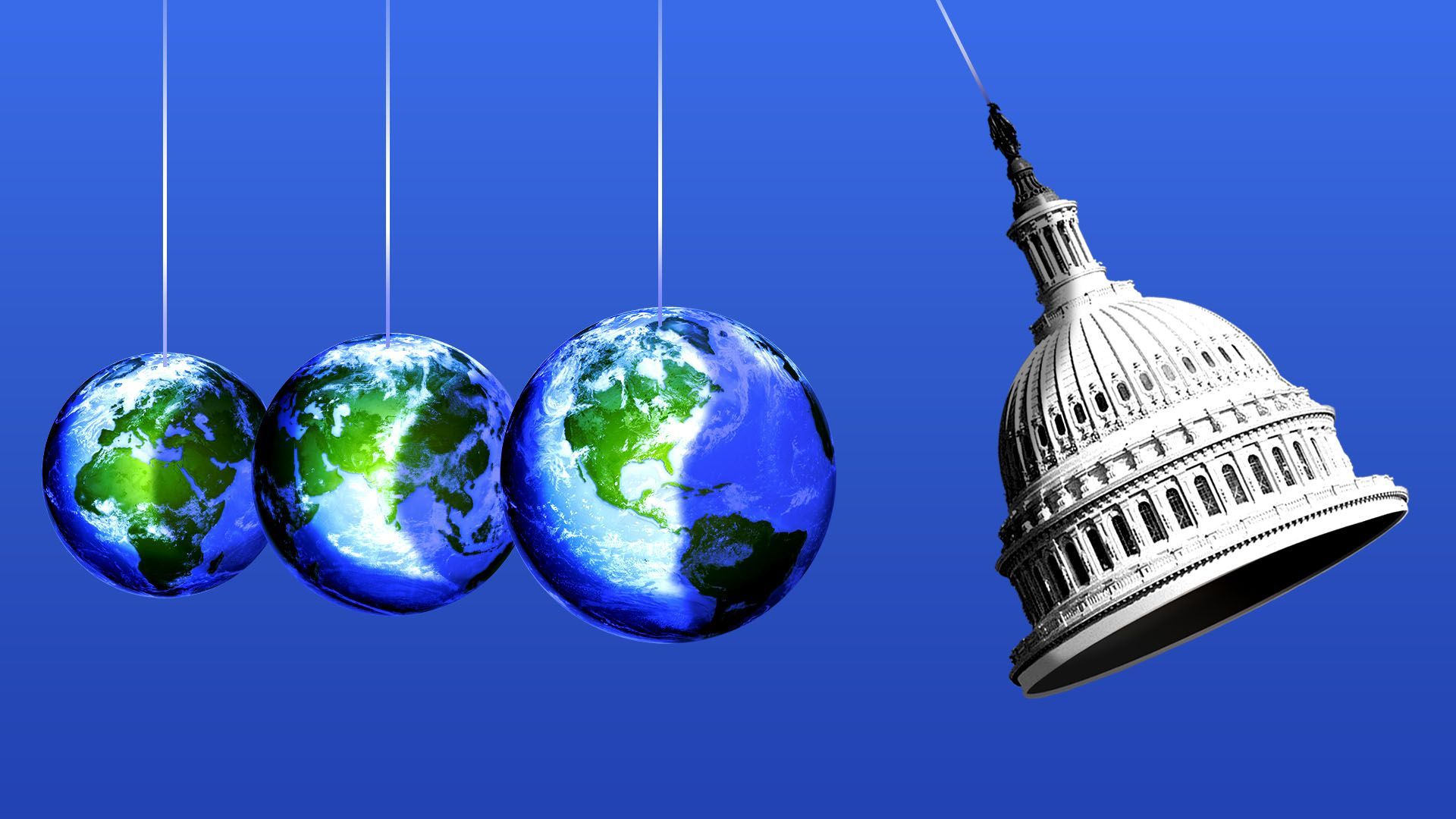
Illustration: Sarah Grillo/Axios
Several things that have nothing to do with one another on their surface — a dysfunctional U.S. House of Representatives, tumbling bond prices, war in the Middle East and tensions with China — are creating an intertwined set of risks for the global economy.
Why it matters: The U.S. economy has held up surprisingly well this year, and the baseline outlook for 2024 appears solid. But internal and external woes may collide in unpredictable ways, which would make the outlook less benign.
- That helps explain why it's been a bumpy several weeks for the stock market, with volatility indexes surging.
- "Geopolitical tensions are highly elevated and pose important risks to global economic activity," said Fed chair Jerome Powell last week.
State of play: There has been no speaker of the House for three weeks — preventing the body from functioning — amid deep tensions within the narrow Republican majority.
- Meanwhile, the U.S. government is set to run out of funding Nov. 17, and the Biden administration seeks $106 billion for assistance to Israel and Ukraine, which the House would have to approve.
- The fiscal outlook is starting to worry bond investors, sending the U.S. government's long-term borrowing costs soaring.
- Simultaneously, China is facing deep economic problems around stagnating growth and an overhang of private-sector debt, amid a ratcheting-up of export controls with the U.S.
What they're saying: "In addition to the focus on each of these risks in isolation, we have been hearing a growing sense of concern that they are reinforcing each other," wrote Tobin Marcus, head of U.S. policy and politics at Wolfe Research, in a note.
- Investors are particularly concerned, he wrote, "that the chaos in DC is exacerbating the risks elsewhere."
Yes, but: The explicit linkages between these crises are limited. There is no political consensus on how to reduce long-term U.S. deficits, for example — which would be true even if there were an empowered, effective speaker of the House.
- The bigger risk to the U.S. economy and markets may be in the headlines themselves. If the entire world seems to be in chaos, it could weigh on confidence among corporate executives, consumers and investors.
"In a better world, we might expect unified, proactive steps in DC to address these issues, most obviously on debt and deficits," wrote Marcus.
- "But relative to baseline expectations for the US political system in recent decades, we don't think the current circus in DC is making things much worse for markets," he wrote.
The biggest near-term financial risk, however, is that persistent inflation causes the Fed to tighten monetary policy more than it already has. That, at least, is what market participants surveyed by the central bank are saying.
Driving the news: The Fed published its semi-annual Financial Stability Report, its formal assessment of risks to the U.S. financial system, on Friday.
- One section sizes up near-term risks, as assessed by financial professionals surveyed by the New York Fed as part of its market intelligence gathering.
By the numbers: Some 72% of the survey respondents saw persistent inflation and resulting Fed interest rate increases as a top near-term risk, up from 56% in May.
- There was a similar surge in concern about commercial and residential real estate, named by 72%, up from 52% in May. Many office and other commercial projects are at risk of default as their debt rolls over in the coming years.
- Perceived risk from banking sector stress was unchanged at 56%, while there was an uptick in those seeing risk from China's economic troubles, to 44% from 12% in May.
Of note: The survey was completed before the Oct. 7 Hamas attack on Israel.
The bottom line: It's a risky world out there, with numerous forces that could upend the smooth U.S. expansion.
