Americans are saving less — and that's great for the economy

Add Axios as your preferred source to
see more of our stories on Google.
Illustration: Aïda Amer/Axios
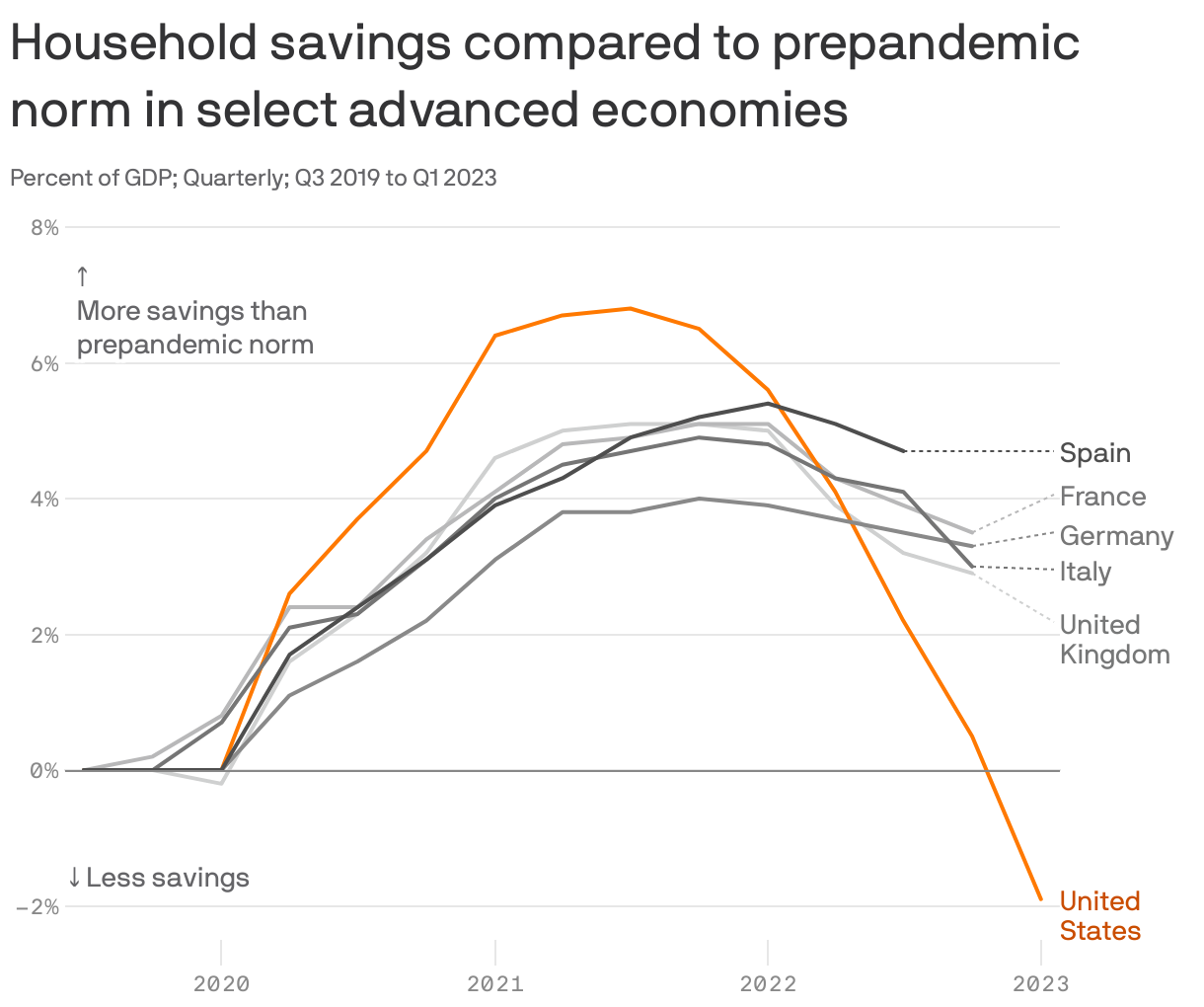
Unlike their counterparts in other rich nations, Americans have been burning through their pandemic-era cushion of extra cash.
Why it matters: Having a smaller stash for a rainy day may be risky for any one individual, but in the aggregate, the U.S. consumer's propensity to spend has made America's pandemic recovery the strongest among major economies.
Driving the news: Reports from the New York Fed and the International Monetary Fund last week spotlighted the divergence of U.S. savings behavior from that of comparable countries.
What they're saying: The NY Fed noted that since 2022, the U.S. savings rate dropped below its pre-pandemic average — while savings rates elsewhere have remained above their pre-pandemic averages.
- IMF analysts wrote in their World Economic Outlook: "Among advanced economies, private consumption has been stronger in the United States than in the euro area, with households receiving larger fiscal transfers early in the pandemic and spending the associated savings more quickly."
The big picture: Consumption basically is the American economy.
- Personal consumer spending accounts for about 68% of GDP.
The intrigue: There's a question about why American consumers are so much more free-spending than their counterparts in other rich nations.
- Economists at the NY Fed posit that the divergence could reflect the fact that more American savings came from the federal government transfers to households during the crisis. Some economic theory suggests households are more willing to spend such unearned "windfalls."
- Analysts at the IMF note that American consumers have also benefited from "being better insulated from the rise in energy prices resulting from the war in Ukraine; and feeling relatively confident amid historically tight U.S. labor markets."
💭 Our thought bubble: While traditionally, willingness to spend down savings suggests a high degree of consumer confidence, American readings on confidence have been pretty low over the last year.
- Such readings are derived from public opinion polling, which has increasingly reflected partisan political views in recent years, making it unreliable as a guide to actual behavior.
- In other words, people might tell pollsters they are miserable, but they sure do seem to be buying a lot of boats.
The bottom line: The post-COVID economy isn't perfect. Americans remain unhappy about the sharp rise in key costs of living — from housing to cars to food.
- But zooming out a bit, the U.S. is actually doing pretty well, largely because Americans feel good enough to keep spending.
