Antarctic sea ice hits lowest seasonal peak on record

Add Axios as your preferred source to
see more of our stories on Google.
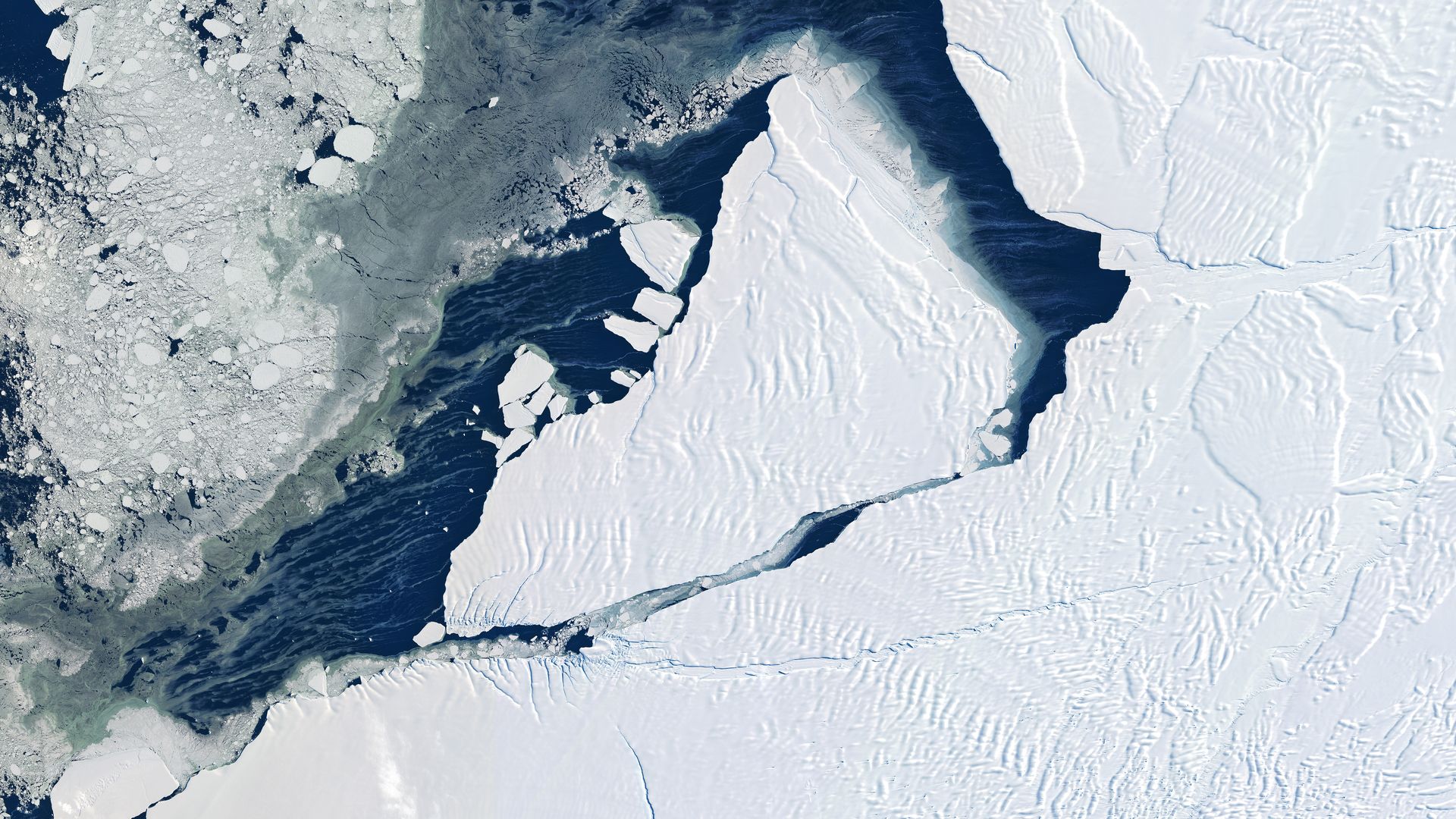
Satellite image of Iceberg A-74 calved from Antarctica's Brunt Ice Shelf in February 2021. Photo: Gallo Images/Orbital Horizon/Copernicus Sentinel Data 2021
Antarctic sea ice fell to an all-time lowest seasonal peak, reaching about 398,000 square miles below the previous record in 1986, according to the National Snow and Ice Data Center in Boulder, Colo.
Why it matters: The pronounced lack of sea ice this year, which is part of a steep drop seen during the past several years, could have implications for land-based ice stability and the functions of global ocean currents.
The big picture: Antarctic sea ice hit its seasonal peak on Sept. 10, the NSIDC announced Monday. At that peak, the sea ice cover was missing an area of floating ice larger than the combination of Texas and Arizona.
- "Antarctica's sea ice has always been variable, but this sharp downward turn this year is pointing towards warmer ocean conditions around the continent," said Ted Scambos, a senior research scientist at the University of Colorado. "Most of the world's oceans are at record warm temperatures."
- Scambos said Antarctic sea ice has historically been quite distinct compared to the Arctic, where ice has been on a longer-term decline, linked to human-caused climate change, since satellite observations began in the late 1970s.
- This year, however, it is the Antarctic sea ice cover that stands out.
What they're saying: "On a map, it may not look dramatic, but the trend in the past five months is so different from the past 45 years that all of us sat up and took notice," Scambos said.
Threat level: The absence of sea ice ringing parts of Antarctica can interfere with unique ecosystems. It may speed up the melt of certain ice shelves and the glaciers they hold back, by allowing slightly warmer water to reach them.
- This could have ramifications for sea level rise due to land-based ice melt, though this is not guaranteed.
- "There is some concern that this may be the beginning of a long-term trend of decline for Antarctic sea ice, since oceans are warming globally, and warm water mixing in the Southern Ocean polar layer could continue," the NSIDC said in a statement.
- "If dramatically lower sea ice extent continues to the 2024 summer minimum and beyond, much more of the Antarctic coastline will be exposed to ocean waves and marine climate," NSIDC stated.
- Scientists wrote that coastal ice and ice shelves could melt as a result, destabilizing the ice sheet, but the presence of more open water could lead to more snow accumulation near the coast. This might offset some of the decline.
Context: As Axios' Jacob Knutson has reported, Antarctic sea ice extent — which is the area of ocean where at least 15% of the surface is frozen — reaches its minimum in summer between February and March before reforming in the winter.
- Scientists had observed Antarctic sea ice expansion between 1979 to 2014, making it an outlier compared to the Arctic, before plateauing and reversing, starting in 2016.
- The anemic sea ice cover occurs at the same time as record heat is enveloping the planet. The globe had its warmest June, July and August period on record, and this is likely to extend through September.
- July was the Earth's hottest month on record.
The bottom line: If the Antarctic sea ice crash of 2023 proves to be temporary, it could spare many animals, including penguins, fish, sea lions and whales, from much harm. But scientists can't rule out that this is the start of a sharp, long-term decline, driven at least in part by human-caused climate change.
Go deeper: Study: Key Atlantic Ocean circulation could shut down by mid-century
