Ad growth expected to slow further in 2023


Add Axios as your preferred source to
see more of our stories on Google.
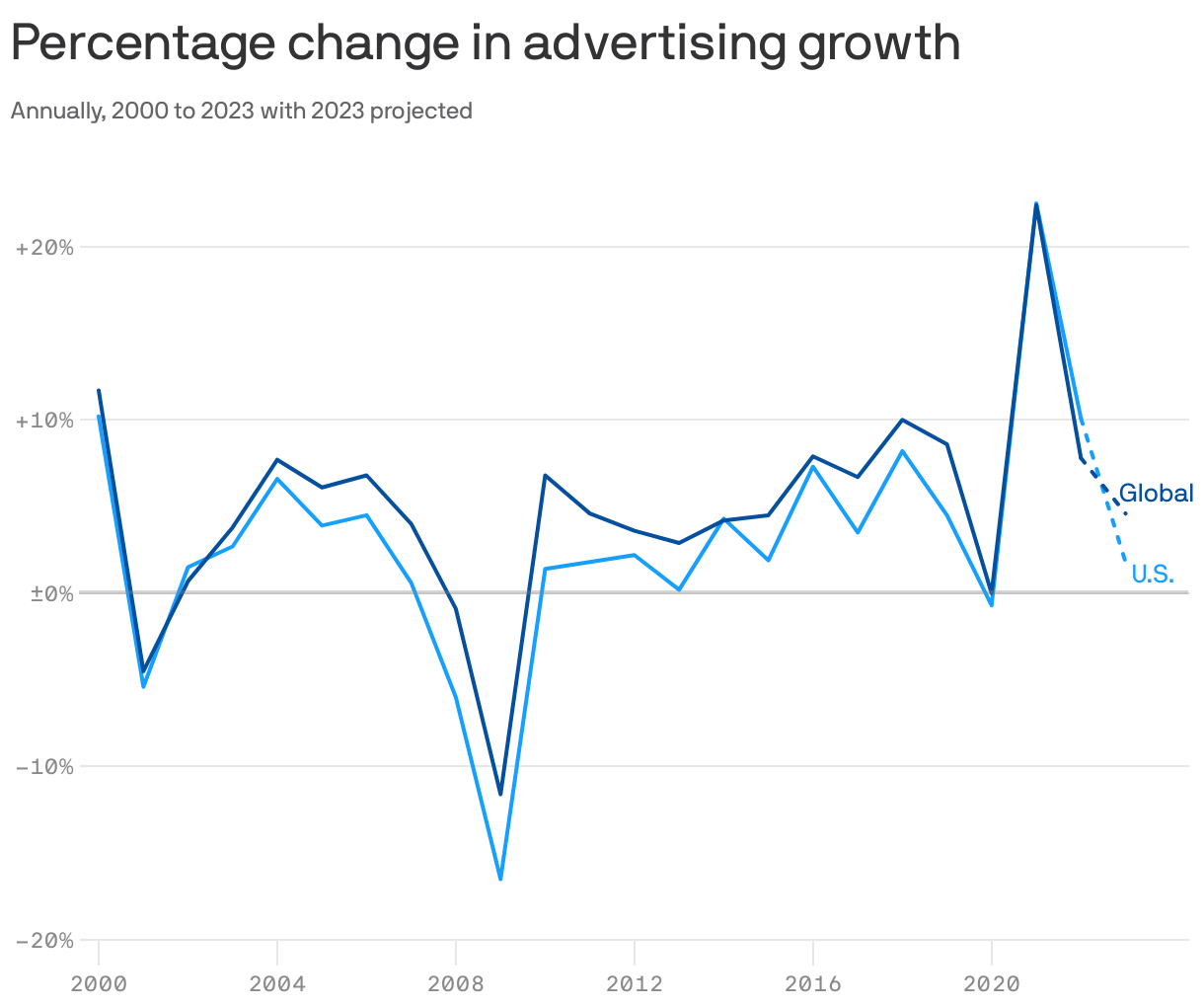
Growth in global ad spending is going to be slower next year than originally anticipated, according to two new forecasts, a troubling sign for media and tech firms that rely on advertising to fuel their businesses.
Why it matters: Much of the slowdown is driven by economic uncertainty, rather than true economic indicators that would cause an advertising recession.
- The ad market slowdown has caused a slew of U.S. companies to implement drastic cost-cutting measures, including sweeping layoffs.
Details: Growth in global ad spend is expected to slow to about 5.9% next year, according to media buying firm GroupM, down from 6.4% estimated in June.
- Magna, a unit of Interpublic Group's Mediabrands, also reduced its forecast slightly. It predicted global ad revenue will grow 4.8% in 2023, down from 6.3% it had reported in June.
Between the lines: Inflation and various macroeconomic factors impacting the world's biggest ad markets are largely to blame.
- In the U.S. — the world's largest ad market by far — inflation remains high, but recession indicators like high unemployment rates are absent. That's caused uncertainty, prompting ad budget cuts.
- In China — the second-largest ad market — COVID lockdowns continue to deter its economy, and in turn, ad spend. In 2022, GroupM expects the Chinese ad market to shrink by 0.6% and then grow by 6.3% in 2023. That's down from previous estimates of 10% growth in December 2021 and then 3.3% in June.
- European countries like Germany, France and the U.K. have seen declines in TV advertising. GroupM updated its June estimates from positive growth to now a decline, citing the war in Ukraine.
Yes, but: Factors contributing to economic uncertainty appear at odds with some of the broader economic progress, GroupM notes, which could provide some optimism amid the bleak advertising outlook.
- While GroupM downgraded estimates in 31 of the markets it tracks, it increased forecasts for 21 markets and made no changes in the other 10, said Kate Scott-Dawkins, global director of business intelligence at GroupM.
- "I assume some of that is inflation driven, but some others saw better results for the year than they had expected," Scott-Dawkins said. "We have heard from some of the largest advertisers that they are planning to increase marketing investment rather than reduce."
- Certain sectors are doing well. GroupM updated its September forecast for retail media's 2022 revenue from $101 billion to $110.7 billion, and it expects connected TV to grow double digits over the next four years. The formation of new businesses is also driving more ad spending.
Be smart: An element of maturation among some of the world's biggest tech firms also could explain the deceleration in ad growth, GroupM said.
- "When capital was very cheap and interest rates were low" some companies spent upwards of 50% on advertising or even more than 100% in a given quarter, Scott-Dawkins said, but that's now decelerated or even declined as interest rates climb.
- "A real theme as we go into the end of the year is that normalization ... to just how strong Q2 and Q3 were in 2021," Scott-Dawkins said. "I think once we lap that and get into next year, we're looking to see more normalized growth rates."
The big picture: Not all advertisers respond equally to economic uncertainty.
- Consumer packaged goods companies and financial firms may slow down marketing spending next year, Magna said, whereas entertainment, travel and betting will continue to grow.
- "Automotive is a big question mark due to the uncertainty in macroeconomic environment and supply issues, but Magna believes ad spend will finally start to recover in 2023," the report said.
Editor's note: This story has been corrected to say GroupM expects the Chinese ad market to shrink by 0.6% in 2022, not 0.06%.
