How Trump could weaponize "Schedule F" in 2025

Add Axios as your preferred source to
see more of our stories on Google.
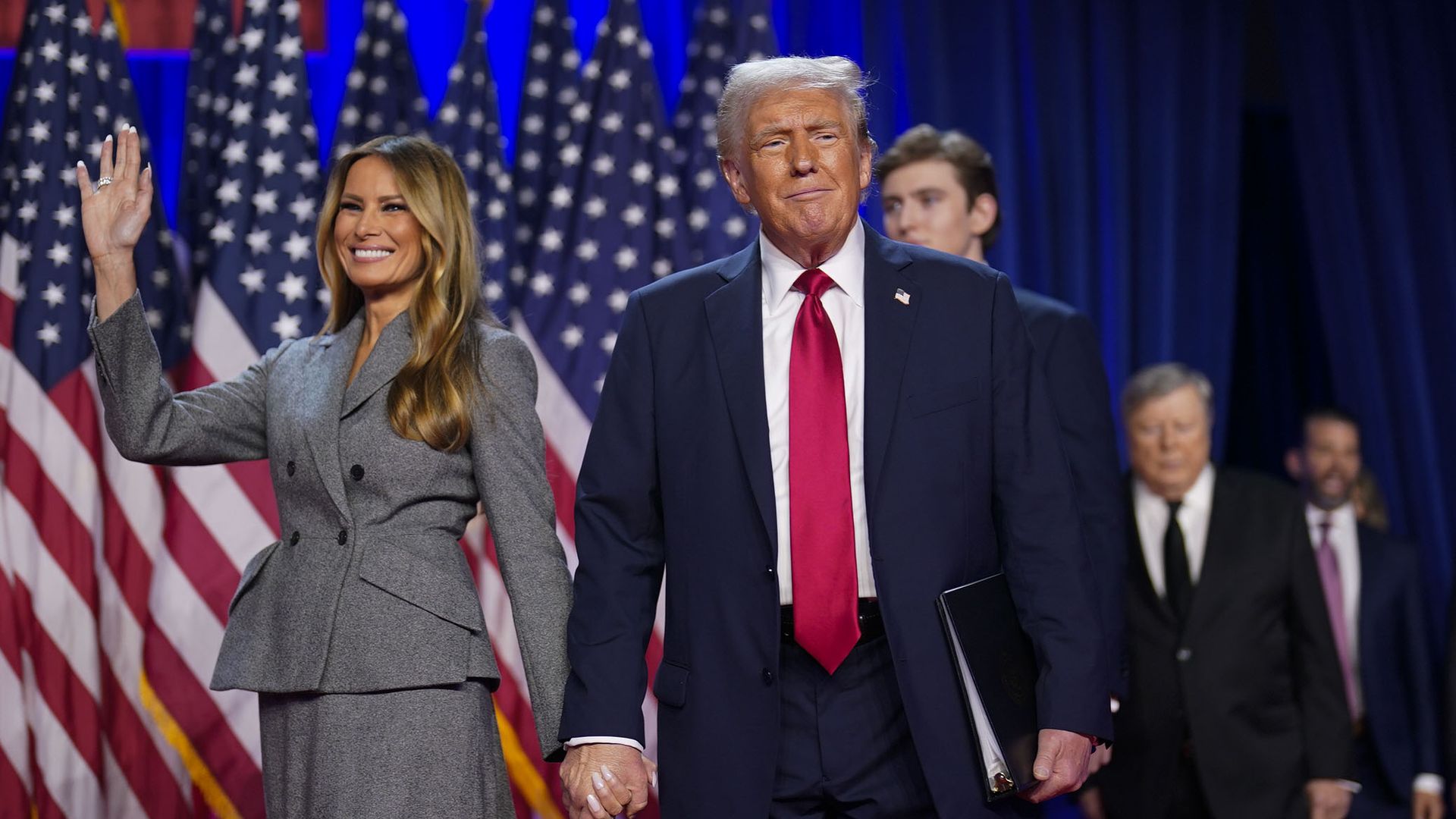
President-elect Trump walks out on stage with his wife Melania after being declared the winner during an election night in West Palm Beach, Florida, on Nov. 6, 2024. Photo: Jabin Botsford/The Washington Post via Getty Images
President-elect Trump in his return to the White House in 2025 has pledged to use a dramatic expansion of executive power to undermine protections for federal employees.
Why it matters: If reinstated, Trump's "Schedule F" executive order from his previous stay on Pennsylvania Ave. could effectively upend the modern civil service, opening the door for the newly-elected president to bring in his own loyalists in place of government bureaucrats.
State of play: Sources close to Trump told Axios in 2022 he would immediately reimpose his "Schedule F" executive order if reelected.
- Last year, Trump pledged to "immediately reissue" his 2020 executive order "restoring the president's authority to remove rogue bureaucrats," vowing to wield that power "very aggressively."
- The Trump campaign and transition team did not immediately respond to Axios' request for comment.
The backstory on Schedule F
Trump signed an executive order in October 2020 which established a new Schedule F employment category for federal employees that increased the president's power to remove civil servants who have historically been shielded from shifts in administration.
- It was rescinded by President Biden shortly after he took office in 2021.
- But back in March of 2022, Trump floated the possibility of going after the federal workforce.
- "We will pass critical reforms making every executive branch employee fireable by the president of the United States," he said at a rally in South Carolina. "The deep state must and will be brought to heel."
- Since then, he has doubled down on his pledge to make it easier to dismiss federal employees — while pro-Trump outside groups have mapped out plans to do so.
What could happen to federal employees under Trump 2.0?
Project 2025, a 900-page Heritage Foundation agenda for the next president, repeatedly calls for Schedule F to be reinstated.
- Trump has continuously distanced himself from the playbook, but his MAGA-world allies and right-wing commentators took less than 24 hours after his win to declare it is in fact a blueprint for his presidency.
- The America First Policy Institute, a group comprised of several Trump administration alumni, has also promoted sweeping changes — going even further than Project 2025 by calling for federal workers to become at-will employees, the New York Times reports.
Schedule F is not mentioned in the official 2024 GOP platform, which vows to "stop woke and weaponized government" and to "declassify Government records, root out wrongdoers, and fire corrupt employees."
Who would be reassigned as Schedule F?
Tens of thousands of civil servants who serve in roles deemed to have some influence over policy would be reassigned as "Schedule F" employees.
Those levels of influence included "confidential, policy-determining, policy-making or policy-advocating," the order says.
What it means to be given a Schedule F assignment
They would lose their employment protections upon re-assignment, making them functionally at-will employees and therefore far easier to fire, Gov Exec reports.
How many people Schedule F would affect
It could apply to as many as 50,000 federal workers out of a workforce of more than 2 million, Axios previously reported.
How is this different from regular presidential appointees?
New presidents typically get to replace more than 4,000 so-called "political" appointees to oversee the running of their administrations.
But below this rotating layer of political appointees sits a mass of government workers who enjoy strong employment protections and typically continue their service from one administration to the next regardless of the president's party affiliation.
Go deeper: A radical plan for Trump’s second term
Editor's note: A prior version of this story ran in 2022.
