The president’s party almost always loses seats in midterms

Add Axios as your preferred source to
see more of our stories on Google.
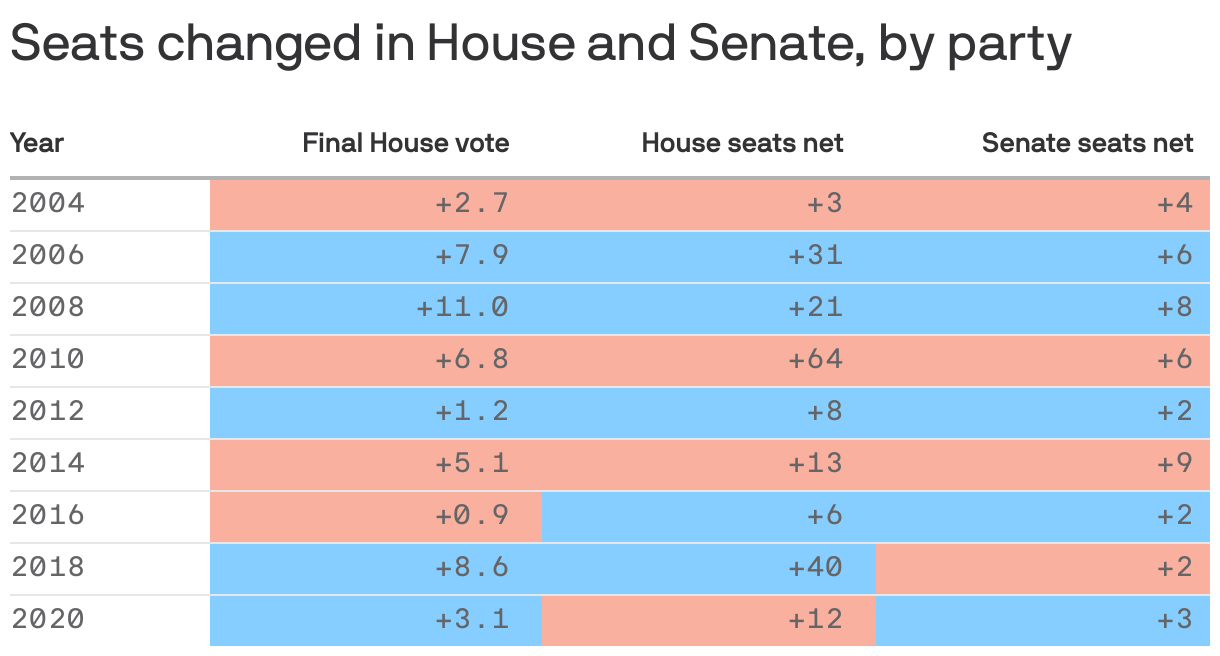
History bears out the political trope that the president’s party loses seats in the midterms: there’s rarely been an exception in modern elections.
Why it matters: Both Democrats and Republicans are gearing up for an intense midterm season this fall, expanding their battlegrounds with the elections only about six months away. A Democratic loss would inhibit President Biden from passing the rest of his political agenda.
- Reps. Bob Gibbs (R-Ohio) and Fred Upton (R-Mich.) recently announced they wouldn't seek re-election this year.
- That brings the total number of Republican retirements to just 18, compared to the Democrats' 31.
The details: The president’s party consistently receives a lower share of the House vote — the average of each major-party's vote in each of the 435 House districts — during the midterms than during the prior presidential election.
- In 2014, the middle of President Obama’s second term, Republicans had a net gain of 13 seats in the House.
- And in 2020, Democrats actually lost seats, despite a Democratic president’s win. They were still able to hold the majority, but only barely.
What we’re watching: Amy Walter of The Cook Political Report predicted last week the likely scenario for this fall's midterms is a Republican gain in the 15-25 seat range.
- RealClear Politics currently has Republicans ahead by 3.6 points in the generic ballot tracker.
- The National Republican Congressional Committee announced it was adding 10 House districts to its list of Democratic targets.
- Republicans are showing they're much more motivated this cycle by which party controls Congress.
